

Your Power Partner
GE 7FA Compressor Problems: Blade Damage, Stator Wear, Fouling, FOD, Clearances & Repair Options
The most common GE 7FA compressor problems are fouling, blade damage, stator wear, foreign object damage (FOD) and out-of-spec clearances. Repair paths run from washing and blade blending to re-bushing, re-staking, coating and replacement. If you run a GE 7FA gas turbine in combined cycle or peaking service, this guide shows how each problem presents, how it is measured, and which action fits.
Key Takeaways
- Five problems drive most loss on 7F.03, 7F.04 and 7F.05 units: fouling, blade damage, stator wear, FOD and clearance growth. Only fouling is fully reversible with a wash.
- Cracks and liberated hardware demand immediate action. Wear inside limits can usually wait for the next planned shutdown.
- Set inspection cadence by GE Vernova (formerly GE Power) Technical Information Letters (TILs) for the 7F, such as TIL 1509-R3, 1638 and 1562, not by calendar habit alone.
- Repair, blend, re-bush or recoat while airfoils sit inside disposition limits. Replace once cracking, thinning or dimensional loss passes them.
- Confirm power generation losses against a clean, ISO-corrected baseline before scoping any work.
Is It Fouling? How Much Output Does a 7FA Compressor Lose, and Online vs. Offline Wash
Start here. Fouling is the most frequent cause and the cheapest to rule in or out. The table maps each problem to its symptoms, detection method, repair and urgency. If your symptoms land on more than one row, that is common, and it usually means the data needs a closer read before anyone commits to a scope.
| Problem | Typical symptoms | Detection method | Typical repair option | Urgency |
|---|---|---|---|---|
| Fouling | Falling corrected output, rising heat rate | Corrected performance trend, offline wash recovery test | Offline or online wash, filtration upgrade | Next shutdown |
| Blade damage | Vibration, surge events, debris | Borescope, eddy current, FPI, 3D scanning | Blend, tip grind, coat, shot peen, replace | Immediate if cracked |
| Stator wear | IGV/VSV angle error, actuation lag | Borescope, bushing play check | Re-bushing, ring repair, replacement | Next planned window |
| FOD | Sudden efficiency step, noise, vibration | Borescope survey, NDE of struck and downstream rows | Blending, row replacement | Immediate |
| Clearance growth | Gradual efficiency loss | Rub-coating assessment, 3D scanning | Abradable restoration, tip work | Plan at overhaul |
What Causes Compressor Fouling on a GE 7FA Gas Turbine and How Often Should It Be Washed?
Particulates that slip past the filters, oil mist, salt and hydrocarbon deposits build up on airfoils and roughen their surfaces. Filtration quality sets how much gets through, and that comes down to ASHRAE 52.2 MERV ratings and Camfil or Donaldson EPA/HEPA-class media at the inlet. Wash frequency should follow your corrected-performance trend, not a fixed date. Deposits left in place also feed oxidation and pitting.
How Much Output and Efficiency Does a Fouled or Damaged 7FA Compressor Lose?
Oxmaint and iFactory wash guides commonly attribute roughly 70 to 85 percent of gas turbine performance loss to compressor fouling, with output losses of several percent. Treat that as indicative, since your unit’s real number comes from its own data. Uneven flow also reaches the combustor and shifts combustion behavior, so a fouled compressor can push heat rate up beyond the compressor’s own efficiency loss.
Run the reversible-versus-permanent test. Do an offline crank wash, then compare corrected compressor efficiency and flow against baseline. If recovery stalls short of baseline, you are likely looking at erosion, clearance growth or damage rather than dirt. Have that result in hand before anyone quotes repair work, including us.
Online vs. Offline Wash: Decision Criteria and the R0 Erosion Caution
Online wash runs while the unit is loaded and works as maintenance between deeper cleanings. Offline wash needs a shutdown and cooldown but reaches deeper. POWER magazine reported that online wash and fogging eroded R0 roots on some 7FAs, as reflected in GE TILs 1303 and 1323. Build your wash protocol around that caution, and check what your unit’s configuration and OEM guidance support.
Blade Damage and Stator Wear: Signs, Inspection Limits, and Whether Repair Options Beat Replacement
What Are the Signs of Compressor Blade Damage in a Frame 7FA Turbine?
Watch for rising vibration, surge or stall events, sudden efficiency drops and debris in the exhaust path. Borescope evidence includes leading-edge erosion, tip curl, corrosion pitting and cracks. High cycle fatigue (HCF) cracking at R0 and R1 roots and tips carries the highest consequence. A liberated blade can wreck every row downstream, the “corn cobbing” scenario that ends in a long forced outage.
Early stages (R0 to R4) see pitting, erosion and clashing in stages 2 and 3. Later stages face tip rub and liberation risk. Combined Cycle Journal reported a case where an R1 blade liberated a dozen starts after a borescope that missed pits and cracks outside the usual hot areas. A borescope alone never clears an airfoil, so we pair it with eddy current, fluorescent penetrant inspection (FPI) and blue-light 3D scanning. If your images show anything you cannot classify with confidence, send them over and we will give you a second opinion before you decide.
Triggers to confirm against current GE Vernova documents:
- TIL 1509-R3 covers R0, R1 and S0 distress and cracking.
- TIL 1638 sets ultrasonic intervals, reported by CCJ as 8,000 fired hours or 150 starts.
- TIL 1562 addresses shim-related issues.
Stator Wear: IGV/VSV Bushings, S17 and EGV Tenon Wear
Worn IGV and VSV bushings let angles drift. That erodes surge margin and shows up as actuation lag in the control system. At the aft end, S17 and exit guide vane (EGV) tenon wear can let segments migrate, so check ring and casing wear alongside them.
Can GE 7FA Compressor Blades and Stator Vanes Be Repaired or Must They Be Replaced?
Often they can be repaired. Within limits, options include:
- Blade blending and dressing for nicks and leading-edge erosion
- Tip grinding to restore profile
- HVOF or cold-spray coatings against pitting and erosion
- Shot peening to improve fatigue resistance
- Re-bushing and ID/OD ring repair for stator components
Replace when cracks, thinning or dimensional loss exceed disposition criteria. MD&A reported a case where a migrating R0 blade was re-staked and S17 segments were replaced rather than run on, which avoided a rotor-out failure. Our 7FA component repair guide outlines how we approach disposition.
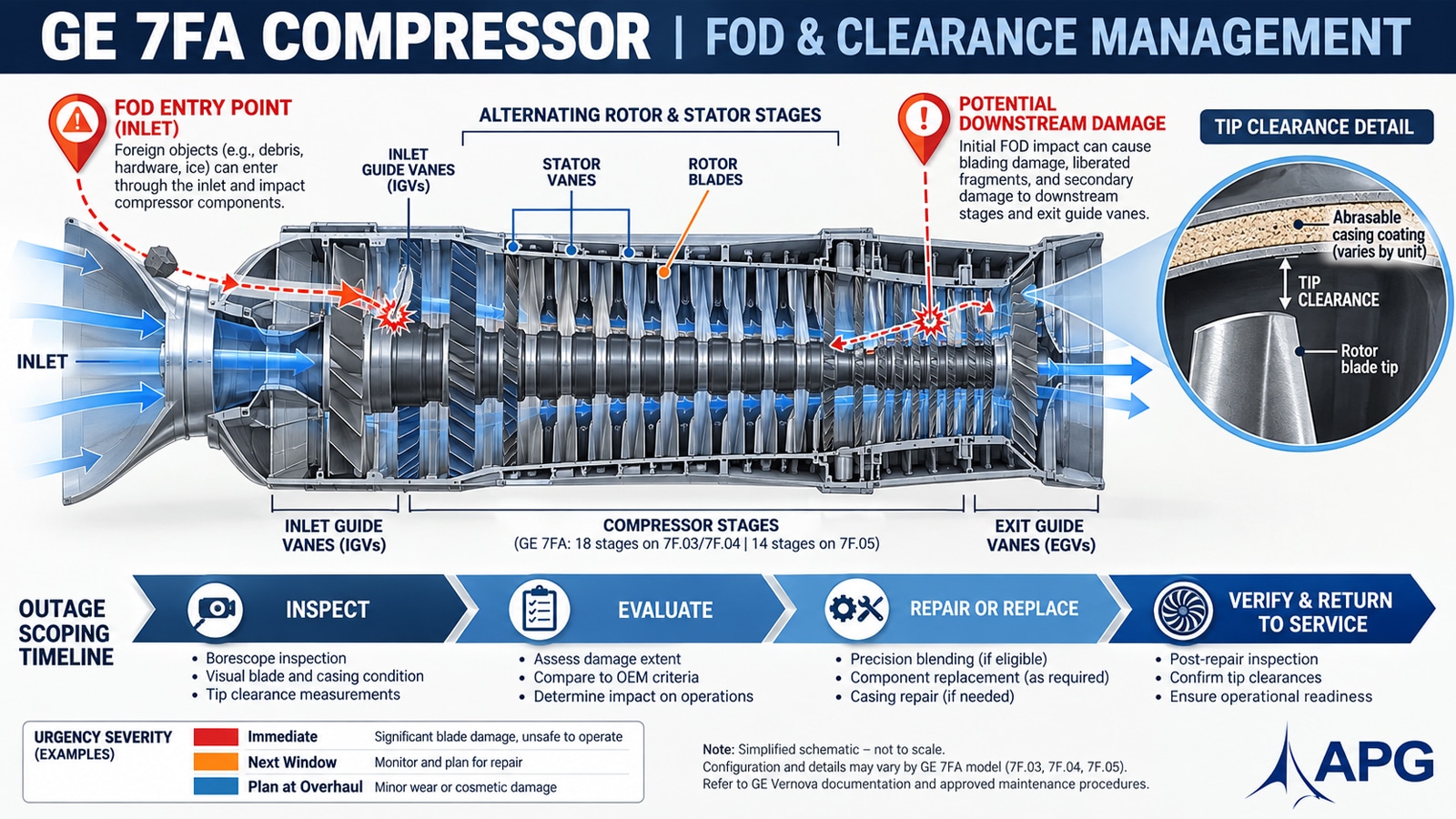
FOD and Clearances: How Foreign Object Damage Happens, What Acceptable Clearances Look Like, and How to Scope the Outage
How Does Foreign Object Damage (FOD) Happen in a 7FA Compressor and What Is the Repair Process?
Foreign object damage comes from the inlet house, failed filter media, liberated hardware and ice. The first row struck is rarely the only one hurt. Assessment starts with a borescope survey, then NDE of affected airfoils and every row downstream. Secondary damage reaches the combustor and the first-stage nozzle, which is why scope often exceeds what is visible. Repair usually means precision blending of minor damage, with row replacement past limits. EGV FOD blending is a common field repair.
What Compressor Clearances Are Acceptable on a 7FA and How Are They Measured?
Numeric limits are unit and OEM specific, so confirm them against your own data and current GE Vernova documents. A published tip-clearance review reports roughly 0.5 percent efficiency loss per 0.125 mm of growth. Rub-coating or abradable condition and rotor-to-casing alignment drive that growth. Measure with optical or blue-light 3D scanning and compare against an ASME PTC 22 baseline. Peaking duty, with its frequent starts, amplifies rub, and deferral gets costly before peak season.
Minimum Compressor-Focused Outage Scope and Repair-vs-Replace Decision Matrix
A minimum scope includes borescope-guided findings, casing lift criteria, NDE of flagged rows and clearance measurement. If a generator inspection is due, coordinate it in the same maintenance window. Use the matrix to frame the call, and treat it as a decision model you adapt to your own unit’s inspection history rather than a fixed rule.
| Condition | Action | Provider consideration |
|---|---|---|
| Reversible loss after wash | Wash, upgrade filtration | Any qualified provider |
| Cracks or liberation evidence | Immediate shutdown, replace | Prioritize lead time and TIL compliance |
| Wear inside limits | Repair at next window | Compare schedule and warranty terms |
| Clearance growth past limit | Restore abradable, rotor-in or rotor-out | Verify dimensional reports |
Wherever you source work, demand traceable NDE, dimensional reports, coatings specifications, warranty terms and documented TIL compliance. That holds whether the provider is GE Vernova, Siemens Energy, Mitsubishi Power or an independent shop. A good provider hands these over without being asked twice.
Conclusion
Wash when loss is reversible. Repair when airfoils sit inside limits. Replace past disposition limits. Defer only with trended data and a clean inspection record. Before you commit to a window, pull your latest borescope report and trend corrected performance against an ISO baseline. Send both to us and we will give you an NDE-backed disposition.
If you would rather talk it through first, call (281) 444-3535 and we can review your findings and help scope a compressor-focused maintenance window ahead of peak season. For a next read, see our 7FA component repair guide.
FAQ
What causes compressor fouling on a GE 7FA gas turbine and how often should it be washed?
Airborne particulates, oil mist and filter breakthrough cause fouling on a GE 7FA gas turbine. Wash frequency should follow your corrected-performance trend rather than a fixed calendar. Confirm the loss is truly reversible with an offline wash recovery test before assuming washing alone will restore output.
How much output and efficiency does a fouled or damaged 7FA compressor lose?
A fouled compressor commonly costs several percent of output, and industry wash guides attribute most gas turbine performance loss to fouling. Recovery after an offline wash separates reversible fouling from permanent damage. ASME PTC 22 baselining gives you a defensible comparison for either case.
What are the signs of compressor blade damage in a frame 7FA turbine?
Rising vibration, surge events, step changes in efficiency and borescope findings such as pitting, tip curl or cracks signal blade damage. A clean borescope alone cannot clear R0 and R1, so supplement it with eddy current or FPI before treating the rows as healthy.
Can GE 7FA compressor blades and stator vanes be repaired or must they be replaced?
Many blades and stator components can be repaired within limits using blending, tip grinding, coating, shot peening and re-bushing. Replacement applies when cracking, thinning or dimensional loss exceeds disposition criteria. A qualified NDE-backed inspection decides which side of the limit each part falls on.
What compressor clearances are acceptable on a 7FA and how are they measured?
Acceptable 7FA clearances are unit and OEM specific, so verify them against your own data and current GE Vernova TILs. Technicians assess them through rub-coating condition and 3D scanning against an ASME PTC 22 baseline, and growth costs roughly 0.5 percent efficiency per 0.125 mm.
How does foreign object damage (FOD) happen in a 7FA compressor and what is the repair process?
FOD enters through the inlet house, failed filter media, liberated hardware or ice. Repair follows assessment of the struck row and every row downstream, then blending or replacement. Damage scope often exceeds what is visible, so plan NDE time into the shutdown.
What is the difference between online and offline compressor water wash on a 7FA?
Online wash runs while the unit is loaded, and offline wash is performed on crank after a shutdown. Offline cleans deeper. Online wash and fogging have been linked to R0 root erosion in TIL 1303 and 1323, so set your protocol carefully.