

Your Power Partner
Causes of Rotor Shaft Deflection
We’ve dedicated years to working with industrial gas turbines, and rotor shaft deflection is a silent threat. Imagine a shaft spinning at thousands of revolutions per minute, bending slightly with each rotation. This bending is known as shaft deflection, a problem more perilous than many operators understand.
The gravity of this issue is immense. A gas turbine rotor spinning at 3,550 rpm deflects about 7,100 times per minute. Each cycle reverses the stress on the shaft material. Over time, this repetitive bending causes micro-cracks, leading to catastrophic failure. The type of shaft material is crucial; its Young’s modulus determines how it will flex, deform, or snap under load.
Several factors contribute to this problem. The shaft’s diameter, radial bearing distance, impeller forces, and the L over D ratio all influence deflection. Proper rotor dynamics analysis and vibration analysis are vital for early detection. At Allied Power Group in Houston, Texas, we are renowned for diagnosing and repairing these complex rotor repair issues. We’ll guide you through the root causes to help you identify them before they cause a shutdown.
Key Takeaways
- Rotor shaft deflection occurs when a rotating shaft bends away from its centerline under radial loads during operation.
- Shaft material properties — especially Young’s modulus — directly determine how a shaft responds to stress and deflection forces.
- A gas turbine rotor at 3,550 rpm undergoes stress reversal over 7,100 times per minute, accelerating fatigue and cracking.
- The L over D ratio is a key indicator of shaft stiffness and deflection potential in overhung configurations.
- Vibration analysis and rotor dynamics studies are essential for early detection of shaft deflection in an industrial gas turbine.
- Allied Power Group specializes in identifying and repairing shaft deflection issues across gas turbine platforms.
Understanding Rotor Shaft Deflection in Industrial Gas Turbines
First off, rotor shaft deflection is not the same as shaft runout. These terms are often confused. Deflection refers to bending under radial loads, whereas shaft runout measures deviation from true circular rotation. Misunderstanding these can mislead your diagnostic efforts. So, let’s dissect this further.
What Is Shaft Deflection and Why It Matters
Mechanical deflection occurs when a rotor bends away from its centerline under load. This bending can cause rotating parts to contact stationary components. In stainless steel assemblies, this contact can lead to galling, which can seize equipment quickly. Seal manufacturers like John Crane require less than 0.002 inches of deflection at seal faces. Exceeding this can lead to premature seal failure and reduced reliability.
The Role of Rotor Dynamics in Turbine Operation
Rotor dynamics study how spinning masses interact with bearings and operational forces. Research from Summit Pump shows that reversed bending with rotation is the primary fatigue failure mode. This often occurs when a pump is run outside its design parameters. An excessive shaft slenderness ratio — meaning the shaft is too long and thin for its speed — amplifies bending dramatically when turbines operate away from their best efficiency point.
Critical Speed and Vibration Analysis Fundamentals
Every rotor has a critical speed where vibration spikes. Operating near this speed invites trouble. ISO 1940 Grade 6.3 balancing standards aim to keep vibration within safe limits. Here’s a quick reference:
| Parameter | Acceptable Range | Risk if Exceeded |
|---|---|---|
| Shaft runout at seal face | Less than 0.002 inches | Seal failure, leaks |
| Vibration at critical speed | Per ISO 1940 G6.3 | Fatigue cracking, seizure |
| Centerline deviation under load | Manufacturer spec | Rotor-to-stator contact |
| Excessive shaft deflection near BEP | Within pump OEM tolerance | Bearing damage, reduced reliability |
Understanding these basics is crucial for identifying what causes rotor shaft deflection. We’ll explore this further next.
Primary Causes and Contributing Factors
What’s causing your rotor shaft to bend? I’ve identified dozens of root causes, categorized into a few major groups. Understanding these can help you spot issues before they worsen.
Mechanical and Thermal Influences on Shaft Bending
Each shaft is built to withstand specific loads. These include torque, speed, hydraulic forces, and component weight. When these loads exceed design limits, the shaft bends under stress. The shaft’s diameter, fillet radius, surface finish, and bearing span all affect its stress absorption capacity.
Common materials for shafts include 304/316 austenitic stainless, 4140 alloy steel, and 17-4 PH precipitation hardened stainless. Each material reacts differently to mechanical and thermal loads. For example, a mechanical seal area requires tight tolerances that can shift under excessive heat.
Bearing Failure and Shaft Misalignment Issues
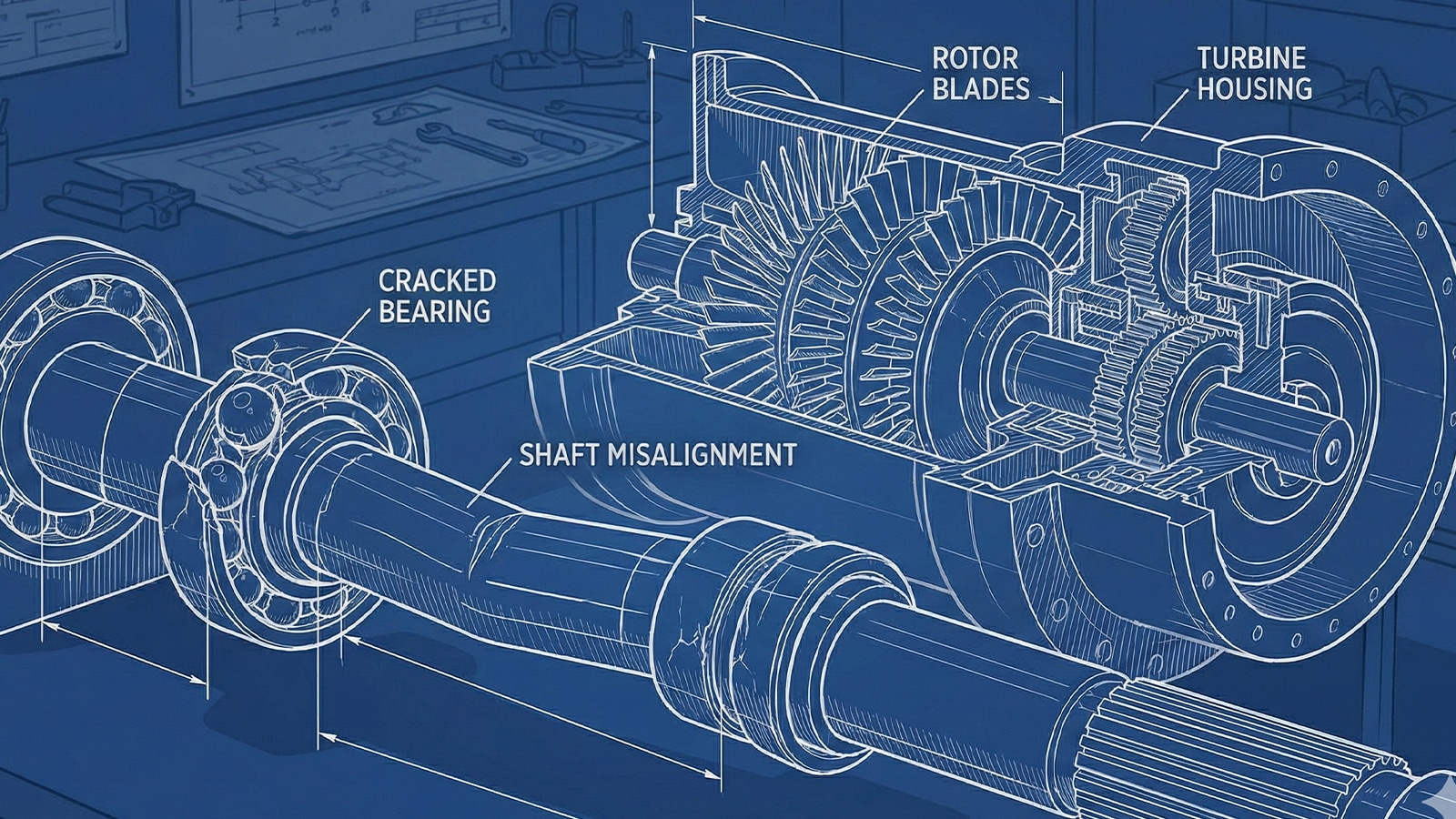
Bearing failure occurs when the oil film thickness changes, causing the shaft centerline to shift. This leads to friction, corrosion, and vibration. Shaft misalignment, between coupling halves or the shaft-to-bearing interface, introduces eccentricity. As the rotor rotates at high speed, this eccentricity generates radial centrifugal forces, increasing deflection.
- Poor casing-to-bearing pad connections
- Foundation frame distortion
- Concentricity problems between components
- Improper coupling installation
- Thermal growth mismatch
- Piping strain on the casing
Unbalance Forces and Excessive Shaft Runout
Unbalance forces from a damaged or fouled impeller cause shaft whip, a violent radial vibration pattern. If runout exceeds 0.0025–0.003 inches, the shaft likely needs replacement. Even small mass imbalances create enormous radial loads at operating speed.
How Allied Power Group Is Your Choice For Rotor Repair
When rotor shaft deflection threatens your equipment, you need a team that truly understands the issue. Allied Power Group, based in Houston, Texas, offers unparalleled expertise in repairing industrial gas turbines and pump rotors. Our team approaches each repair with a deep understanding, not just on paper but in real-world application.
Our technicians recognize that shaft deflection stems from mechanical, thermal, and design-related factors. We employ a detailed diagnostic process. This includes evaluating Young’s modulus values for each material to ensure the right alloy is used for your specific conditions. Temperature ranges, corrosive environments, and suspended solids levels are all considered.
We directly address the three main causes of deflection:
- Pre-existing shaft bending—any rotating shaft showing runout above 0.003 inches gets replaced
- Rotor imbalance—precision balancing eliminates uneven mass distribution
- Radial thrust from off-design operation—we redesign flow paths and recommend operational adjustments
In pump applications, we focus on L-over-D ratios for overhung designs. Smart geometry is more effective than upgrading shaft material alone. We replace sleeved shafts with solid designs and install cartridge-type mechanical seals to reduce deflection.
During turbine shutdowns, we adhere to strict cooling protocols. This protects every rotating shaft in the assembly.
| Shutdown Parameter | Allied Power Group Standard | Risk If Exceeded |
|---|---|---|
| HP Cylinder Temperature | Below 150°C | Thermal bowing of rotor |
| Oil Temperature | Below 75°C | Bearing degradation |
| Shaft Runout Tolerance | Under 0.003 inches | Chronic rotor shaft deflection |
| Cooling Rate Compliance | Per OEM specification | Casing distortion |
You don’t just need a repair shop—you need a power partner who understands why rotor shaft deflection happens and how to prevent it. That’s us.
Conclusion
Rotor shaft deflection in industrial gas turbines is more than just material weakness. It involves geometry, balance, and thermal control. Young’s modulus, near 29 x 10⁶ psi for most shaft steels, shows that optimizing the L/D ratio is key. Deflection happens when radial loads, stiffness issues, and imbalance combine.
Keeping runout under 0.003 inches and balancing to ISO 1940 grade 6.3 are crucial. These steps help prevent premature failure. Vibration analysis acts as an early warning system, detecting issues like temperature gradients and seal face deflection.
Ignoring these signs can lead to rapid escalation of problems. A thorough maintenance routine is essential. It includes alignment checks, bearing inspections, and thermal management. This approach prevents minor deflection from turning into a major shutdown.
Allied Power Group in Houston offers advanced technical expertise for rotor repairs. Their team focuses on finding and fixing root causes, enhancing reliability and extending turbine life. Investing in diagnostics and expert repair is crucial for maintaining peak performance.