

Your Power Partner
Introduction To Gas Turbine Blade Damage
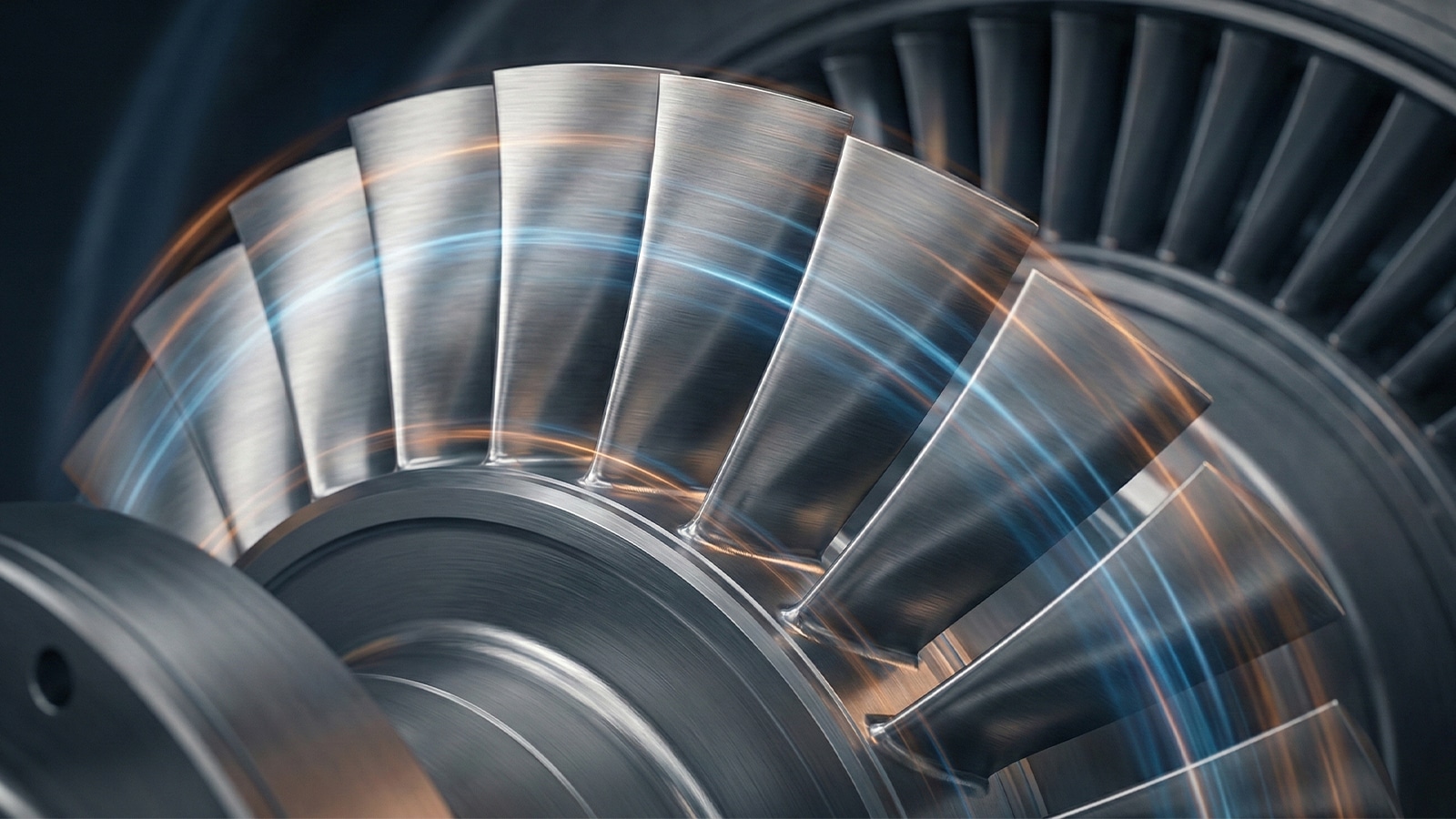
Power generation facilities depend on precision components operating under extreme conditions. Blades in a gas turbine face temperatures exceeding 2,400°F, rotational speeds in thousands of RPM, and immense mechanical stress. These parts convert thermal energy into mechanical work, making them critical yet susceptible to various forms of deterioration.
Manufacturing defects, operational stress, and environmental factors contribute to component degradation. Even minor damage can significantly impact efficiency, reliability, and operational costs. Understanding failure mechanisms helps operators develop effective prevention strategies.
Allied Power Group, based in Houston, Texas, brings decades of specialized experience in diagnosing and component repair. The company serves power plants throughout the United States with comprehensive restoration solutions for both industrial gas turbines and steam turbine applications.
This article explores the complete spectrum of turbine blade damage patterns. Topics include fundamental roles, common deterioration types, root causes, stage-specific failures, and expert restoration approaches.
Key Takeaways
- Components operate under extreme conditions with temperatures exceeding 2,400°F
- Blade damage stems from thermal stress, mechanical loads, and environmental factors
- Understanding damage mechanisms extends equipment lifespan and ensures reliable operations
- Allied Power Group provides specialized diagnostic and repair services from Houston, Texas
- Comprehensive inspection and restoration prevent costly failures in power generation systems
Understanding Turbine Blades and Their Critical Function
Gas turbine blades convert thermal energy from high-temperature combustion gases into rotational mechanical force. This force drives generators for power generation. At Allied Power Group, understanding blade engineering forms the cornerstone of restoration services.
The Role of Turbine Blades in Power Generation
Turbine blades serve as the primary mechanism for energy conversion. Hot gas strikes the blade surface at temperatures over 2,800°F in advanced designs. This interaction transforms thermal energy into rotational movement of the turbine rotor, which drives electrical generators.
Blade geometry significantly impacts energy conversion efficiency. Studies show a 1% loss in aerodynamic efficiency translates to measurable increases in fuel consumption. Turbine blades operate in cascaded arrangements, with each stage performing specific expansion work as gas progresses through successive rows.
Blade Design and Material Selection
Modern blade design balances multiple performance requirements. Gas turbine blade materials typically consist of advanced nickel-based or cobalt-based superalloys engineered for high temperature applications. Manufacturing techniques produce directionally solidified and single-crystal structures that eliminate grain boundaries weakening components at elevated temperatures.
Protective coating systems add complexity to blade design. Thermal barrier coatings insulate the base metal from extreme gas temperatures. Oxidation-resistant coatings prevent surface degradation. These multi-layer systems extend blade life by hundreds of operating hours.
Internal cooling passages represent critical design elements in hot section blades. Complex networks allow cooling air to flow through blade interiors. Some designs incorporate film cooling holes creating protective air layers on the surface of the blade, reducing thermal exposure.
Operating Conditions and Stress Factors
The environment where turbine blades operate ranks among the most severe in industrial machinery. Combustion gas temperatures regularly exceed the melting point of blade material made from advanced superalloys. Only sophisticated cooling systems and protective coatings enable survival.
Centrifugal forces create enormous tensile stresses in the blades. Rotation speeds of 3,600 rpm generate forces exceeding 40,000 psi in some sections. These constant loads combine with thermal stresses from temperature gradients, creating complex multi-axial stress states.
Thermal cycling during start-stop operations introduces additional challenges. Rapid temperature changes cause expansion and contraction at different rates, generating stresses in the blades that can lead to crack initiation over time. Vibratory stresses add another dimension—aerodynamic forces create alternating pressures on blade surfaces that accumulate fatigue damage.
Common Types of Gas Turbine Blade Damage
Industrial gas turbines face various forms of deterioration impacting performance and reliability. Early identification of damage patterns prevents failures and downtime. Allied Power Group’s Houston-based technical team has extensive knowledge in recognizing and assessing different damage mechanisms from decades of field experience.
What are Erosion Damage Mechanisms?
Blade erosion represents a common form of turbine blade damage. The leading edge typically experiences the most severe erosion damage due to direct exposure to gas path contaminants.
Solid particle erosion results from airborne dust, sand, and combustion contaminants impacting blade surfaces at high velocities. These particles act like sandblasting media, gradually removing protective coatings and base material. Turbines operating in coastal or desert environments face aggressive erosion conditions.
Sulfidation attack occurs when sulfur compounds in fuel react with blade materials at elevated temperatures. Gas turbines burning low-quality fuels suffer from accelerated sulfidation damage. Examples of typical erosion damage include coating spallation, where protective thermal barrier coatings detach from substrate material, exposing the underlying superalloy to accelerated oxidation.
Initial blade erosion damage appears as surface roughening disrupting the smooth aerodynamic profile. As deterioration advances, coating penetration exposes substrate beneath. Further progression leads to loss of blade material that can significantly alter a blade’s geometry and clearances.
What are Cracking and Fatigue Failure Patterns?
Crack formation represents a critical failure mechanism that can lead to catastrophic blade failure if unaddressed. Multiple crack types develop from different stress conditions and operating environments.
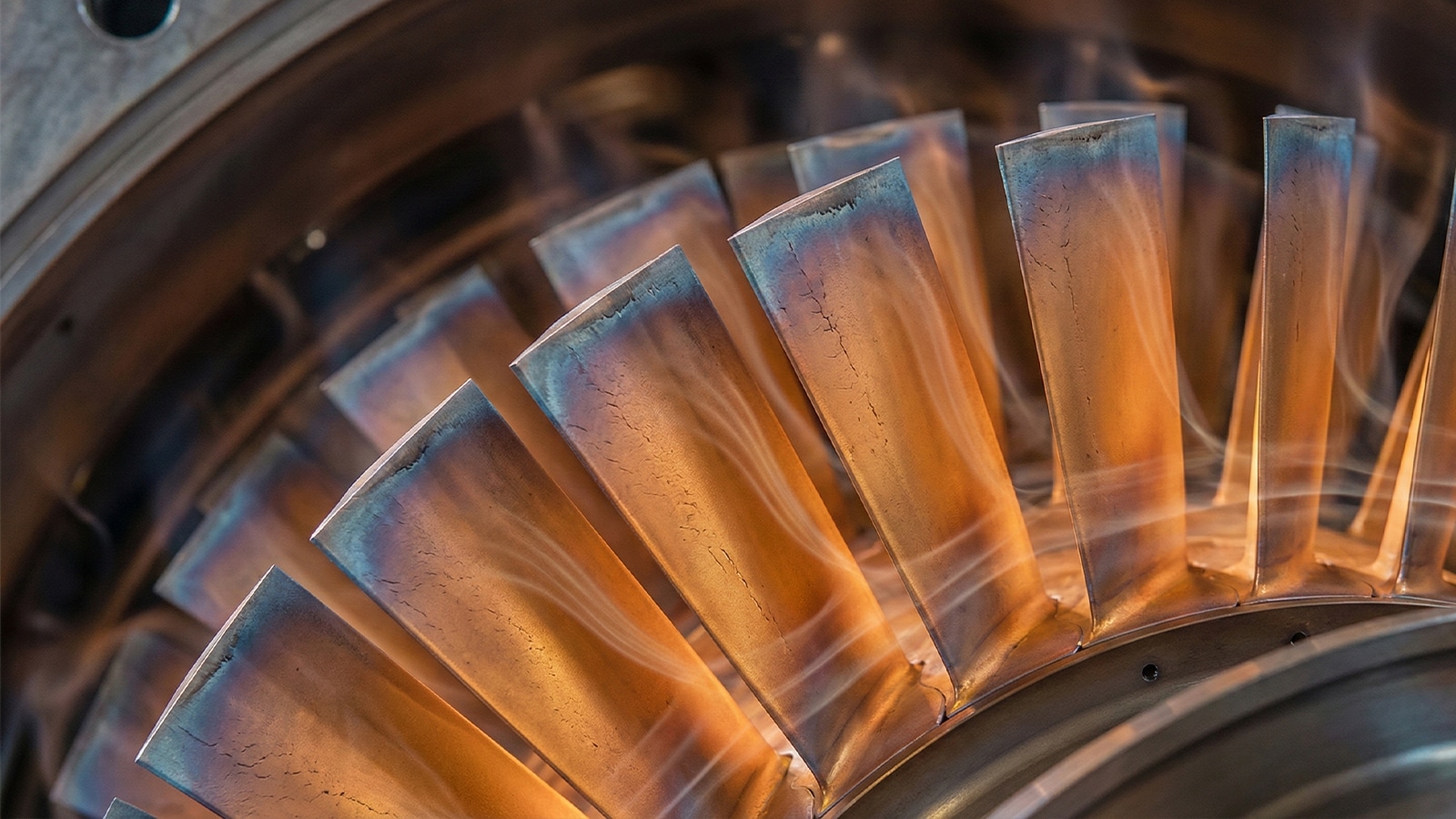
Thermal fatigue cracks result from start-stop thermal cycling creating expansion and contraction stresses. High-cycle fatigue failure can occur from vibratory stress causing millions of stress reversals during operation. These cracks often initiate at stress concentrations like cooling holes, trailing edges, and blade attachment points.
Low-cycle fatigue occurs during major load changes creating significant mechanical stress variations. Creep cracks form during sustained high temperature operation when material slowly deforms under constant stress. First stage turbine blades operating at peak temperatures show highest susceptibility.
Crack initiation sites concentrate at geometric discontinuities and stress concentration areas. Cooling holes create stress risers where cracks frequently begin. Multiple crack mechanisms often interact to accelerate blade failure—a thermal fatigue crack creates a stress concentration that speeds high-cycle fatigue propagation.
What is Material Loss and Surface Degradation?
Progressive material loss through chemical and mechanical processes gradually reduces blade integrity. These degradation mechanisms work simultaneously to compromise blade structure.
Oxidation scale formation occurs when blade materials react with oxygen at high temperatures. This protective oxide layer can become unstable and spall away, exposing fresh material to continued attack. Hot corrosion develops in two distinct forms attacking blade materials through different mechanisms at various temperature ranges.
Creep deformation causes blade stretching and tip deflection from sustained high temperature exposure under centrifugal loading. This permanent plastic deformation changes blade geometry and clearances. Blades can grow several millimeters in length before requiring replacement.
The loss of blade material through combined mechanisms affects individual blade strength and overall system behavior. Unbalanced material removal creates vibration issues propagating throughout the turbine assembly. Changed profiles alter aerodynamic performance and stage turbine efficiency.
Primary Causes of Turbine Blade Damage
The causes of gas turbine deterioration are complex, involving thermal, mechanical, and environmental factors. Research shows that combined factors, not single incidents, typically lead to gas turbine failure. Allied Power Group’s Houston-based engineering team analyzes these interconnected damage mechanisms to provide detailed root cause assessments.
Thermal Stress and High Temperature Exposure
Modern gas turbines operate in extreme thermal environments with hot gas temperatures often exceeding 2,400°F. First stage blades face combustion gases hotter than their melting points. Sophisticated internal cooling passages and protective thermal barrier coatings help them survive.
Thermal stress arises from temperature gradients across blade geometry. The outer surface faces direct combustion gas exposure while internal cooling channels maintain lower temperatures. This differential creates substantial mechanical stress within the blade structure during steady-state operation.
Temperature variations cause multiple damage mechanisms: thermal fatigue from repeated start-stop cycling, creep accumulation where sustained high temperature and centrifugal stress cause time-dependent deformation, thermal barrier coating spallation when protective ceramic layers separate, oxidation layer formation consuming base material, and microstructural degradation in nickel superalloys.
Each startup cycle induces thermal shock as blades rapidly heat from ambient conditions. Gas temperatures rise to operational levels within minutes, creating severe thermal gradients. This rapid heating generates internal stress that can cause blade damage even without obvious external indicators.
Mechanical Stress and Vibratory Response
Turbine blades experience tremendous mechanical loads during operation. Centrifugal forces create tensile stress exceeding 20,000 times gravitational acceleration in some designs. This constant stress loads blade material to substantial percentages of ultimate strength.
The vibratory response of the blade becomes critical when operating conditions create resonance. Aerodynamic forces from combustion gas flow generate oscillating loads at specific frequencies. When excitation frequencies align with natural frequencies, resonance failure conditions develop that amplify vibration dramatically.
Rapid high-cycle fatigue failure under resonance represents one of the most dangerous damage modes because little warning precedes catastrophic breakage. Mechanical damping of the blade helps attenuate vibratory response. Material internal damping dissipates vibration energy, yet provides limited protection against strong excitation forces.
Damping of the blade group offers additional vibration control in certain designs. Shrouded configurations allow controlled contact between adjacent blades creating friction damping. Blade lacing wire systems, common in steam turbine blade designs, thread wires through blade holes to provide mechanical coupling.
These damping mechanisms require careful maintenance because wear reduces effectiveness. Blade frequencies change as operating conditions evolve. Temperature variations alter material stiffness. Rotational speed changes affect centrifugal stiffening. Material loss from erosion shifts natural frequencies, potentially creating resonance conditions that didn’t exist when turbines were new.
Foreign Object Damage and Environmental Factors
Foreign object damage occurs when debris enters the gas path and impacts rotating blades. Sources include incomplete combustion particles, upstream component failures, inadequate inlet filtration, and maintenance debris. Even small particles traveling at combustion gas velocities carry substantial kinetic energy.
Impact severity ranges from minor surface nicks to immediate catastrophic failure. Small particles create localized damage generating stress concentrations where fatigue cracks can initiate. Leading edge impacts create notches disrupting airflow and reducing efficiency. Trailing edge damage affects exit flow angles and downstream stage performance.
Operating environment significantly influences blade degradation rates. Sulfur content in fuels creates aggressive attack mechanisms. High temperature sulfidation occurs when sulfur compounds react with blade materials. Coastal installations face salt ingestion challenges that accelerate hot corrosion. Sodium chloride deposits combine with combustion products to create molten salt films on blade surfaces enabling rapid material degradation.
Environmental damage mechanisms interact with other causes of gas turbine deterioration. Corrosion pits act as stress concentrations combining with mechanical stress to initiate fatigue failure. Surface roughening from corrosion disrupts protective cooling films and increases thermal stress.
Stage-Specific Damage in Industrial Gas Turbines
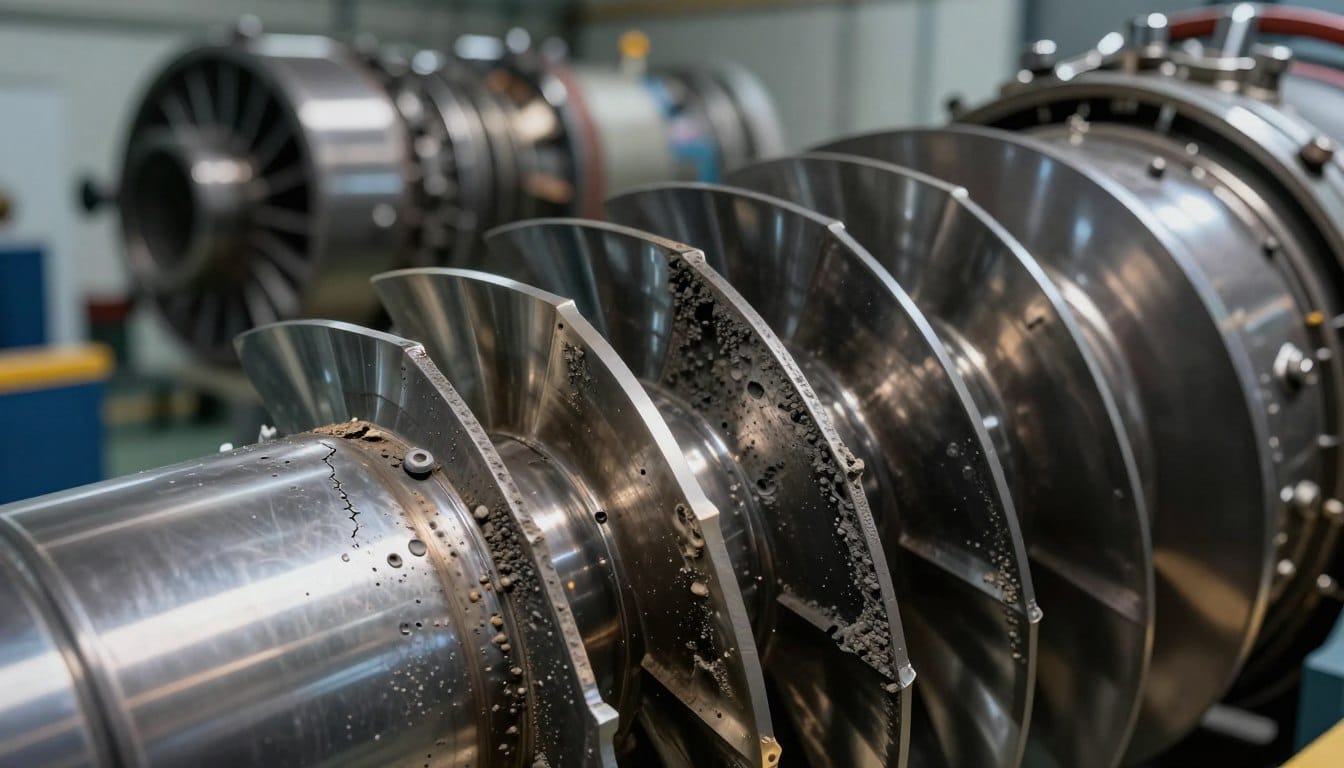
Different turbine stages face unique operational conditions leading to specific damage patterns. Each section experiences distinct temperature ranges, pressure levels, and velocity profiles. The gas path through an industrial turbine subjects each row to changing conditions.
Extreme Operating Conditions for Initial Hot Section Components
1st stage gas turbine blades endure the most severe thermal environment with gas temperatures reaching 2,400-2,800°F. The combination of extreme heat, high rotational speeds, and combustion gas exposure makes these components vulnerable to multiple damage mechanisms.
Advanced cooling designs in first stage blades include multiple internal passages and film cooling holes featuring thermal barrier coatings typically 0.015-0.030 inches thick. When these coatings fail, the underlying superalloy faces temperatures beyond design limits.
Thermal barrier coating spallation is common in first stage blades after repeated thermal cycling. Once coating breaches, oxidation rapidly attacks the superalloy substrate. Hot corrosion becomes aggressive at temperatures between 1,400-1,800°F, accelerating material loss and weakening the rotor blade structure.
Tip burning represents another characteristic first-stage damage mode. Material loss from blade tips occurs due to inadequate cooling or excessive tip clearance. This damage directly impacts turbine efficiency by allowing hot gas to bypass the intended flow path.
Creep deformation causes first stage turbine blades to stretch over time under sustained high temperature operation. This elongation increases tip clearances and reduces overall performance. First-stage blade damage creates cascading effects throughout the turbine rotor—shed coating particles erode downstream components.
Cold-End Component Degradation
Compressor blades face different challenges compared to hot section components. Operating in the cold end of the gas path, these components encounter mechanical stresses, foreign object damage, and environmental factors producing distinct failure patterns.
Foreign object damage from inlet debris represents the most common compressor blade problem. Even small particles cause leading edge erosion when impacting blades at high velocities. This damage accumulates over time degrading aerodynamic efficiency.
Fatigue failure develops due to vibratory stresses more pronounced in cantilevered designs without shrouds or mid-span dampers. Blade corrosion accelerates in humid or coastal environments where salt-laden air enters the compressor. Compressor fouling changes blade aerodynamics through contaminant buildup on airfoil surfaces.
Vibratory Fatigue Across Multiple Sections
High-cycle fatigue failure can occur when turbine blading experiences resonant vibration at natural frequencies. Unlike other damage mechanisms developing over months or years, rapid high-cycle fatigue failure manifests in hours or days once resonant conditions establish.
Turbine blading are typically tuned during design to avoid resonance at normal operating speeds. Operational changes can shift these carefully planned frequency relationships creating unexpected resonance conditions. Several factors alter blade frequencies from design values including wear, temperature variations, and fouling.
When resonance occurs, damage frequently extends through multiple blades in a blade group. Blades mounted adjacent often share similar frequencies and vibrate together as coupled systems. Some steam turbine blade designs employ blade lacing wire for vibration control—these wire connections float in the blade hole and provide additional damping through controlled friction.
Allied Power Group’s Expert Repair and Restoration Solutions
When turbine blade damage threatens operational efficiency, Allied Power Group delivers expert restoration services. Based in Houston, Texas, the company serves power plant operators and industrial facilities across North America offering complete turbine maintenance solutions addressing both gas turbine engine and steam turbine applications.
Comprehensive Damage Assessment Protocols
Effective repair begins with accurate diagnosis. Allied Power Group employs systematic inspection methodologies identifying all damage mechanisms affecting components. The assessment process combines visual examination with advanced non-destructive testing technologies.
Initial inspection establishes baseline component condition. Technicians document visible damage patterns including erosion, cracking, coating loss, and deformation. Dimensional inspection follows visual assessment quantifying material loss and geometry changes.
Allied Power Group’s non-destructive testing capabilities include fluorescent penetrant inspection detecting surface cracks, magnetic particle inspection identifying defects in ferromagnetic materials, ultrasonic testing revealing internal defects and measuring remaining wall thickness, and eddy current inspection locating surface anomalies.
The failure analysis of gas turbine components extends beyond damage identification. Engineers determine root causes by examining damage patterns in context of operating history. Analysis of gas turbine blades considers stage-specific operating environments—first stage turbine blades experience extreme thermal conditions producing different damage patterns than compressor stages.
Metallurgical analysis supports complex investigations through microstructural examination identifying material degradation mechanisms. Inspection findings inform repair-versus-replace decisions evaluating damage extent, remaining material properties, and projected service life.
Advanced Repair Techniques
Allied Power Group maintains diverse restoration capabilities for industrial gas turbines and steam turbine applications. Repair technologies address structural damage, material loss, and protective coating degradation.
Weld repair represents a primary restoration technique for damaged sections. Advanced fusion and diffusion welding processes suit high temperature alloy systems. Post-weld heat treatment restores metallurgical properties in repaired areas through controlled thermal cycles relieving residual stresses.
Thermal spray coating restoration protects blade surfaces from environmental degradation. Applied coating systems include thermal barrier coatings insulating hot section components, oxidation-resistant bond coats protecting substrate materials, erosion-resistant coatings defending compressor blades, and corrosion-resistant coatings shielding steam turbine blade surfaces.
Material blending removes damaged substrate and restores aerodynamic profiles. Skilled technicians use precision grinding to eliminate cracks, oxidation, and erosion damage maintaining smooth contours preserving blade efficiency.
Tip restoration addresses one of the most common damage zones. Allied Power Group rebuilds damaged tips using weld buildup followed by precision machining. The restored blade geometry matches original specifications maintaining proper clearances within the gas turbine engine flow path.
Quality Assurance and Testing
Allied Power Group implements rigorous quality control throughout restoration. Multiple verification steps confirm repaired components meet or exceed original specifications.
Dimensional verification confirms restored blade geometry matches design requirements. Non-destructive testing of all repair areas provides 100% inspection coverage. Every weld receives fluorescent penetrant examination detecting surface defects.
Surface finish verification ensures repaired areas meet smoothness requirements. Proper surface texture proves critical for both aerodynamic efficiency and fatigue resistance. Coating inspection validates thermal spray applications verifying thickness and adhesion.
Quality documentation provides complete repair traceability including pre-repair condition reports, repair procedure records, post-repair inspection results, material certifications, and service recommendations guiding reinstallation and operational monitoring.
Conclusion: Ensuring Turbine Reliability Through Expert Blade Management
Effective turbine blade damage management maintains efficiency and prevents costly failures. Blades of gas turbines face extreme conditions leading to inevitable wear. Blade degradation goes beyond reactive repairs—it involves proactive inspection, understanding specific damage mechanisms, and expert repairs when needed.
Allied Power Group, based in Houston, Texas, specializes in gas and steam turbine blade solutions offering damage assessment, advanced repair techniques, and quality assurance testing. For those dealing with turbine blade damage, Allied Power Group provides consultation services evaluating situations and recommending optimal solutions. Their expertise in industrial gas turbines repair proves invaluable for maintaining critical power plant assets. Contact their Houston team to discuss turbine maintenance needs and learn how expert blade management safeguards your power generation investments.
FAQ
What are the most common causes of blade erosion in power generation equipment?
Blade erosion typically results from solid particles like dust and sand impacting surfaces at high velocities, along with sulfur compounds in fuel creating chemical attacks at elevated temperatures. Coastal and desert environments create especially aggressive conditions that accelerate this type of surface degradation.
How can operators prevent blade failure in industrial applications?
Preventing blade failure requires regular inspection programs, fuel quality management, proper operating procedures, and timely maintenance interventions. Early detection of damage patterns through systematic inspections allows repairs before minor issues evolve into catastrophic failures.
What damage causes should maintenance teams monitor most closely?
The primary damage causes include thermal stress from temperature cycling, mechanical stress from centrifugal forces and vibration, foreign object impacts, and environmental corrosion from fuel contaminants and atmospheric conditions. These factors often work together, so comprehensive monitoring addresses all potential degradation mechanisms.
Does blade thickness affect component lifespan and performance?
Yes, blade thickness distribution directly impacts structural strength and cooling effectiveness in hot section components. Material loss that reduces thickness compromises both mechanical integrity and the ability to withstand operational stresses, ultimately shortening service life.
When should components be repaired versus replaced after damage occurs?
Repair decisions depend on damage extent, remaining material properties, previous repair history, and cost-effectiveness compared to replacement. Allied Power Group’s engineering team evaluates these factors to recommend the most economical solution that maintains safety and performance standards.