

Your Power Partner
Signs Your Gas Turbine Rotor Needs Refurbishment
We’ve witnessed it too often — a gas turbine rotor sends out clear warning signs, yet teams are often caught off guard. It’s time to change this.
Your gas turbine is the core of your power generation facility. With around 6,000 large frame-size units globally, about 60% are General Electric’s. Siemens Westinghouse and ABB Alstom make up the rest. Rotor refurbishment is inevitable for every operator, not a question of “if,” but “when.”
Hot-section hardware deteriorates due to oxidation, creep, cracking, and dimensional distortion. They are caused by accumulated operating hours, stop-start cycles, or a combination of both. Fortunately, most turbine rotor components can be repaired at a cost of 10–30% of new parts.
When it comes to maintenance intervals, your approach depends on your equipment’s usage. Peaker units running under 300 hours annually are often price-sensitive. Baseload operators, on the other hand, prioritize quality and scope. Regardless, planning outages at least 12 months in advance is key. This allows for reviewing past inspections, scheduling crews, and securing parts.
Let’s explore the critical signs that indicate it’s time to inspect your turbine closely to avoid rotor damage. This way, you can avoid a small issue turning into a costly shutdown.
Key Takeaways
- Gas turbine rotors need refurbishment based on accumulated operating hours, start-stop cycles, or both — not just calendar time.
- Primary failure mechanisms include oxidation, creep, cracking, and dimensional distortion in hot-section components.
- Rotor refurbishment typically costs 10–30% of new component pricing, with turnaround times of one to four weeks.
- Peaking units and baseload units require different inspection and maintenance strategies to maintain reliability.
- Effective power generation maintenance planning should begin at least 12 months before a scheduled outage.
- Early detection through routine inspection prevents unplanned downtime and protects your bottom line.
Critical Warning Signs During Gas Turbine Operation
Your gas turbine is trying to communicate with you. It sends out subtle and not-so-subtle signals before a major failure occurs. As an operator at a power plant, recognizing these warning signs early can significantly reduce downtime. It also helps avoid major crises. Let’s explore what you should be watching for.
Excessive Vibration and Harmonic Imbalances
Vibration is your first defense. Harmonic testing can uncover frequencies that are not within the standard range, indicating rotor problems. Key metrics include blade area, harmonics, and moment weight. If these readings increase, it’s imperative to schedule gas turbine repair to prevent a small issue from escalating into a major failure.
Performance Degradation and Reduced Power Output
When your machine can’t reach its rated output, there’s a problem in the gas path. Issues like fouled compressor blades, eroded nozzles, or worn seals can all reduce power. Units that frequently start and stop wear down faster. This necessitates more proactive maintenance to protect critical components.
Abnormal Temperature Patterns and Thermal Distress
Uneven exhaust temperatures or hot spots along the gas path indicate thermal distress. Units that cycle frequently, experiencing more thermal and mechanical stress, are at higher risk. Loose wedges, corona damage, and exciter wear often appear during inspections related to these issues.
Unusual Noise and Mechanical Anomalies
Don’t overlook strange grinding, clicking, or rumbling sounds. Rotor earth faults pose a significant threat, with a single fault manageable but a second leading to a complete rewind of rotor and stator. Early detection of cracks or mechanical anomalies through careful monitoring is essential for reducing downtime at power plants.
| Warning Sign | Likely Cause | Risk Level | Recommended Action |
|---|---|---|---|
| Excessive vibration | Rotor imbalance or blade damage | High | Harmonic analysis and balancing |
| Reduced power output | Gas path fouling or seal wear | Medium-High | Compressor wash and inspection |
| Uneven exhaust temps | Combustor or nozzle degradation | High | Borescope and thermal mapping |
| Unusual mechanical noise | Bearing wear or rotor earth fault | Critical | Immediate shutdown and gas turbine repair |
Understanding Rotor Refurbishment Through Inspection Results
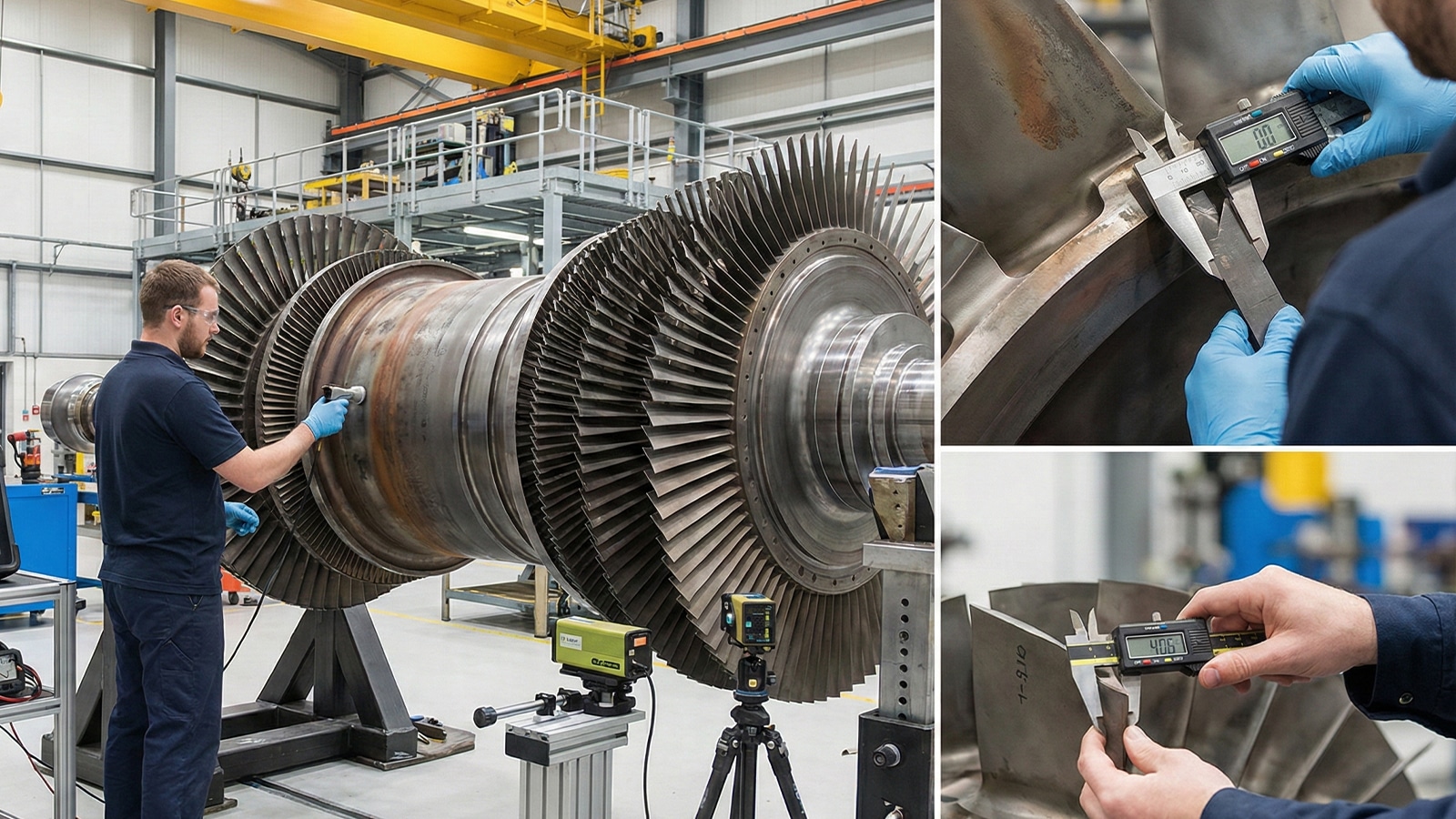
Operating symptoms hint at a problem. Inspection results reveal the exact issue. When a rotor is evaluated, various tests provide a detailed health assessment. Let’s explore the critical inspection areas that influence refurbishment choices.
Non-Destructive Testing Indicators
Two standout methods are used to find cracks and subsurface flaws. Eddy current testing identifies defects in conductive materials by measuring electromagnetic response changes. Magnetic particle inspection reveals surface and near-surface cracks that the naked eye can’t detect. These methods are effective on both gas and steam turbine rotors, catching minor issues before they escalate.
Dimensional Inspection and Creep Assessment
High temperatures cause metal to slowly deform over time, a phenomenon known as creep. This permanent deformation changes part geometry. Precise dimensional measurements show if components have stretched or distorted beyond acceptable limits. Creep assessment is vital for blades and discs made from nickel-based superalloys, where even small changes are significant.
Metallurgical Evaluation and Material Degradation
Metallurgical analysis examines microstructure, composition, and corrosion attack depth. Modern turbine components feature complex cast alloys with 2–4 types of internal cooling passages. Thermal mechanical fatigue causes cracking patterns in nickel-based superalloys that require expert interpretation. This evaluation determines the remaining life of your base metal.
Coating Condition and Surface Damage Analysis
Every coating system degrades over time. Removal involves ceramic grit blasting and acid stripping of the metallic bond coat. Common pitfalls include:
- Excessive base metal removal during stripping
- Inter-granular acid attack on exposed surfaces
- Incomplete coating removal leaving contaminated layers
Reapplication uses thermal spray processes where part geometry, pre-heat temperature, surface cleanliness, and powder properties all impact quality. Achieving this ensures your refurbished rotor performs optimally, preparing you for future maintenance intervals.
Operating Hours and Maintenance Intervals That Trigger Repairs
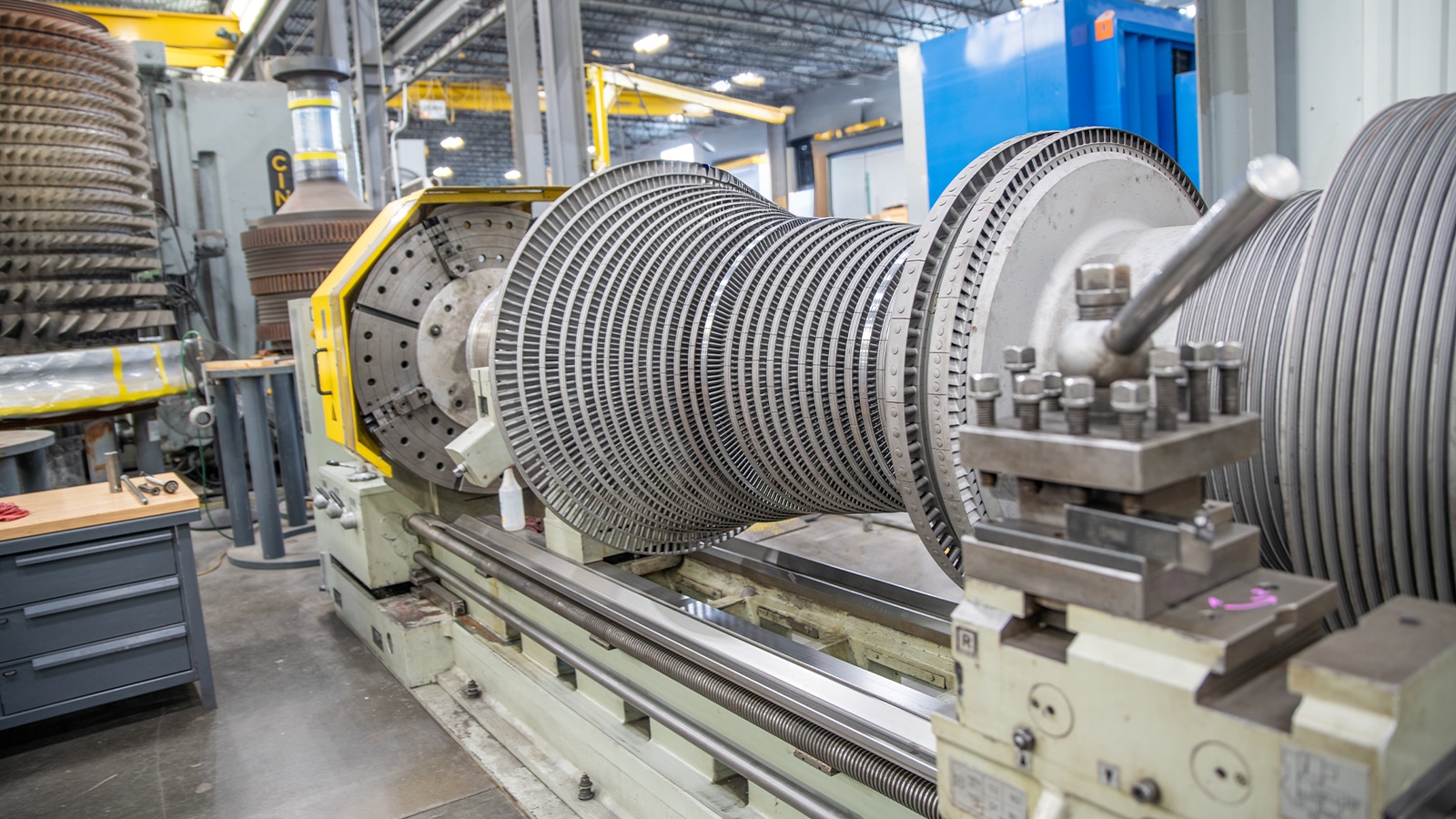
Numbers matter when it comes to your gas turbine’s lifespan. Most units last between 20 to 25 years before needing a major overhaul. Yet, the operating conditions significantly influence this timeline. A unit running continuously will age differently than one that cycles on and off.
Consider it like a car. Highway driving is easier on a vehicle than city traffic. Cyclic and peaking operations stress a full rotor assembly more, speeding up wear and increasing damage risk at critical points.
Newer generator components, like rotor retaining rings, need non-destructive testing before 30 years or 10,000 starts, whichever comes first. GE’s GEK 103566M document outlines specific testing recommendations your team should follow.
The repair process is straightforward:
- Initial inspection at a qualified repair facility
- Determine the scope of work based on findings
- Evaluate bids and get approval
- Complete refurbishment and restore components
- Final inspection and quality check
Several factors influence your refurbishment decision. Here’s a quick overview:
| Decision Factor | What It Tells You |
|---|---|
| Total Fired Hours | Cumulative thermal stress on components |
| Firing Temperature | Rate of material degradation and creep |
| Operational Mode | Baseload vs. cyclic fatigue impact |
| Future Service Needs | Life extension goals and planned output |
Proactive scheduling is key to minimizing downtime. Waiting for a breakdown is far more costly. Plan your maintenance intervals, track your hours, and stay ahead of the curve.
Why Allied Power Group Is Your Choice For Rotor Refurbishment
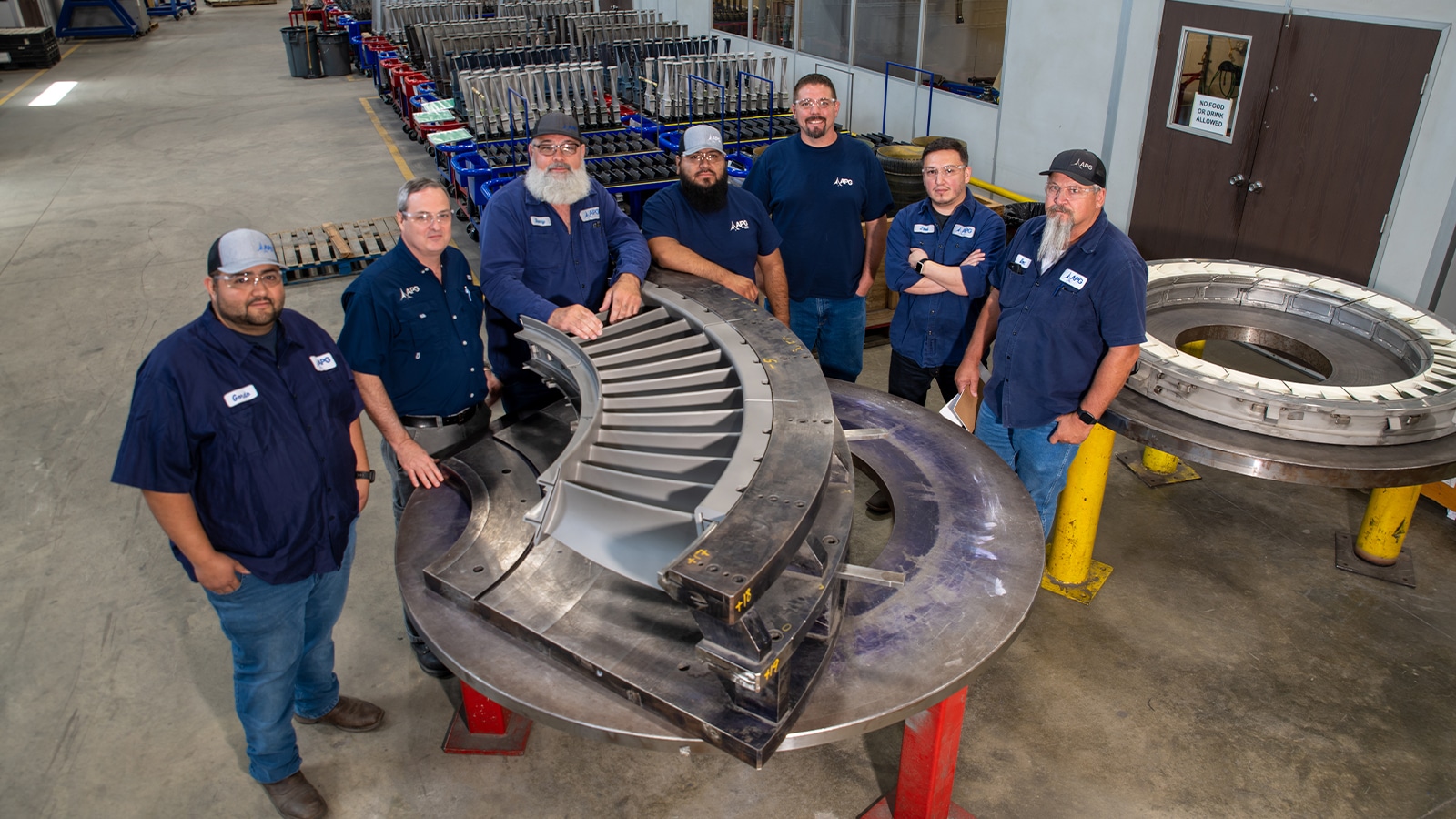
When your rotor shows signs of trouble, you need a team that gets it right the first time. Allied Power Group, based in Houston Texas, is a leader in Industrial Gas Turbine Repair. Our expertise in the power generation industry is unmatched.
What makes us stand out? We’ve developed repair specifications based on years of hands-on experience. Each turbine blade and rotor component undergoes a process perfected through real-world application, not speculation. Our team excels in inspecting, welding, coating, and restoring parts for GE frames and other major OEM platforms with unmatched precision.
Here’s a snapshot of our core capabilities:
- Laser and high-tech weld processes for material build-up and tip repair
- Vacuum heat treating with documented time-versus-temperature charts
- Plasma coating and computerized dimensional restoration
- Laser and EDM hole drilling for cooling passages
- Metallurgical evaluation to catch hidden material degradation
Quality is not just a buzzword at our facility. We conduct flow checks, pressure checks, and cooling hole blockage tests on every turbine blade. Blade moment weights and flow area measurements are verified against strict dimensional tolerances.
Documentation is thorough, too. Routing sheets detail each step. Inspection forms, repair procedures, and dimension records provide a complete audit trail. This ensures that when you inspect the final deliverables, you’ll understand exactly what was done and why.
If you’re in the power generation industry and need a power partner who treats your rotor components with care to extend the life, Allied Power Group in Houston Texas is the right choice.
Conclusion
Keeping your gas turbine rotor in top shape isn’t just about reacting to problems. It’s about staying ahead of them. Extreme temperatures, cyclic stress, and wear on nickel-based superalloy components all take a toll over time. The warning signs I’ve outlined in this article give you a clear roadmap for knowing when refurbishment is due. Early detection through advanced diagnostics and regular inspections saves you real money and keeps your operations running safely.
Strategic planning is your best friend here. Forecasting maintenance needs and aligning them with your budget means fewer surprises and smarter spending. When you maximize reliability through proactive care, you’re not just protecting a piece of equipment. You’re safeguarding a critical business asset that drives revenue every single day.
Choosing the right partner matters just as much as the maintenance itself. A facility like Allied Power Group, with documented quality systems and proven in-house capabilities, delivers the expert refurbishment services your rotor demands. The decisions you make today — about inspections, timing, and who handles your repairs — directly shape how your turbine performs tomorrow. So don’t wait for a failure to force your hand. Act now, plan smart, and keep that rotor spinning strong.