

Your Power Partner
When to Repair vs. Replace Major 7FA.04 Components: A Practical Guide for Plant Engineers
Every major outage on a GE 7FA.04 puts the same question on the table: repair it or replace it. It sounds straightforward until you’re standing in front of a set of first-stage buckets with an outage window closing, a six-figure replacement quote in hand, and a repair provider telling you they can return the components to service for a fraction of that cost.
The stakes are high enough — and the variables specific enough to the 7FA.04 — that guessing in either direction has consequences that follow the machine long after it comes back online. Repair too aggressively and you risk a component that fails before the next planned interval. Replace unnecessarily and you absorb costs that a qualified repair could have avoided.
This guide walks through the practical framework experienced plant engineers use to make defensible repair vs. replace decisions on major 7FA.04 components during hot gas path and major inspection outages.
Key Takeaways
- Repair is the cost-effective default for most 7FA.04 hot gas path components through multiple cycles — but only when supported by rigorous dimensional and coating inspection, not visual checks alone
- The differences between the 7FA.04 and earlier 7FA variants are concentrated in combustion and hot gas path parts; the turbine rotor comparison is largely equivalent, so rotor repair strategies carry over
- OEM repairability limits are typically more conservative than what qualified independent providers can achieve — certified third-party shops routinely extend component life beyond OEM thresholds with documented results
- Lead times for new 7FA.04 components have extended considerably; supply chain reality now belongs in the repair vs. replace analysis alongside lifecycle cost
- A structured repair process — dimensional inspection, weld repair, thermal barrier coating restoration, and dimensional restoration — can extend component life by thousands of equivalent operating hours when executed correctly
What Makes the 7FA.04 Different — and Why It Matters for Repair Decisions
The GE 7FA platform, including the widely deployed 7FA.04 variant, represents one of the largest installed bases of gas turbines in North American power generation. Combined-cycle plants operating 180-MW GE 7FA.04 gas turbines have accumulated decades of operating history, and that history now defines the repair challenge: many of these turbines are approaching critical lifecycle thresholds at exactly the moment power demand is surging.
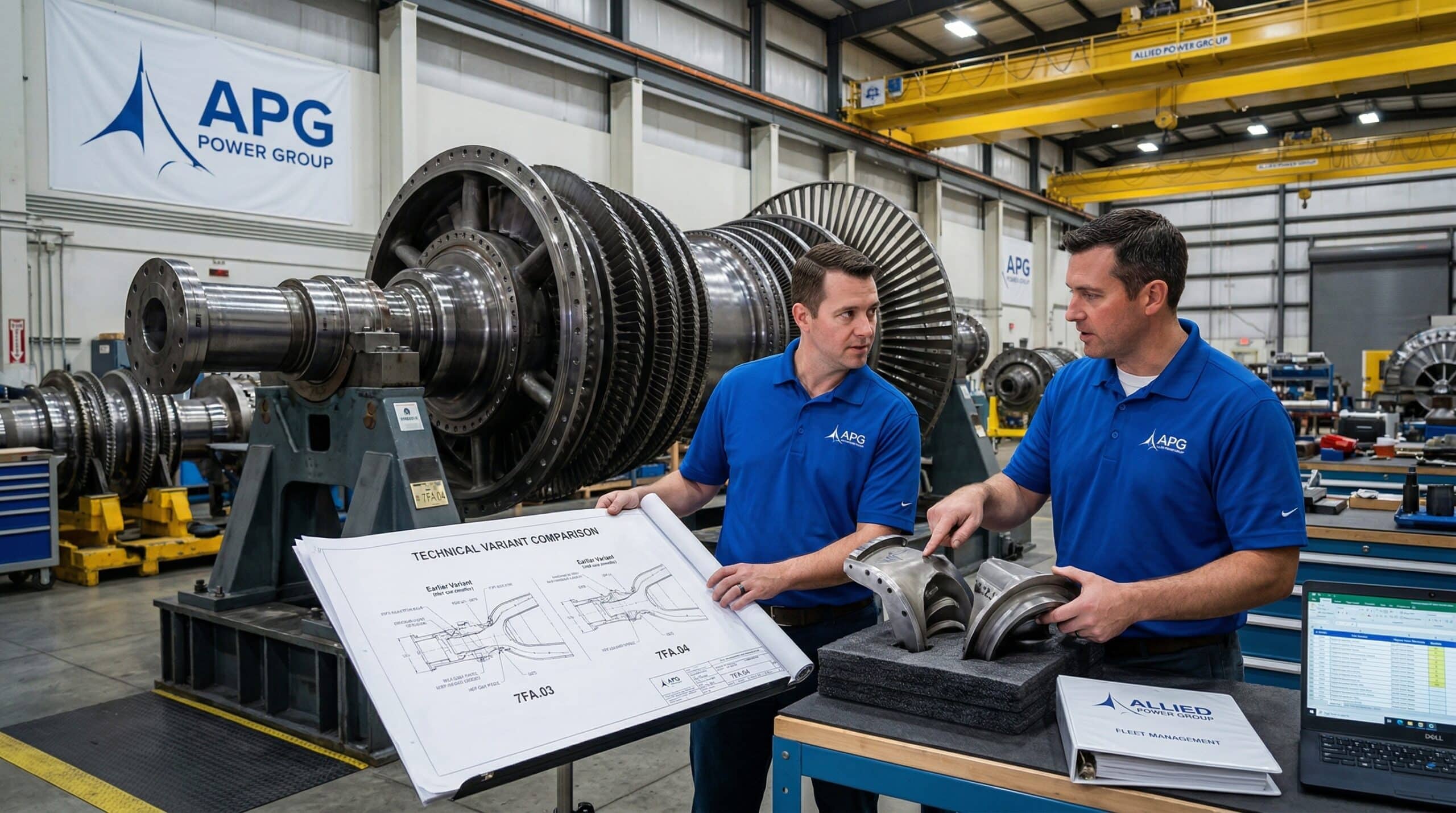
One clarification matters before any repair decision is made. There are no meaningful differences between the 7FA.03 and 7FA.04 turbine rotors — the distinction between these variants lies in the combustion and hot gas path components. Engineers moving from 9FA or earlier 7FA configurations will recognize much of the turbine rotor repair logic, but must verify that repair procedures and inspection criteria account for the specific combustion components and hot gas path configurations of the .04 variant. Component-level specifics differ enough that direct procedural transfer is not appropriate without validation.
7FA.04 vs. Earlier 7FA Variants: What Changes, What Doesn’t
Combustion components — specifically transition pieces, liners, and flow sleeves — see meaningful configuration differences between 7FA variants. These are the components where engineers must confirm they are working from applicable repair procedures before committing to a repair scope. The gas turbine rotor, turbine blades, and stage buckets carry over substantially across variants, which simplifies lifecycle planning for operators managing mixed-vintage fleets. For 9fa gas turbines in the same fleet, the repair logic is similar enough to serve as a reference framework, though component-specific validation still applies.
Inspection First: The Gate That Governs Every Repair Decision
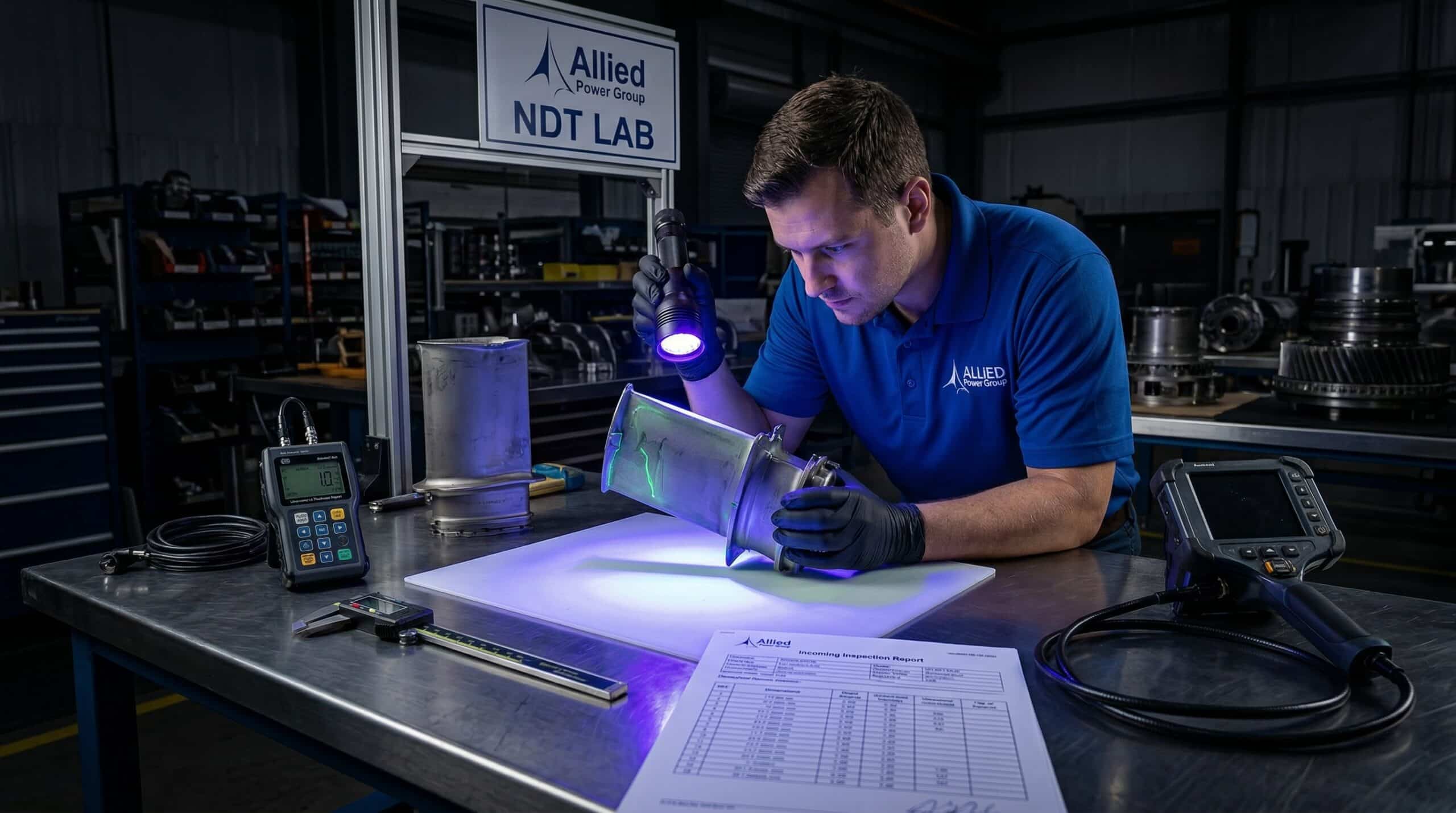
No repair vs. replace decision is defensible without a thorough inspection — and pricing pressures in the gas turbine services market have led some operators and providers to rely on visual inspection alone, which is simply not enough. Visual assessment misses wall thinning, subsurface cracking, and coating delamination — the conditions that actually determine whether a component can be returned to service safely.
Pre-repair inspection findings define both the technical viability and the economic viability of proceeding with repair. The approach that separates credible providers from transactional ones is an inspect-and-advise model: components are fully evaluated before repair scope is committed and priced, so the operator is making a decision based on actual incoming condition rather than assumptions. If you’re evaluating providers ahead of a scheduled outage and want to understand what a thorough incoming inspection looks like in practice, Allied Power Group’s engineering team is available at (281) 444-3535.
During a major inspection outage, the full hot gas path should be evaluated systematically. Each component category — buckets, nozzle segments, shrouds, transition pieces, liners, and vanes — requires its own inspection criteria. Outage schedules do not drive repair scope. Inspection findings do.
What a Credible Inspection Protocol Covers
A rigorous inspection protocol for 7FA.04 components includes dimensional measurement of airfoil wall thickness, blade tip condition, and shroud sealing geometry. It includes fluorescent penetrant inspection for crack detection in nozzles, vanes, and buckets. Thermal barrier coating integrity assessment — TBC spallation mapping and bond coat evaluation — is non-negotiable, as are mechanical dynamics checks relevant to rotating components. Providers that skip any of these steps are optimizing for speed, not for the operator’s lifecycle outcomes.
Component-by-Component: Repair vs. Replace Decision Framework
The decision logic differs meaningfully by component type. What makes a bucket a repair candidate does not necessarily make a nozzle one. Here is how the primary 7FA.04 hot gas path components break down.
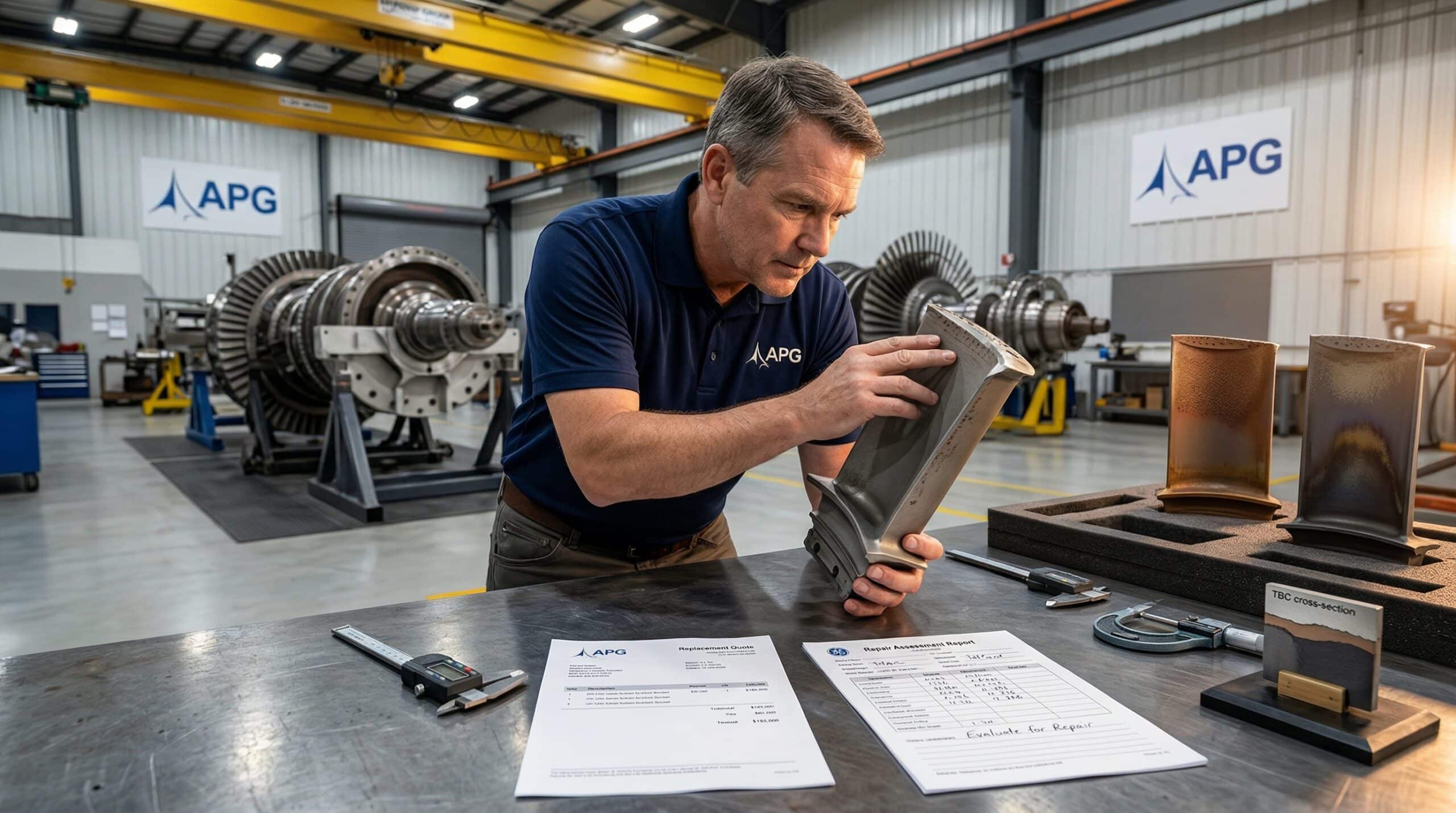
Stage 1 buckets sustain the highest combined thermal and mechanical load in the gas turbine. Common damage modes include blade tip erosion, tip shroud cracking, TBC spallation, and trailing edge oxidation. Weld repair, bucket tip restoration, and thermal barrier coating reapplication can recover most cases through multiple repair cycles. The 7FA.04 1st blade and stage buckets, including single-crystal variants, have a documented repair history — blade repair procedures have proven effective across the fleet, and repairs also exhibit excellent abrasion resistance in service. The replacement trigger is wall thinning that compromises base metal structural integrity, or tip shroud damage so extensive that dimensional restoration cannot recover sealing geometry. Changes in shroud design on the 7FA.04 make certain tip shroud damage modes more difficult to address than on earlier variants, and an honest provider will call for replacement rather than attempt a marginal repair.
Stage 2 and stage buckets operate at lower temperatures but accumulate creep deformation and platform burn over time. Repair candidacy is generally higher than for Stage 1, and coating restoration combined with blend repair addresses the majority of incoming damage conditions.
Nozzles present a specific repair challenge on the 7FA.04. The GTD-111 material used in these components is not easily weldable, which shapes the repair strategy fundamentally. Including weld repair as a nozzle repair technique requires material-specific procedures that not all providers have qualified. Braze repair is a lower-cost alternative, but it is not as durable — there are real service life benefits to weld repair over braze, and that tradeoff should be explicit in any repair scope discussion. Replacement is warranted when throat area distortion affects aerodynamic performance beyond the acceptable dimensional range.
Shrouds wear at sealing features and develop cracking under thermal cycling. Blend repair and dimensional restoration recover most shroud cases. Complete loss of sealing geometry — where the shroud can no longer be returned to dimensional specification — is a replacement trigger.
Combustion components — liners, transition pieces, and flow sleeves — crack and oxidize predictably over operating cycles. Most are candidates for repair through multiple service intervals, and replacement is warranted only when base metal loss exceeds repair limits or cracking has compromised the structural envelope.
Repair vs. Replace Decision Table
| Component | Common Damage Modes | Repair Viable When | Replace When | Typical Repair Cycles |
|---|---|---|---|---|
| Stage 1 Bucket | TBC spallation, blade tip erosion, tip shroud cracking | Wall thickness within limits; tip shroud geometry recoverable | Wall thinning exceeds limits; tip shroud total loss | 2–3 cycles |
| Stage 2/3 Bucket | Creep deformation, platform burn, coating loss | Airfoil profile within dimensional tolerance | Creep beyond aerodynamic limits | 3–4 cycles |
| Stage 1 Nozzle | Oxidation, hot corrosion, throat distortion | Throat area within flow tolerance; weld repair applicable | Throat distortion beyond aerodynamic limits | 2–3 cycles |
| Shroud | Sealing feature wear, thermal cracking | Sealing geometry recoverable by dimensional restoration | Complete loss of sealing geometry | 3–4 cycles |
| Transition Piece | Cracking, oxidation, distortion | Base metal within repair limits | Base metal loss exceeds limits | 3–5 cycles |
| Liner / Flow Sleeve | Cracking, oxidation, burn-through | Cracking within weld repair limits | Structural envelope compromised | 3–5 cycles |
Lifecycle Cost Logic: When Repair Economics Make the Decision for You
Repair almost always delivers a lower lifecycle cost than replacement — but the analysis has to be done honestly. Lifecycle cost must account for repair cost per cycle, the number of remaining repair cycles available to the component, replacement part cost, and current lead times. That last variable has changed the calculus in ways that weren’t true five years ago.
New 7FA.04 components now face extended procurement lead times. Forging houses that produce gas turbine components also serve aerospace and defense industries, and all are experiencing simultaneous demand surges — resulting in longer and less predictable lead times for replacement hardware. A component that might have been replaced in a prior outage cycle may now be a repair candidate simply because replacement hardware cannot be sourced within the outage window. Planning 12 to 18 months ahead preserves all options and is the most effective tool operators have for reducing operating costs over the turbine’s remaining service life. The goal is to reduce lifecycle costs without sacrificing reliability — and a qualified repair executed to the correct specification is the most defensible path when inspection supports it.
OEM Limits vs. Independent Repair Capabilities
OEM repairability limits represent a conservative baseline, not a ceiling. Qualified independent providers with dedicated engineering expertise and advanced repair capabilities — including weld repair, thermal barrier coating application, and dimensional restoration — routinely achieve life extension outcomes beyond OEM thresholds. This is about applying current repair techniques to components the OEM has deprioritized in favor of newer platforms. The 7FH2 generator and associated mechanical dynamics considerations are part of this picture as well — a complete asset assessment at major inspection should address generator health alongside hot gas path repair decisions. Allied Power Group integrates MD&A’s mechanical dynamics expertise directly within its service scope, so operators aren’t coordinating two separate providers for what is fundamentally one assessment.
What a Rigorous Repair Process Looks Like
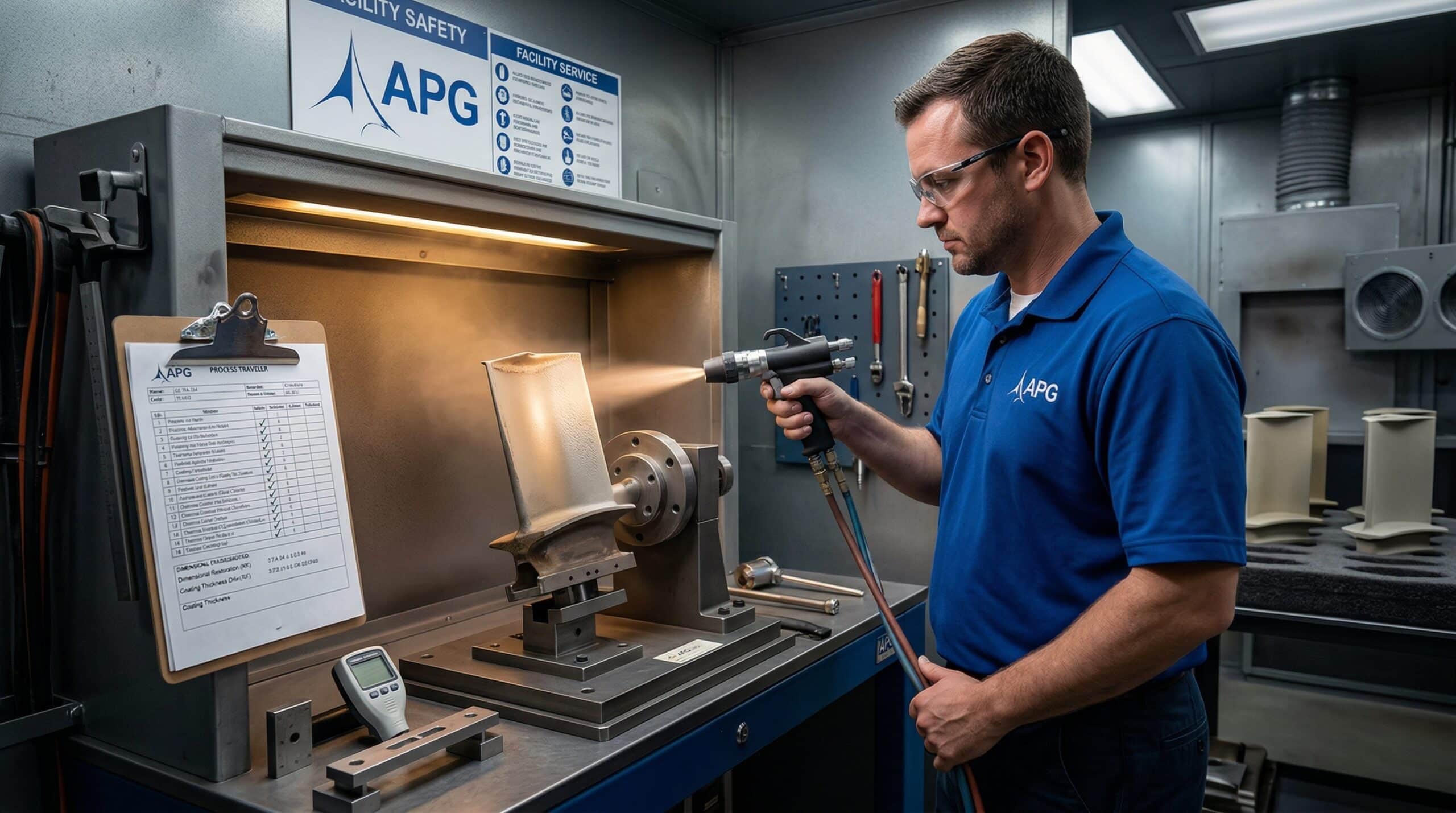
Gas turbine component repair at a qualified provider follows a defined sequence: receive and inspect, dimensional measurement and documentation, coating strip, base metal repair including weld repair where applicable, dimensional restoration, thermal barrier coating application, final inspection, and documentation package. A repair process designed for stage buckets differs from the one applied to nozzles or shrouds — component-specific repair procedures are not optional.
AGP gas turbine component repairs span the full 7FA hot gas path — including 7FA.04 first-stage buckets in single-crystal configuration — as well as combustion components, with documented repair procedures and field performance history across the platform. Since 2005, Allied Power Group has been developing and refining repair solutions for GE 7F and related assets, with a track record of zero failures across more than 1,500 repaired part sets. That combination of repair and life extension experience, applied to an inspect-and-advise model, is what gas turbine component repair at this level of precision actually requires.
Engineers evaluating a repair provider should ask pointed questions: Does the provider perform their own dimensional inspection and issue a written report before quoting scope? Can they document repair scopes and cycle history for 7FA.04 stage buckets specifically? Is thermal barrier coating applied in-house or subcontracted? Do their repair procedures address mechanical dynamics and turbine rotor balance considerations? These are not administrative questions — they determine whether the provider can deliver what a 7FA.04 operator actually needs to extend component life with confidence.
Making the Call: A Decision Framework for Your Next Outage
Start with inspection findings. Apply component-specific repairability thresholds. Layer in lifecycle cost and lead time realities. Then select the path that minimizes lifecycle cost without sacrificing reliability. For most 7FA.04 operators approaching a hot gas path or major inspection outage, the majority of components will be repair candidates — replacement is the exception, triggered by specific inspectable conditions, not by age or outage count alone.
Operators who plan ahead, engage repair providers early, and use a structured inspect-and-advise process consistently spend less per fired hour over the turbine’s remaining service life than those making reactive decisions at the outage. The goal is not to find the cheapest option. It is to find the most defensible one.
Conclusion
For most 7FA.04 operators, the right answer at the next outage is repair — not because it is cheaper, but because inspection-driven repair executed by a qualified provider is the most defensible path available. That principle holds across buckets, nozzles, shrouds, transition pieces, liners, and vanes, provided repair decisions are grounded in rigorous inspection findings and executed by providers with genuine repair capabilities and documented field performance data. Replacement is appropriate when specific, measurable conditions require it — not before.
Allied Power Group works with 7FA.04 operators at every stage of that decision: evaluating incoming component condition, developing repair scope before the outage clock is running, and executing repairs with documented procedures across a platform they have been servicing since 2005. Gas turbine services at this level demand both engineering expertise and accountability — Allied Power Group offers comprehensive repairs with a track record that reflects both. If a scheduled outage is on the horizon, reach the Allied Power Group team at (281) 444-3535 to assess your repair strategies and component condition before the timeline forces your hand.
FAQ
How many times can a 7FA.04 first-stage bucket be repaired before it must be replaced?
Most 7FA.04 stage 1 buckets can complete two to three repair cycles when inspected and repaired to proper standards. The limiting factor is base metal condition — specifically wall thinning and structural integrity of the airfoil. A qualified provider tracking dimensional data across outages can identify remaining repair life accurately. OEM limits are typically conservative; experienced independent providers with advanced repair capabilities routinely extend component life beyond those thresholds when inspection data supports it.
What is the difference between a hot gas path inspection and a major inspection for 7FA.04 turbines?
A hot gas path inspection focuses on combustion and hot gas path components — buckets, nozzles, transition pieces, liners, vanes, and shrouds — and typically occurs at roughly half the interval of a major inspection. A major inspection includes all of that scope plus a full turbine rotor inspection and cold section assessment. Repair vs. replace decisions are made at both intervals, but the major inspection is where turbine rotor lifecycle planning and rotor life extension decisions become critical.
Are OEM repair limits the right benchmark for 7FA.04 component repairability?
OEM repairability limits are a useful starting point but are generally more conservative than what qualified independent providers can achieve. Third-party shops with dedicated engineering expertise and advanced repair techniques — including weld repair, thermal barrier coating application, and dimensional restoration — often extend component life beyond OEM thresholds while maintaining or improving reliability. Any repair beyond OEM limits should be backed by engineering analysis and documented field performance history.
How do lead times affect the repair vs. replace decision for 7FA.04 components?
Lead times for new 7FA.04 components have extended materially as supply chains tighten. A component that would have been replaced in a prior outage cycle may now be a repair candidate because replacement hardware cannot be sourced within the outage window. Operators should factor current lead times into their repair vs. replace analysis and engage repair providers at least 12 to 18 months before a scheduled outage to preserve all options and avoid forced decisions.
What damage modes on 7FA.04 nozzles make repair impractical?
Most 7FA.04 nozzle damage — including oxidation, hot corrosion, and minor distortion — is repairable. The condition that moves a nozzle toward replacement is throat area distortion that cannot be corrected without compromising aerodynamic performance. Material constraints on the 7FA.04 nozzle also shape the repair approach: GTD-111 is not easily weldable, so repair procedures must be specifically qualified for this alloy. Providers without those qualified procedures should not be trusted to inspect or repair these components.