

Your Power Partner
Advanced Coatings for GE 7FA Blades: The Complete Technical Guide
The coating systems protecting 7FA blades from destruction are more engineered than most plant engineers encounter in a single career — and when they fail, the consequences land fast. The multilayer system these machines depend on consists of an MCrAlY bond coat applied via HVOF or atmospheric plasma spray, a yttria-stabilized zirconia thermal barrier coating applied by APS or EB-PVD, and an oxidation-resistant diffusion aluminide base layer. If you are managing GE 7FA blade coating repair decisions and want to understand how those choices connect to heat rate improvements, this guide covers the complete coating stack, stage-by-stage failure modes, inspection intervals, and how qualified non-OEM specialists deliver results that meet or exceed OEM standards.
What advanced coatings are used on GE 7FA turbine blades? GE 7FA blades use a multilayer coating system including an MCrAlY bond coat applied via HVOF or APS, a yttria-stabilized zirconia (YSZ) thermal barrier coating (TBC) applied by APS or EB-PVD, and oxidation-resistant aluminide diffusion coatings — with first-stage buckets requiring the heaviest TBC load due to gas path temperatures exceeding 2,400°F.
Key Takeaways
- GE 7FA first-stage buckets require the thickest TBC application in the hot gas path because they operate at the highest thermal gradient of any stage in the machine, making bond coat integrity the single most important predictor of coating lifespan.
- The GTD-111 DS and GTD-444 base alloys used across the 7FA stage sequence respond differently to thermal cycling, and coating system selection must account for those substrate differences.
- TBC spallation driven by thermally grown oxide accumulation at the bond coat interface is the leading coating failure mode in aging 7FA fleets, and borescope access can detect it before it becomes a hardware loss event.
- The hot gas path inspection interval of approximately 24,000 equivalent operating hours is the primary scheduling trigger for recoating decisions, though high-cycle peaking units will reach the start-based trigger first.
- Nadcap-accredited third-party coating shops equipped with documented processes and qualified engineers can match and in many cases exceed OEM coating performance on 7FA turbine components.
Why Do GE 7FA Turbine Blades Demand Specialized Coatings?
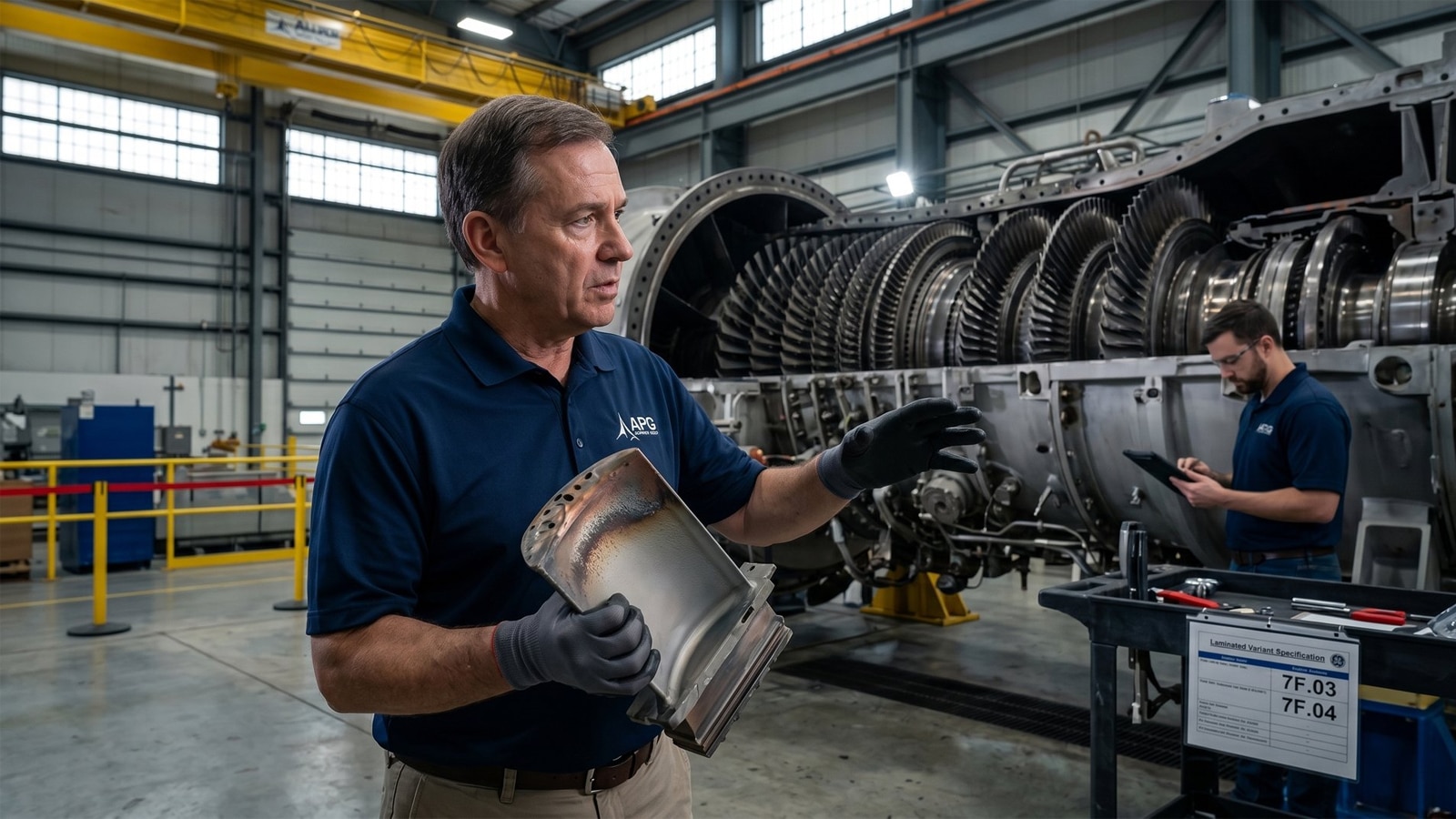
The GE Frame 7FA is one of the most widely deployed gas turbines in the North American combined-cycle fleet. The 7F.03 and 7F.04 variants represent the dominant installed base from the late 1990s through the mid-2000s buildout, and both operate at firing temperatures that exceed what nickel-base superalloys can sustain without a high-performance coating stack. The 7F.04 introduced combustion and aerodynamic refinements that shifted thermal loading on Stage 1 and Stage 2 buckets relative to the 7F.03 — which means coating specifications developed for one variant do not automatically apply to the other.
Substrate materials add another layer of complexity. Stage 1 and Stage 2 buckets are cast from GTD-111 DS, a directionally solidified alloy with strong creep resistance but specific oxidation characteristics that govern how well coatings adhere through thermal cycling. Some upgrade configurations use GTD-444, a single-crystal alloy with different thermal expansion behavior that affects TBC strain tolerance requirements. Applying a generic coating recipe uniformly across all stages is not a viable approach — variant-specific process documentation is one of the first things engineers should verify when evaluating any coating shop.
Urgency around these decisions has grown. Aging fleets are cycling more aggressively as grid operators respond to surging electricity demand, compressing the interval between coating stress events. Units that once ran at baseload are now starting and stopping multiple times per week in ERCOT and PJM markets. Each start cycle introduces a thermal transient that stresses the coating stack in ways steady-state operation does not. For plant engineers managing these machines, coating decisions have moved from long-horizon planning to immediate operational priority.
What Does the 7FA Coating Stack Actually Consist Of?
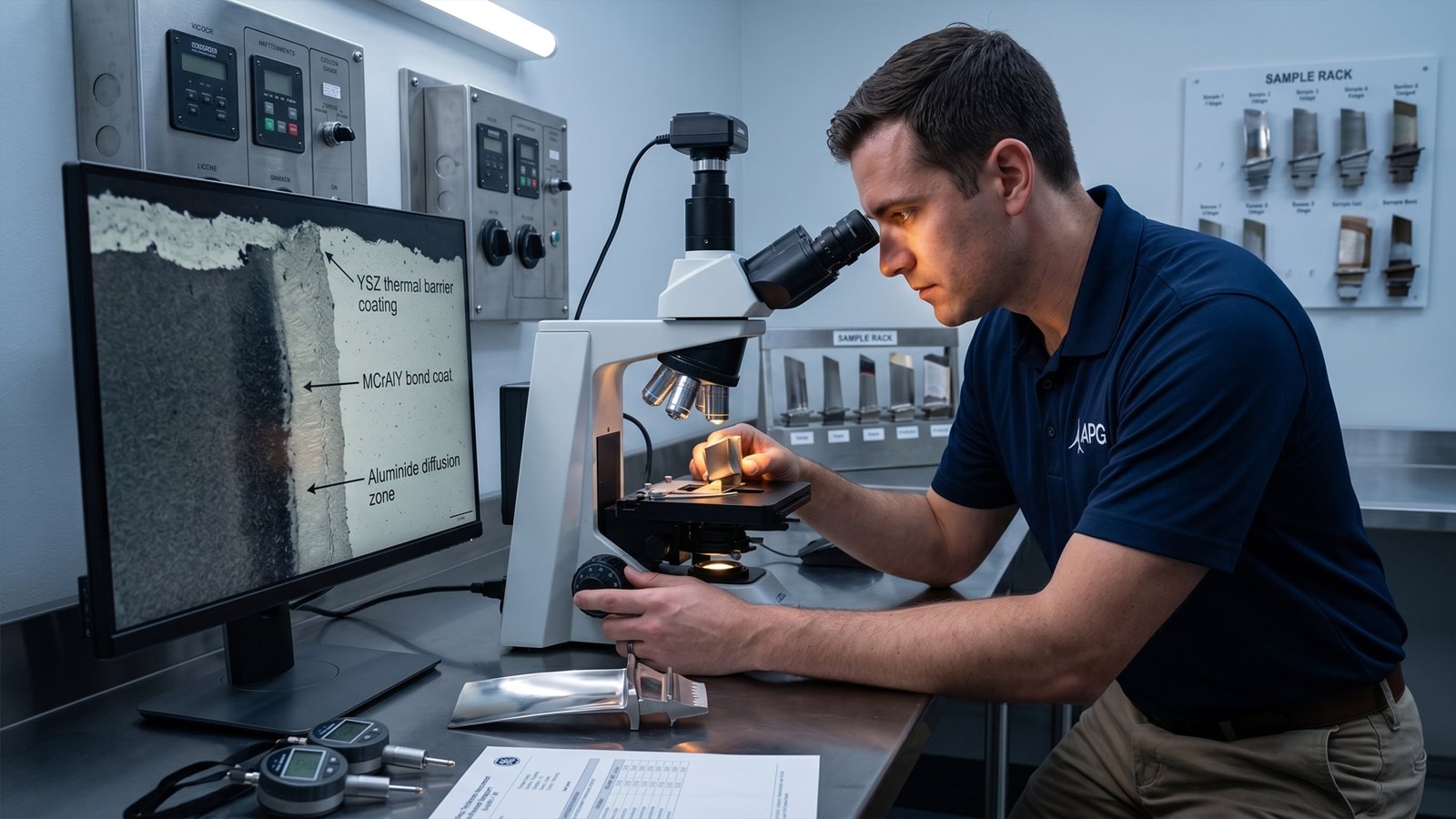
The 7FA coating system is a sequenced set of interdependent layers. Each performs a distinct function, and failure in one accelerates degradation of the layers adjacent to it.
How Do Diffusion Aluminide Coatings Protect 7FA Blades?
Diffusion aluminide coatings are applied across all three turbine blade stages on the 7FA and serve as the oxidation foundation of the entire stack. The process diffuses aluminum into the nickel-base superalloy substrate, forming a NiAl intermetallic layer that grows a protective alumina scale during high-temperature operation. That alumina scale resists further oxidation of the base alloy beneath it at gas turbine firing temperatures. These coatings matter most on internal cooling passage surfaces and at the leading edge of Stage 1 buckets, where TBC thickness constraints limit full ceramic coverage. On Stage 2 and Stage 3 blades operating at lower gas path temperatures, platinum aluminide variants extend coating life without requiring a full thermal barrier coating stack. Both chemical vapor deposition and pack cementation produce a metallurgically bonded layer rather than a mechanically adhered one — a meaningful distinction for durability under high thermal stress.
Why Does the MCrAlY Bond Coat Predict TBC Life?
The MCrAlY bond coat determines how long the thermal barrier coating above it will survive. It performs two simultaneous functions: providing oxidation resistance at the substrate interface and creating a mechanically compatible surface to which the TBC ceramic layer adheres during thermal cycling. HVOF thermal spray is the preferred application method for bond coats on first-stage buckets. The high-velocity oxygen fuel process produces a denser, lower-porosity deposit with higher bond strength than APS achieves. On Stage 1 hardware where thermal cycling is most severe, that density difference matters. APS bond coat application is appropriate for lower-stage turbine components where temperature gradients and cycling frequency are reduced.
During operation, the bond coat oxidizes gradually, forming a thermally grown oxide layer at the bond coat and YSZ interface. The TGO grows steadily throughout the component’s service life. When its thickness exceeds approximately 5 to 7 microns, elastic mismatch between the TGO and surrounding materials generates shear stresses during thermal cycling that delaminate the TBC. Bond coat thickness on 7FA Stage 1 buckets typically falls between 100 and 200 microns depending on the coating specification. The table below compares HVOF and APS bond coat characteristics for 7FA stage application decisions.
| Characteristic | HVOF Bond Coat | APS Bond Coat |
|---|---|---|
| Porosity Level | 1–2% (low) | 5–10% (moderate) |
| Bond Strength | High (70+ MPa) | Moderate (35–55 MPa) |
| Preferred Stage Application | Stage 1 and Stage 2 | Stage 2 and Stage 3 |
| TBC Lifespan Supported | Extended | Standard |
What Role Do Thermal Barrier Coatings Play in 7F Gas Turbine Blade Protection?
The thermal barrier coating layer is what allows the 7FA to operate at firing temperatures that far exceed what base alloy materials can survive unprotected. Ceramic TBCs reduce metal surface temperatures by approximately 100 to 150°C under rated conditions and can nearly double turbine blade lifespan by keeping metal temperatures within the alloy’s safe operating range. Over four decades of gas turbine development, turbine inlet temperatures increased by roughly 500°C while base alloy temperature capability improved by only about 220°C. The remaining gap was closed almost entirely by advances in thermal barrier coating science and internal cooling design — a fact that puts TBC condition at the center of every hot gas path maintenance decision.
What Type of Thermal Barrier Coating Is Used on GE 7FA First-Stage Buckets?
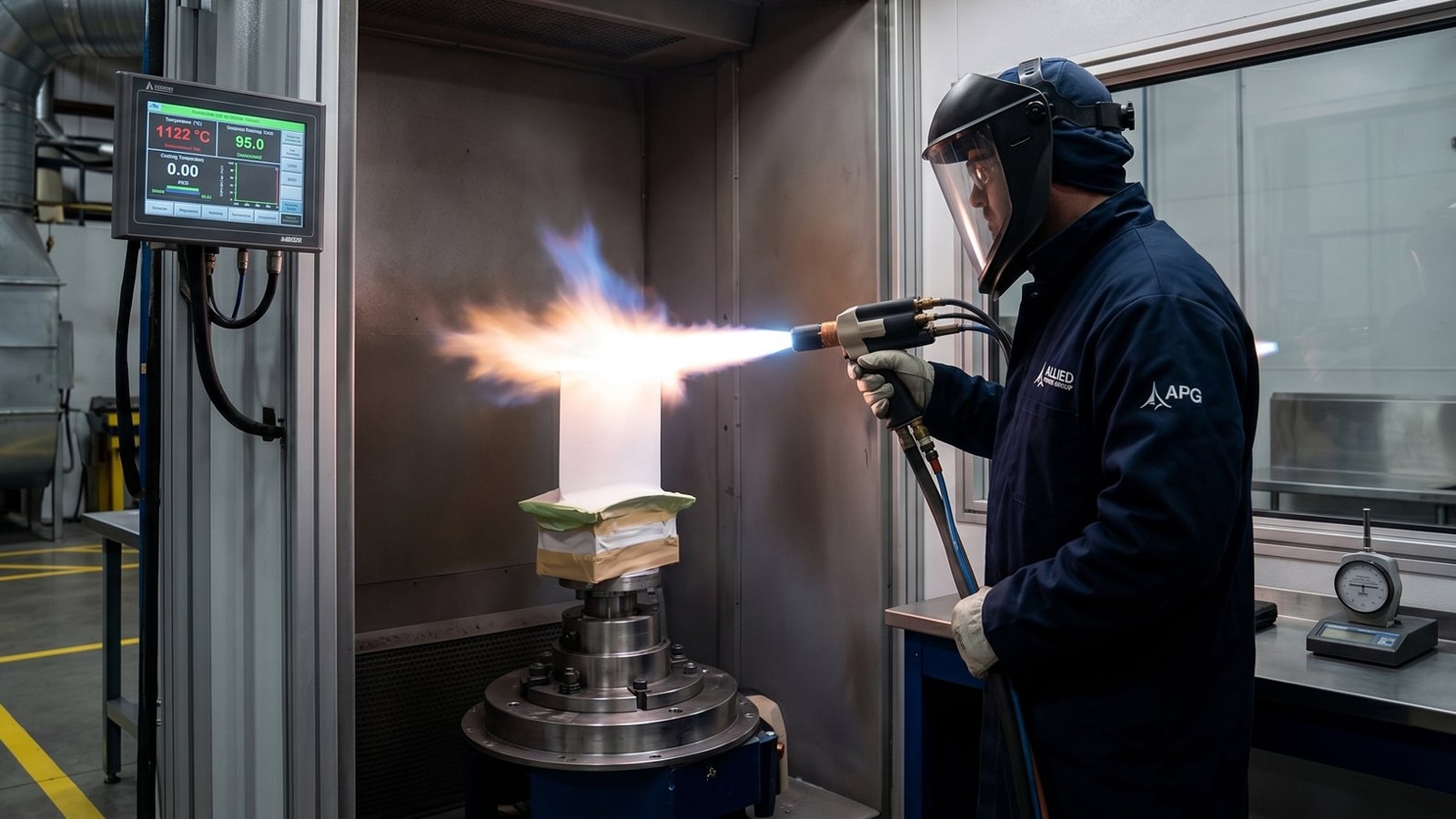
GE 7FA first-stage buckets receive yttria-stabilized zirconia TBC, a ceramic coating selected because its thermal conductivity of approximately 2.0 to 2.5 W/m·K creates a substantial temperature drop across the coating layer while remaining phase-stable through the thermal cycles these components experience. The YSZ composition is typically 7 to 8 weight percent yttria in a zirconia matrix, which stabilizes the tetragonal crystal phase that gives the coating its strain tolerance. Most production and repair applications use APS to deposit the TBC topcoat. EB-PVD is reserved for applications where superior aerodynamic surface quality or enhanced strain tolerance justifies the higher process cost, particularly on leading edge geometries of Stage 1 buckets in high-cycle duty.
APS produces a lamellar microstructure — particles stacked in thin splats — that increases thermal insulation but reduces strain tolerance. EB-PVD produces a columnar microstructure where individual crystals can flex slightly during thermal expansion, improving resistance to spallation under cyclic loading. EB-PVD coatings are also smoother, which affects turbine efficiency and fuel consumption on leading edge and pressure surface geometries. The choice between thermal spray processes for a given repair cycle depends on the stage, remaining component life, duty profile, and outage budget — not a universal prescription. Engineers at Allied Power Group evaluate all of those factors before recommending a coating path.
How Do Abradable Coatings Protect the Rotor-Stator Interface on the 7FA?
Abradable coatings are applied to shroud blocks and stator seal surfaces — not to rotating blades directly — and function by permitting controlled, sacrificial abrasion when blade tips contact the shroud during thermal transients. The design intent is clearance optimization. If the shroud surface were a hard material, blade tip contact would cause catastrophic damage to the blade or rotor. An abradable coating surface wears away in a controlled manner, allowing the blade tip to establish a tight clearance profile without damaging itself. That tighter gap directly reduces hot gas bypass around blade tips. Proper clearance control through abradable coatings can improve turbine stage efficiency by 0.5 to 1.0 percentage points — a meaningful number for operational efficiency at the scale of a 7FA combined-cycle plant.
On the 7FA, abradable coatings are typically based on MCrAlY matrices with incorporated porosity agents such as polyester particles that burn out during thermal spray processes, leaving a soft, friable surface capable of controlled abrasion. During outage inspections, engineers should examine abradable coating surfaces for glazing from hard deposit accumulation, erosion channels that eliminate the sacrificial layer, or areas where the abradable material has worn through to the substrate. Any of those conditions should trigger a recoating decision as part of the hot gas path maintenance cycle. Optimization of clearances through well-maintained abradable coatings is one of the more cost-effective ways to maintain turbine performance between major overhauls.
What Are Environmental Barrier Coatings and How Do They Apply to 7FA Upgrades?
Environmental barrier coatings protect turbine components from chemical attack by combustion gases — specifically, high-temperature water vapor that reacts with silicon carbide and silicon nitride ceramics to form volatile silica species that erode the surface. This mechanism is most relevant for turbine components incorporating ceramic matrix composite advanced materials, which are beginning to appear in upgrade configurations for F-class machines. For the existing installed base of 7FA units operating on metallic superalloy blades, environmental barrier coatings are not part of the standard coating system. However, as gas turbine upgrades increasingly incorporate CMC shroud segments and advanced airfoil configurations, EBC compatibility becomes a specification requirement engineers need to understand. Distinguishing thermal and environmental protection coatings is increasingly relevant to fleet lifecycle planning as CMC adoption in land-based power generation accelerates, and it positions operators to evaluate upgrade proposals on technical merit.

What Coating Failures Should 7F Gas Turbine Engineers Watch For?
Coating failures rarely arrive without warning. The challenge is knowing what to look for during borescope access. Each failure mode has a distinct visual signature and a different urgency level for the repair decision.
TBC spallation from thermally grown oxide growth is the most common and consequential failure in aging 7FA hot gas path components. As the bond coat oxidizes during normal operating conditions, TGO accumulates at the bond coat and YSZ interface. In thin form it is expected and benign. When TGO thickness approaches 5 to 7 microns, shear stresses generated during thermal cycling exceed TBC adhesion strength and spallation follows. Borescope signals include visible discoloration on bucket pressure surfaces, patches of exposed metallic bond coat, and bright oxidation halos at spall edges. When spallation is confirmed on Stage 1 hardware, the correct repair path is a full strip and recoat sequence: chemical or mechanical strip, fluorescent penetrant inspection per ASTM E1417 to assess substrate condition, HVOF bond coat, and YSZ TBC reapplication to drawing thickness. Patch repair of spalled TBC on Stage 1 buckets is not advisable — the TBC adjacent to any spall is typically in a compromised adhesion state that will produce additional spallation during the next operating cycle.
Oxidation breakthrough at the leading edge is the highest-urgency failure mode. The leading edge of a Stage 1 bucket faces the highest local heat flux in the hot gas path, making it the most vulnerable location when diffusion aluminide coating reserves are depleted. Visual indicators include a matte or roughened surface texture, localized color changes from gray-green to dark oxide brown, and in advanced cases, pitting or surface recession where base alloy oxidation has begun. This is a hardware loss event in progress and does not self-correct between outages. Full strip, fluorescent penetrant inspection, alloy condition assessment, and qualified recoat by a Nadcap-accredited shop with documented 7FA-specific processes are required.
Erosion from particulate ingestion affects Stage 1 buckets in peaking units that start and stop frequently. Fine particulate matter physically removes TBC material at the leading edge and blade tip, thinning thermal protection and exposing bond coat or base alloy. Inlet filter condition monitoring directly affects erosion rates on 7FA buckets and should be part of the inspection and maintenance review at every outage.
Best Practices for 7FA Blade Coating Inspection and Maintenance
Scheduling inspection against the standard hot gas path interval of approximately 24,000 equivalent operating hours or 900 starts — whichever comes first — is the baseline. Peaking units with high start frequency will typically reach the start-based trigger first, and maintenance costs associated with unplanned outages caused by coating failures consistently exceed the cost of a timely scheduled inspection. Engineers should document borescope findings at every inspection using consistent image capture protocols that allow condition trending across multiple outages. Trending matters more than any single inspection result because coating degradation is gradual and the rate of change between inspections is often more informative than the absolute condition at any one point.
For aging fleets operating beyond original design cycle counts, proactive recoating decisions based on trending data produce better outcomes than running to a defined limit. A qualified coating engineer reviewing imagery from three consecutive outages can often identify a TBC condition trajectory that justifies accelerating the recoat decision by one interval — avoiding the unscheduled outage that would otherwise follow. Allied Power Group engineers have supported 7FA, 7EA, and Siemens-Westinghouse frame units with exactly this kind of fleet-level analysis. If your next outage is approaching and you want a technical assessment before the scope is locked, reach out at (281) 444-3535.
Gas Turbine Upgrades: How Advanced Coatings Extend 7FA Lifecycle
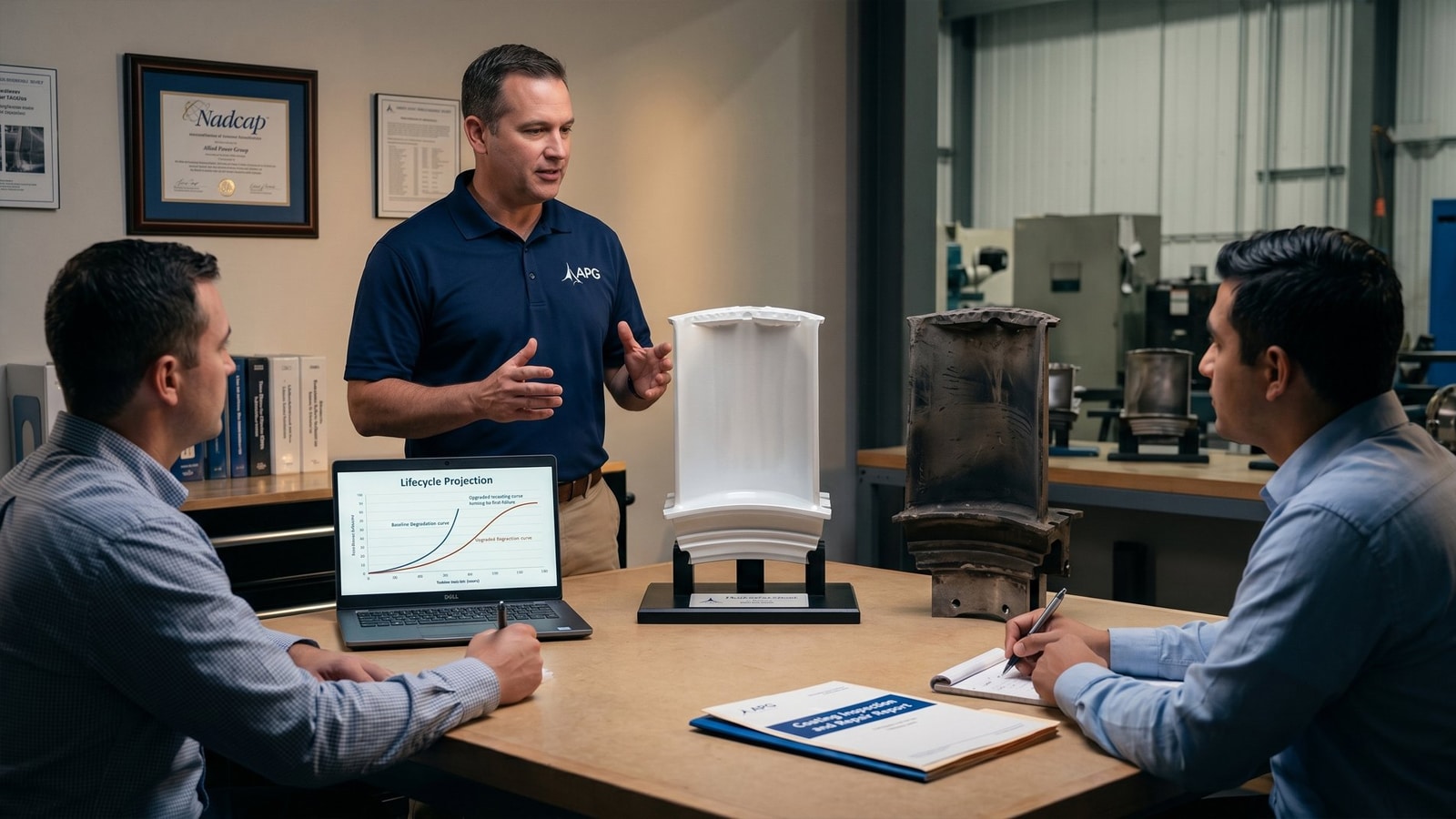
Advanced coatings are not only a maintenance tool — they are an upgrade pathway. Abradable TBC shroud blocks with optimized clearance profiles, next-generation low-conductivity YSZ formulations with rare-earth oxide additions, and CMAS-resistant TBC chemistries for units in high-dust environments all extend the lifecycle of existing 7FA hardware beyond what original coating specifications contemplated. In 2024, a TBC Rainbow Test conducted at Dominion’s facility evaluated conventional YSZ and advanced rare-earth stabilized TBCs on GE 7F.03 first-stage buckets, with participants including Allied Power Group alongside Honeywell, Liburdi, PSM, Cincinnati Thermal Spray, Doosan, MD&A, and Sulzer — a real-world comparative evaluation of coating performance across qualified suppliers. That kind of industry-level testing is how the turbine technology field validates non-OEM coating capability, and Allied Power Group’s participation reflects the company’s standing in that field.
For fleet decision-makers evaluating whether to renew OEM coating agreements or qualify independent alternatives, the practical answer is that non-OEM specialists with Nadcap accreditation, documented 7FA-specific processes, and demonstrated industry participation can deliver coating performance that matches or exceeds OEM output — without the LTSA lock-in that limits flexibility when operating conditions change. As your power partner, Allied Power Group brings that independent capability directly to your fleet planning conversation. Contact us online or call (281) 444-3535 to schedule a technical review of your 7FA coating program.
Conclusion
GE 7FA turbine blades operate in one of the most thermally demanding environments in land-based power generation. The multilayer coating system that keeps them running — diffusion aluminide, MCrAlY bond coat, and YSZ thermal barrier coating — requires platform-specific knowledge to specify, apply, and maintain correctly. Coating decisions made with that specificity extend component lifespan, support turbine efficiency, reduce maintenance costs, and protect against the unscheduled outages that carry the real financial consequences. Allied Power Group’s engineers are ready to support that work across every stage of the 7FA coating lifecycle.
FAQ
What causes TBC spallation on GE 7FA blades?
TBC spallation on 7FA blades is primarily caused by thermally grown oxide accumulation at the MCrAlY bond coat and YSZ interface. As TGO thickness approaches 5 to 7 microns during normal operation, the elastic mismatch between layers generates shear stresses during thermal cycling that exceed TBC adhesion strength and cause the ceramic topcoat to delaminate.
How often should GE 7FA blade coatings be inspected?
The standard hot gas path inspection interval for the GE Frame 7FA is approximately 24,000 equivalent operating hours or 900 starts, whichever is reached first. Peaking units with high start frequency typically reach the start-based trigger before the hour-based limit. Borescope inspection at each scheduled outage is the baseline, with condition trending across outages informing recoat timing decisions.
Can non-OEM coating shops match GE OEM coating quality on 7FA blades?
Yes. Nadcap-accredited non-OEM coating shops with documented 7FA-specific processes and qualified engineers can match and in many cases exceed OEM coating performance. Allied Power Group participated alongside OEM-aligned suppliers in the 2024 TBC Rainbow Test on GE 7F.03 first-stage buckets, demonstrating independently verified coating capability.
What is HVOF and why is it used on 7FA bond coats?
HVOF — High-Velocity Oxygen Fuel — is a thermal spray process that accelerates coating particles to velocities that produce a dense, low-porosity bond coat deposit with high bond strength. On 7FA Stage 1 buckets where thermal cycling is most severe, HVOF bond coats outperform APS bond coats in adhesion life and TBC support — which is why HVOF is the preferred process for first-stage hardware.
What is the difference between APS and EB-PVD TBC on gas turbine blades?
APS produces a lamellar microstructure with higher porosity and better thermal insulation but lower strain tolerance. EB-PVD produces a columnar microstructure with individual crystal columns that flex during thermal cycling, improving resistance to spallation and delivering a smoother aerodynamic surface. APS is the dominant method in repair cycles due to lower cost and broader shop availability. EB-PVD is used on leading edge and high-cycle applications where its strain tolerance advantages justify the additional cost.