

Your Power Partner
Pre-Outage Planning for DLN 2.6+ Combustion Systems: What to Do Before the Crew Arrives
A DLN 2.6+ combustion outage that goes sideways rarely fails during execution. It fails during the planning cycle that happened six to twelve months earlier — when parts didn’t get ordered, dynamics data sat unreviewed, and the post-outage tuning plan was left as a conversation for another day. By the time the crew arrives, the decisions that determine whether the turbine returns to full load in emissions compliance have already been made, or defaulted.
For operators running GE 7FA gas turbines with DLN 2.6+ combustion systems, that pattern has a well-documented outcome: a turbine returns from a scheduled outage with NOx above permit limits, combustion dynamics that won’t settle, and an emergency call to whoever picks up the phone. This article is the planning framework designed to prevent that.
Key Takeaways
- Capital parts lead times for DLN 2.6+ components — including combustion liners, transition pieces, and fuel nozzle assemblies — commonly reach 12 months or more, making early procurement the single most avoidable planning failure on GE F-class outages.
- Combustion dynamics monitoring data reviewed and annotated before the outage window opens gives the repair team a diagnostic head start, reduces time-on-tools, and eliminates guesswork in scope definition.
- Effusion plate cracking and center fuel nozzle tip cracking are documented failure modes on 7F DLN 2.6+ systems — verifying your repair team’s specific experience with these issues before the outage begins is not optional.
- Upgrade decisions, including axial fuel staging integration, must be evaluated and committed well before the outage starts — mid-outage scope changes are expensive and rarely executed well under schedule pressure.
- Post-outage DLN tuning requires advance planning across all active combustion modes and is not a commissioning afterthought — the quality of pre-outage data directly determines first-fire success.
What Is the GE DLN 2.6+ Combustion System?
GE introduced the DLN 2.6+ combustion system in 2015 for new and existing 7F gas turbines. It is a dry low NOx premixed combustion architecture designed to achieve single-digit NOx performance — targets in the 9 ppm range — across operating modes including 6.2A, 3.3, 3.1, and MECL 6.2A. Unlike earlier configurations, the DLN 2.6+ injects fuel through multiple manifolds, and emissions performance depends directly on maintaining precise fuel split balance between those nozzles throughout each mode.
That sensitivity is what makes this system demanding to maintain. Even moderate degradation in flow uniformity across the fuel nozzle set shifts combustion dynamics and pushes NOx or CO out of compliance. Effusion plate cracking between center and outer fuel nozzles has been documented at approximately 3,000 hours on cycling units. Center fuel nozzle tip cracking is a separately documented failure mode on 7F hardware. These are tracked field observations, not hypothetical risks.
How DLN-1 and DLN 2.6+ Differ
DLN-1 systems use two combustion zones with a simpler premix configuration and fewer active operating modes. Emissions compliance on DLN-1 is achievable primarily at upper load ranges, and the hardware inspection scope, while not trivial, is narrower. Operators moving from DLN-1 experience to DLN 2.6+ management consistently underestimate the planning complexity — the newer system operates across more modes, tolerates less hardware variation, and demands a more structured tuning sequence after any combustion hardware change. The table below summarizes the key planning differences.
| Attribute | DLN-1 | DLN 2.6+ |
|---|---|---|
| Operating modes | Fewer, simpler | Multiple (6.2A, 3.3, 3.1, MECL 6.2A) |
| NOx target capability | Moderate (25 ppm range) | Low (9–15 ppm with proper tuning) |
| Hardware inspection complexity | Moderate | High — effusion plates, multi-nozzle tips |
| Combustion dynamics sensitivity | Lower | High — fuel split balance critical |
| Upgrade path available | Yes (to DLN 2.6+) | Yes (AFS integration) |
| Tuning window requirement | Standard | Extended — mode-by-mode validation |
If you’re planning your first DLN 2.6+ outage after years on DLN-1, the assumptions that served you well don’t transfer cleanly. A direct conversation with an ISP that has documented experience with this specific architecture before scope definition begins is worth the time.
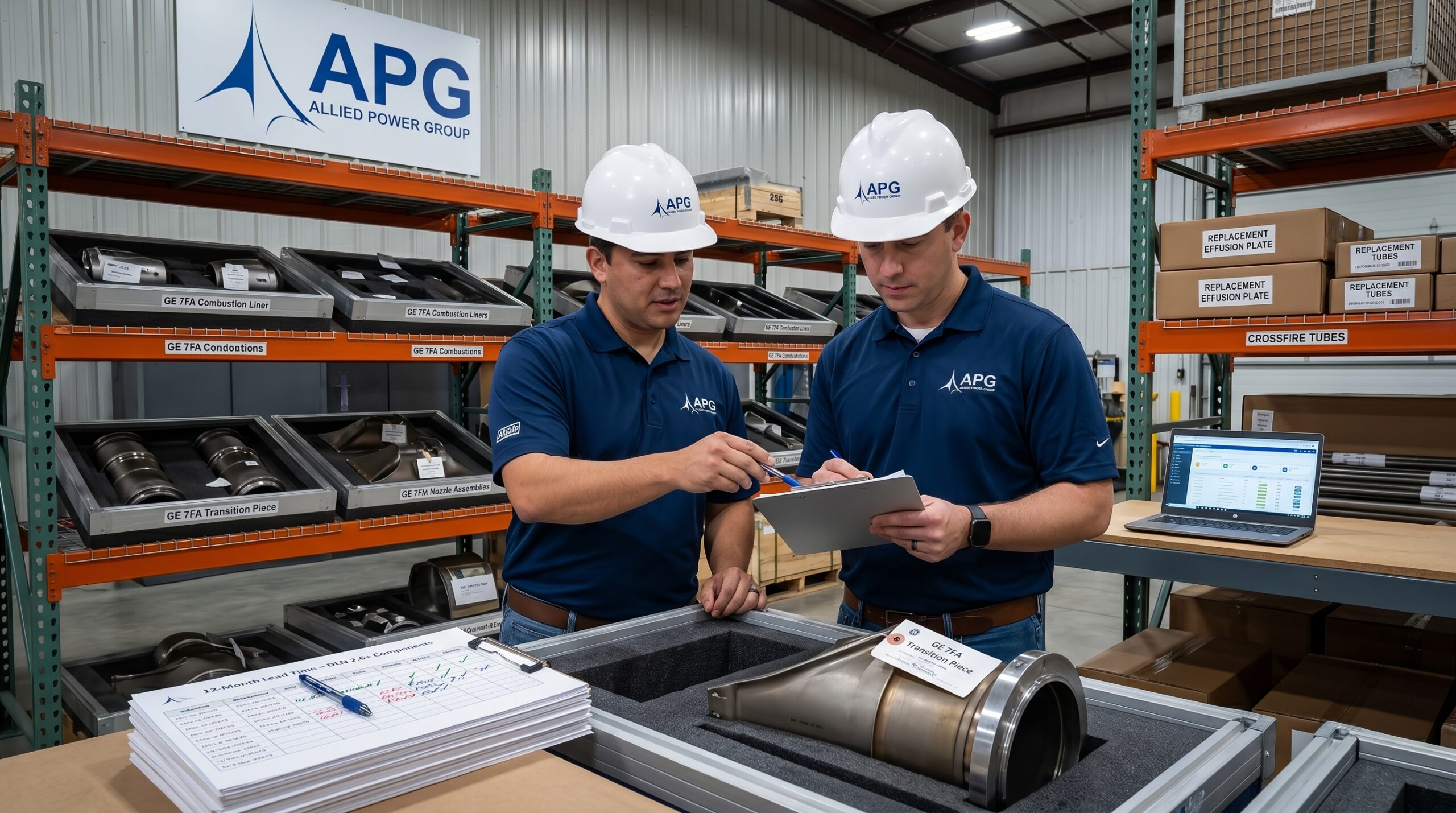
Gas Turbine Parts and Documentation: Confirming Readiness Before the Window Opens
Capital parts must be on order at least 12 months before your scheduled outage. Combustion liners, transition pieces, fuel nozzle assemblies, and effusion plates for GE F-class gas turbines are not shelf items. Sourcing them late compresses the outage schedule and forces scope compromises that affect long-term reliability.
The documentation package your repair team needs on arrival covers unit operating history with equivalent hours and starts, combustion dynamics monitoring trend logs, all prior tuning records, inspection photos from previous combustion outages, and the current emissions compliance baseline from your CEMS historian. GE manuals frequently do not address all operating conditions or recent technology changes — experienced ISPs compensate with field-built knowledge accumulated across a large installed base.
Fuel Nozzle and Effusion Plate Inspection Priorities
Confirming fuel nozzle flow test results from the previous inspection cycle is a non-negotiable step. If records are incomplete, schedule flow testing as a pre-outage activity. Precise control of fuel-to-air ratio distribution across the nozzle set holds the turbine in emissions compliance across operating modes — degraded flow uniformity that wasn’t caught in the last cycle will produce a failed tuning run in this one. Effusion plate inspection should be explicitly scoped given the documented cracking patterns on 7F DLN 2.6+ hardware, with each component evaluated for reuse or flagged for replacement before the outage window closes.
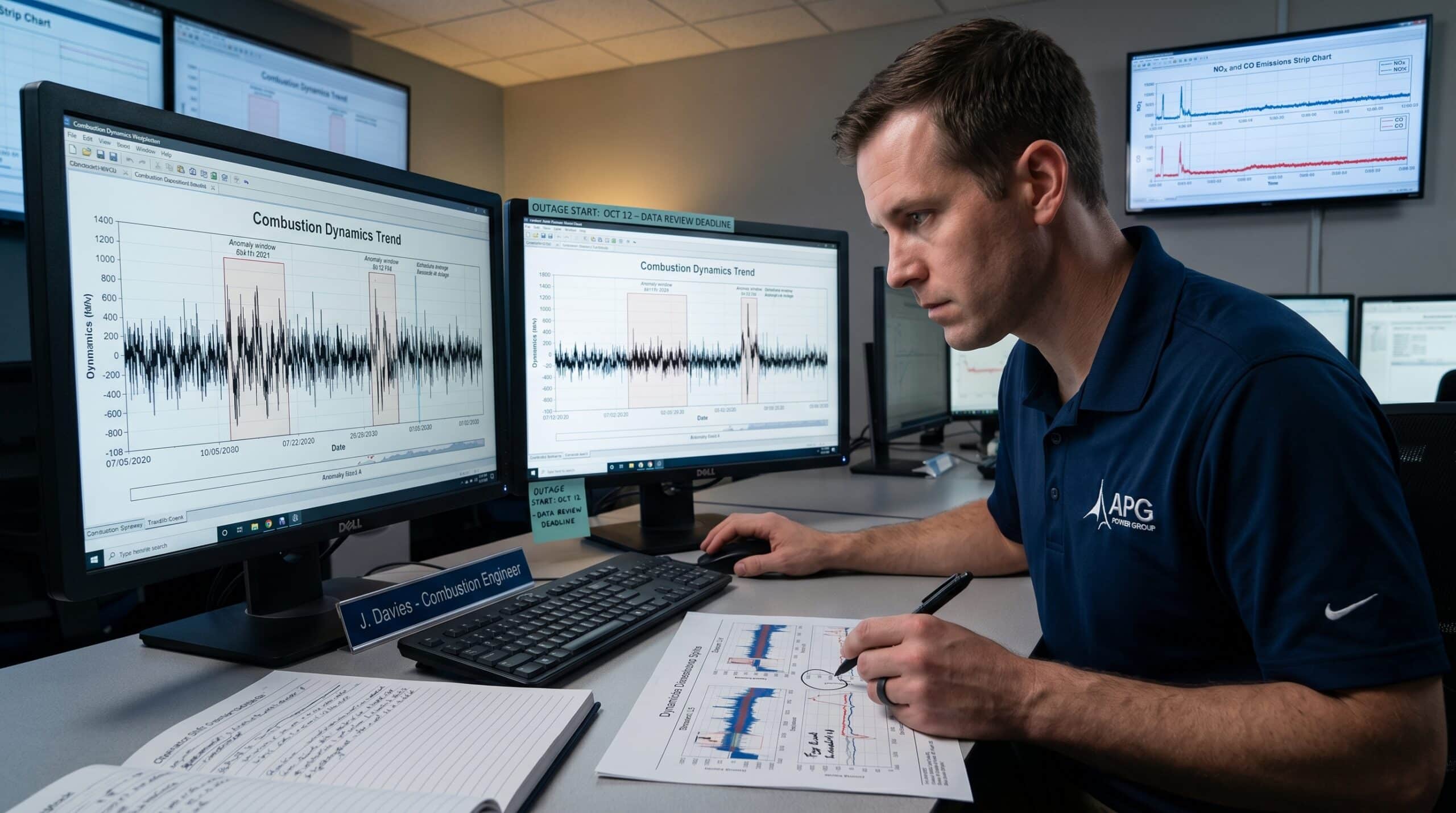
Combustion Dynamics Monitoring as a Pre-Outage Tool
Combustion dynamics monitoring measures dynamic pressure pulsations inside the combustor, tracking flame stability, mode transition behavior, and proximity to lean blowout conditions. It is the most information-rich diagnostic tool available to DLN operators — and it is consistently underused as a pre-outage planning input.
Reviewing CDMS trend data from the last three to six months of operation before the outage shows which combustors are running at the margins of their dynamics limits, which operating modes are producing elevated pulsation levels, and where fuel split imbalance is developing. Combustion system faults show up in dynamics data before they appear as hardware failures. Operators who bring a complete, annotated dynamics data package to the repair team reduce diagnostic time in the outage window measurably.
Best Practices for Pre-Outage Dynamics Data Review
A structured pre-outage data review meeting between the plant team and the repair ISP, held at least 60 days before the outage start date, is where scope gets defined accurately. The data package reviewed at that meeting should cover CDMS trend logs, NOx and CO emissions historian data, operating mode transition records, and any alarm or trip history related to combustion dynamics. This is also where upgrade decisions are best informed — dynamics data frequently reveals whether another repair cycle will hold emissions compliance or whether a hardware upgrade is the more defensible path.
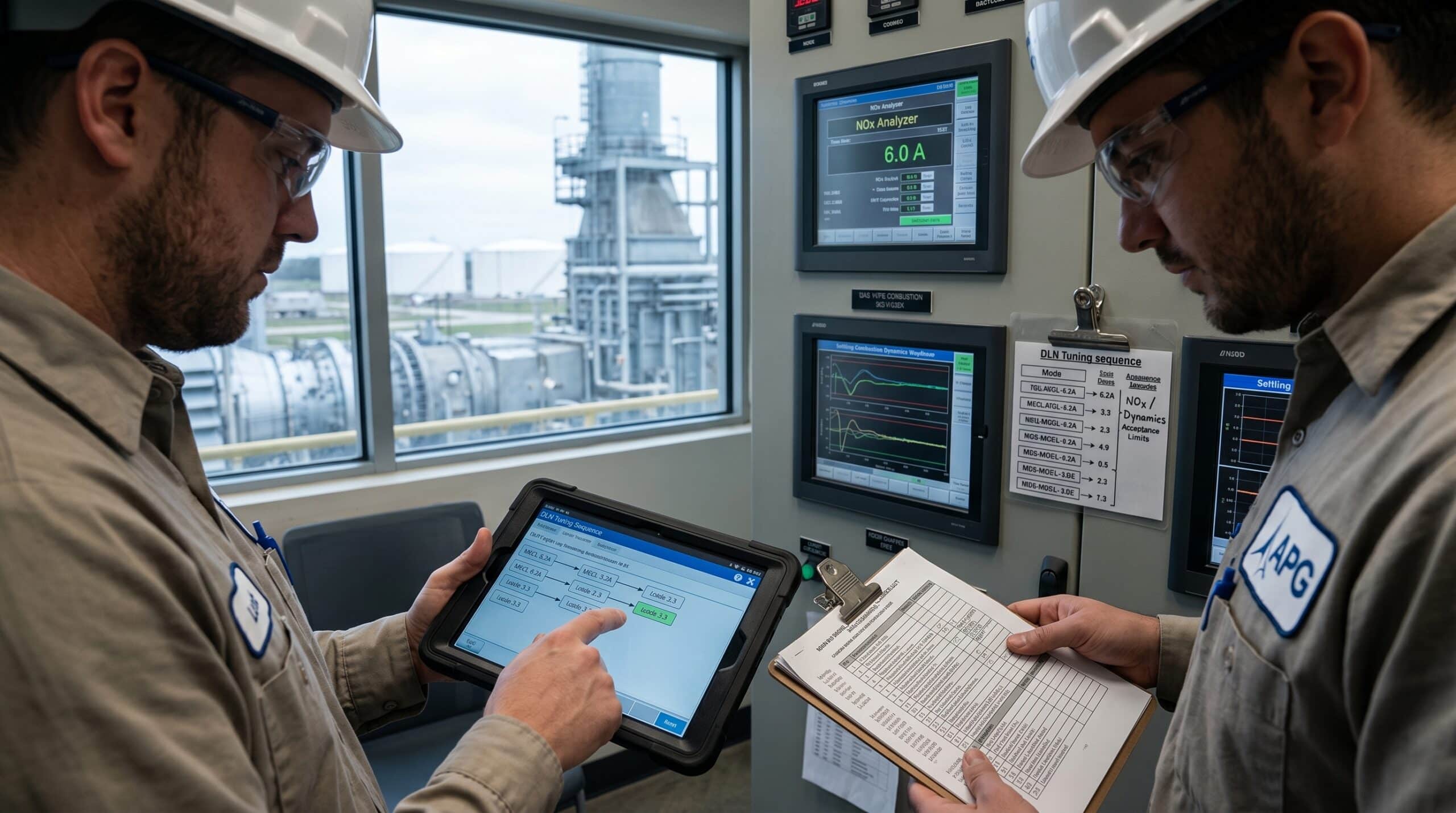
DLN Tuning: Planning the Post-Outage Commissioning Sequence
DLN tuning requires advance planning, the right instrumentation, and a commissioning sequence that validates each operating mode independently. The process adjusts fuel flow splits between nozzles to achieve the target balance of NOx emissions, CO output, and dynamic pressure within prescribed limits. On DLN 2.6+ systems, each mode has its own tuning targets, and a gas turbine that passes tuning in one mode and fails in another is a common post-outage outcome when sequencing is under-planned.
Cold weather shifts the combustion thermodynamics of lean-premix operation, and a tuning baseline established in mild ambient conditions may not hold through a significant temperature drop. If the outage occurs in a season where ambient temperature will change materially before the next scheduled tuning event, that variability should be factored into the commissioning plan from the start.
How Hardware Condition Affects Emissions Compliance
Hardware condition and tuning outcomes are directly connected. A combustor liner with altered dilution geometry from a prior repair, or a nozzle with degraded flow uniformity, will not respond to tuning the same way a fully refurbished component does. The repair team and the tuning team need to be coordinating from the outset — ideally they are the same ISP. That integration prevents the information gap that causes post-outage emissions failures and is where combined repair-and-tuning capability reduces real risk.
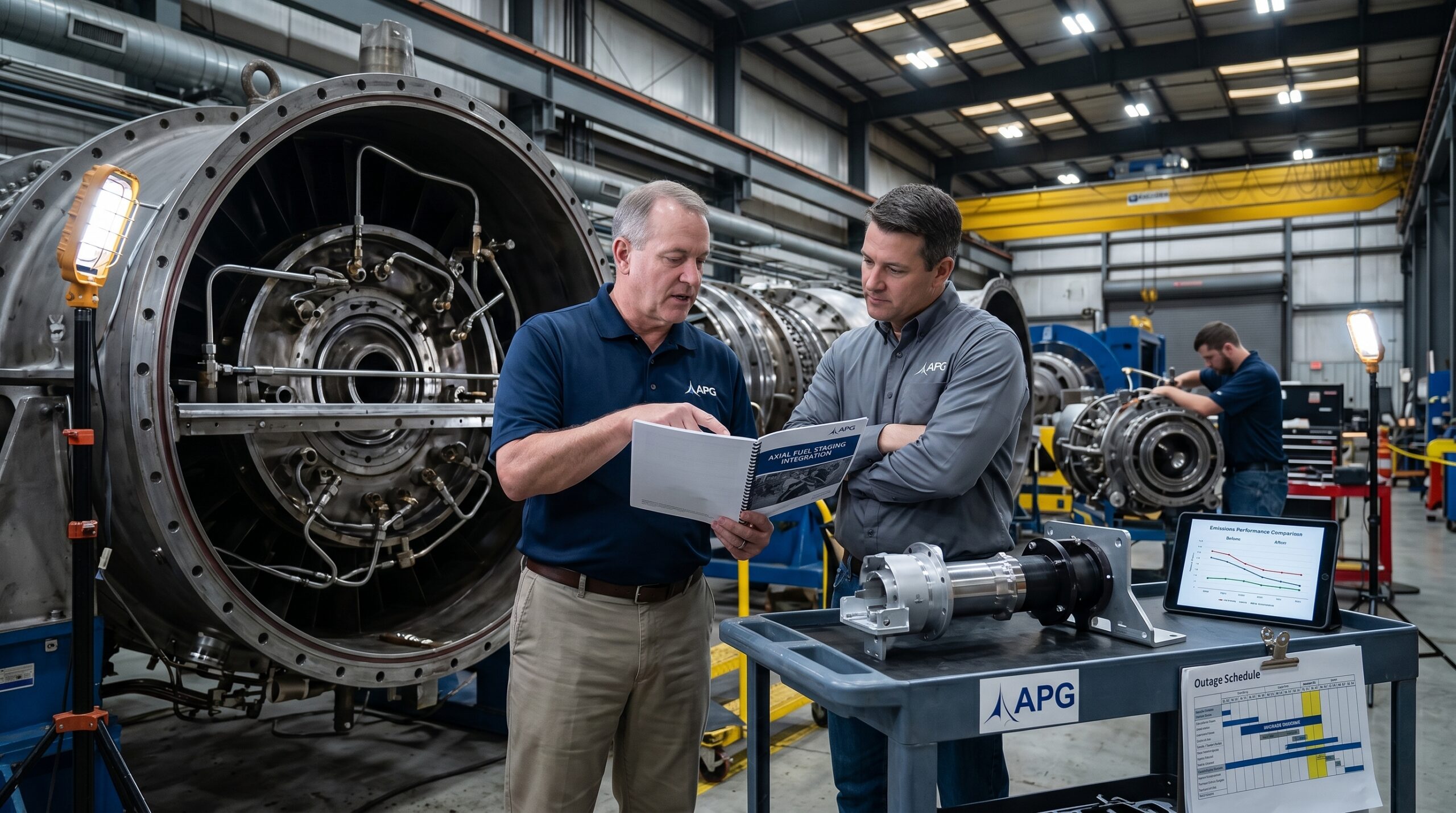
Turbine Technology Upgrade Timing: Making the Most of Your Outage Window
The outage window is the right time to execute an upgrade decision, not to make one. By the time the turbine is open, parts lead times and engineering review cycles have already closed most options. Upgrade paths available to DLN 2.6+ operators include axial fuel staging integration — announced by GE in 2018 as the “flex” upgrade combining DLN 2.6+ with AFS technology — replacement of life-limited combustion hardware with improved-design components, and low NOx combustion system upgrades that extend the emissions compliance window for older units. The business case for any of these is best built six to twelve months out.
With renewable energy capacity expanding across the grid, gas turbines are increasingly asked to cycle more aggressively and respond faster to demand signals. That cycling duty accelerates thermal fatigue on combustion hardware and tightens the compliance margin. Operators who reduce emissions exposure and extend hardware life through a planned upgrade capture value that reactive repairs cannot replicate.
When a Like-for-Like Repair Isn’t Enough
For aging 7FA units with combustion hardware through multiple repair cycles, the question worth asking before committing to another round of like-for-like repairs is whether the repaired configuration can still reliably hold NOx compliance. When dynamics data shows chronic marginal performance and inspection findings show cumulative degradation, the incremental cost of upgrading during a planned window frequently compares favorably to the cost of an NOx exceedance or an unplanned forced outage. Allied Power Group’s combustion engineering team works through exactly this analysis with operators in the pre-outage planning phase as a scope-definition discipline, not a sales exercise.
Conclusion
Pre-outage planning for DLN 2.6+ combustion systems is an engineering discipline. The difference between a clean outage return and a post-outage NOx exceedance is almost always traceable to decisions made — or deferred — weeks and months before the crew arrives. Parts procurement timelines, dynamics data review, fuel nozzle flow test validation, upgrade path evaluation, and DLN tuning sequencing are technical decisions, not administrative ones. They determine whether the turbine meets emissions compliance, holds its dynamics limits, and returns to full load on schedule.
If your next combustion inspection is within 18 months, the window for getting ahead of it is open now. Allied Power Group’s combustion engineering team works with 7FA and F-class operators through every stage of the outage planning cycle — from pre-outage data review through post-outage DLN tuning. Contact us to start your pre-outage readiness review before the schedule starts making decisions for you.
FAQ
How far in advance should I order parts for a DLN 2.6+ combustion inspection?
Capital parts for GE F-class combustion outages — including transition pieces, combustion liners, and fuel nozzle assemblies — should be confirmed on order at least 12 months before the scheduled outage start date. Lead times for some components exceed that window depending on production schedules and whether refurbished alternatives are being sourced. Late procurement is the most common and most avoidable cause of outage scope compression.
What are the most common hardware failure modes on 7F DLN 2.6+ systems?
The two most frequently documented failure modes on GE 7FA DLN 2.6+ hardware are effusion plate cracking and center fuel nozzle tip cracking. Effusion plate cracking, typically between center and outer fuel nozzles, has been reported at approximately 3,000 hours on cycling units and is driven by thermal strain. Both failure modes affect combustion performance and emissions compliance and should be explicitly scoped in any combustion inspection.
Why does my turbine drift out of emissions compliance in cold weather?
Cold ambient temperatures shift the thermodynamics of lean-premixed combustion in DLN systems. On DLN 2.6+ units, cold weather often produces a condition where NOx can be reduced below permit limits only at the cost of elevated dynamic pressure levels, or vice versa. Hardware through multiple repair cycles compounds the problem. Pre-outage review of cold-weather dynamics data and tuning sequencing that accounts for seasonal temperature variation is the most reliable mitigation.
What is the difference between a combustion inspection and a hot gas path inspection for DLN 2.6+ systems?
A combustion inspection covers the combustion hardware — liners, transition pieces, fuel nozzles, end covers, and DLN components including effusion plates. A hot gas path inspection extends the scope downstream to include first-stage turbine nozzles, buckets, and shrouds. Combustion inspections are typically performed at shorter intervals and focus heavily on premix hardware condition and DLN component integrity. Both inspection types require post-outage tuning validation.
When should I evaluate a DLN upgrade rather than another like-for-like repair?
The strongest indicators are persistent emissions exceedances or near-limit compliance performance in the current hardware configuration, chronic combustion dynamics issues unresolved through tuning, and combustion hardware that has completed multiple repair cycles with cumulative degradation. Upgrade options for DLN 2.6+ operators include axial fuel staging integration and improved combustion hardware designs. The analysis is most useful when conducted six to twelve months before the outage, not during it.
Does post-outage DLN tuning need to be planned in advance?
Yes. DLN tuning after any combustion or hot gas path hardware change is a required part of the outage scope. On DLN 2.6+ systems, tuning must validate each active operating mode individually, which requires dedicated commissioning time, CEMS and CDMS instrumentation, and a fuel nozzle flow data baseline from the repair process. Operators who do not plan for tuning in the outage schedule frequently encounter extended commissioning periods and post-restart permit violations