

Your Power Partner
7FA Bucket Damage: When Repair Isn’t Enough and Downtime Becomes a Crisis
A planned hot gas path inspection on a GE Frame 7FA can turn into something far more expensive the moment bucket condition becomes an open question. If you’ve pulled borescope images showing oxidation, tip wear, or TBC spallation on your 7FA buckets, the repair-versus-replace decision needs to be made before your outage window opens — not after the unit is already offline.
This article walks through what qualified inspection and repair actually involve, what damage profiles cross the line into replacement territory, and what a missed failure actually costs. For a full breakdown of Allied Power Group’s GE Frame 7F gas turbine repair capabilities, visit the service page before your next outage window closes.
Key Takeaways
- Creep damage and TBC bond coat failure in 7FA stage buckets are subsurface — borescope inspection alone cannot confirm repairability
- The repair-vs.-replace decision must be made before the outage window opens, not after the unit comes offline
- An undetected Stage 1 bucket failure can convert a planned hot gas path inspection into an unplanned full rotor event
- Third-party repair shops with 7FA-specific track records can offer cost-effective alternatives to OEM replacement across the full gas path
- Qualified assessment requires white light scanning, fluorescent penetrant inspection, and cycle-count history — not visual inspection alone
What 7FA Bucket Damage Actually Looks Like — and What It Hides
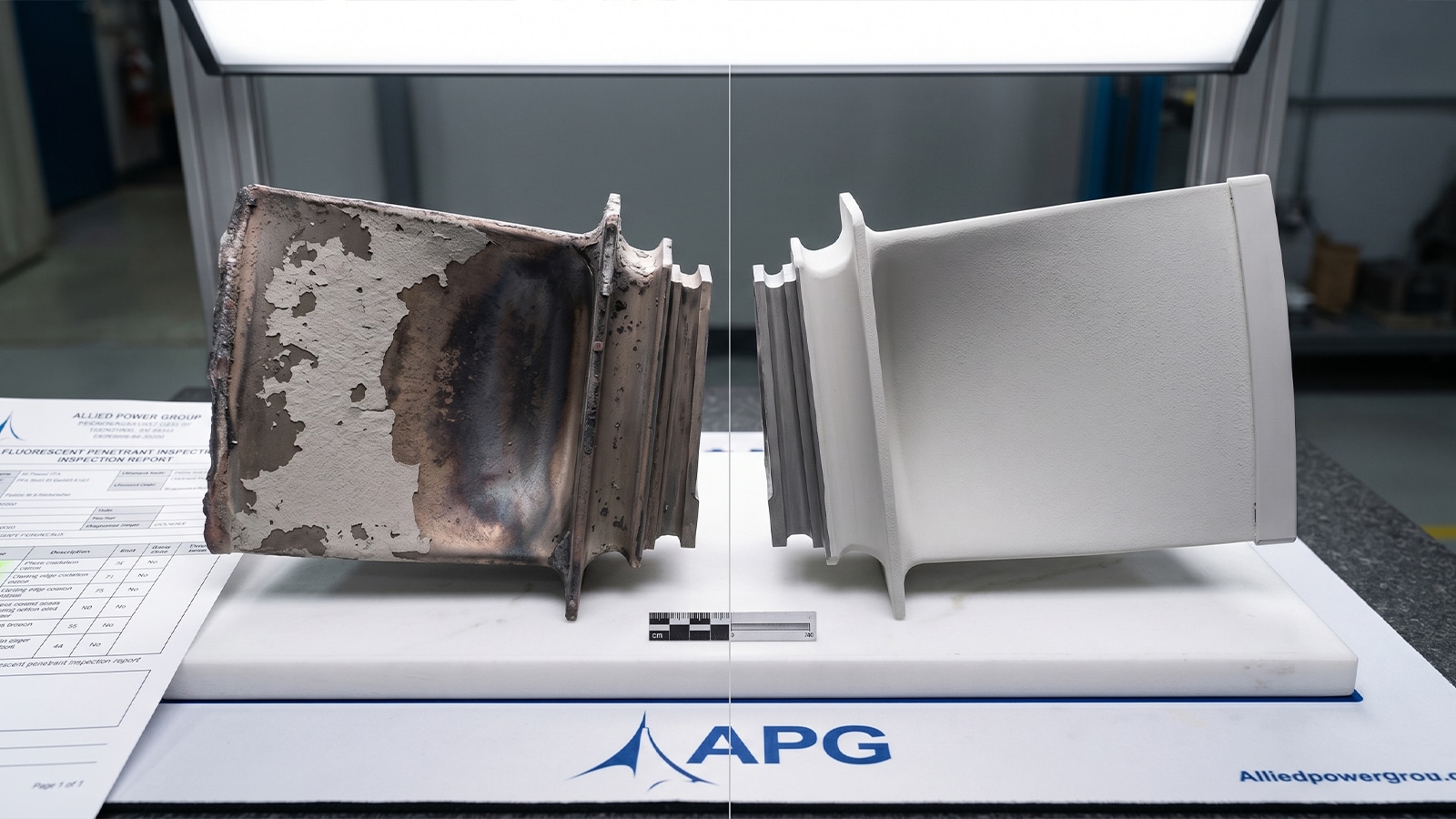
Operators working through a hot gas path inspection on 7FA components encounter a consistent set of failure modes: blade tip wear, shroud contact erosion, oxidation on the airfoil leading edge and suction face, trailing edge cracking, TBC spallation. What makes this platform particularly demanding is that every visible symptom typically points to a deeper condition that field assessment cannot characterize.
Visible Damage vs. Subsurface Reality
Creep damage in 7FA Stage 1 and Stage 2 buckets develops along grain boundaries under sustained thermal and mechanical load. It does not announce itself on the airfoil surface. It progresses internally until material loss is imminent. Only CT scanning combined with metallurgical analysis can determine how far that damage has propagated before tip separation becomes a real risk.
TBC spallation is the other major diagnostic trap. A spalled coating zone that looks cosmetic in the field is often the surface result of bond coat oxidation failure underneath. Once the bond coat has oxidized through, the thermal protection function is gone and the base alloy is already experiencing metal temperatures it was never designed to sustain. The 7FA.04 1st blade is particularly vulnerable to this progression given its proximity to peak combustion temperature and the complexity of its cooling circuit geometry.
Problems commonly observed in incoming condition include tip cracks, tip cap oxidation, and wall thinning alongside airfoil TBC coating that is missing with oxidation through the bond coat and into the parent material. Restricted cooling from passage blockage accelerates metal temperature exceedance, and visual inspection alone cannot confirm passage integrity. Flow testing in a certified repair facility is the only reliable method. If borescope images show any of these conditions and you are weighing whether to defer assessment to the next interval, the damage picture is almost certainly already ahead of what those images are showing.
Inspection: Why Field Assessment Isn’t Enough
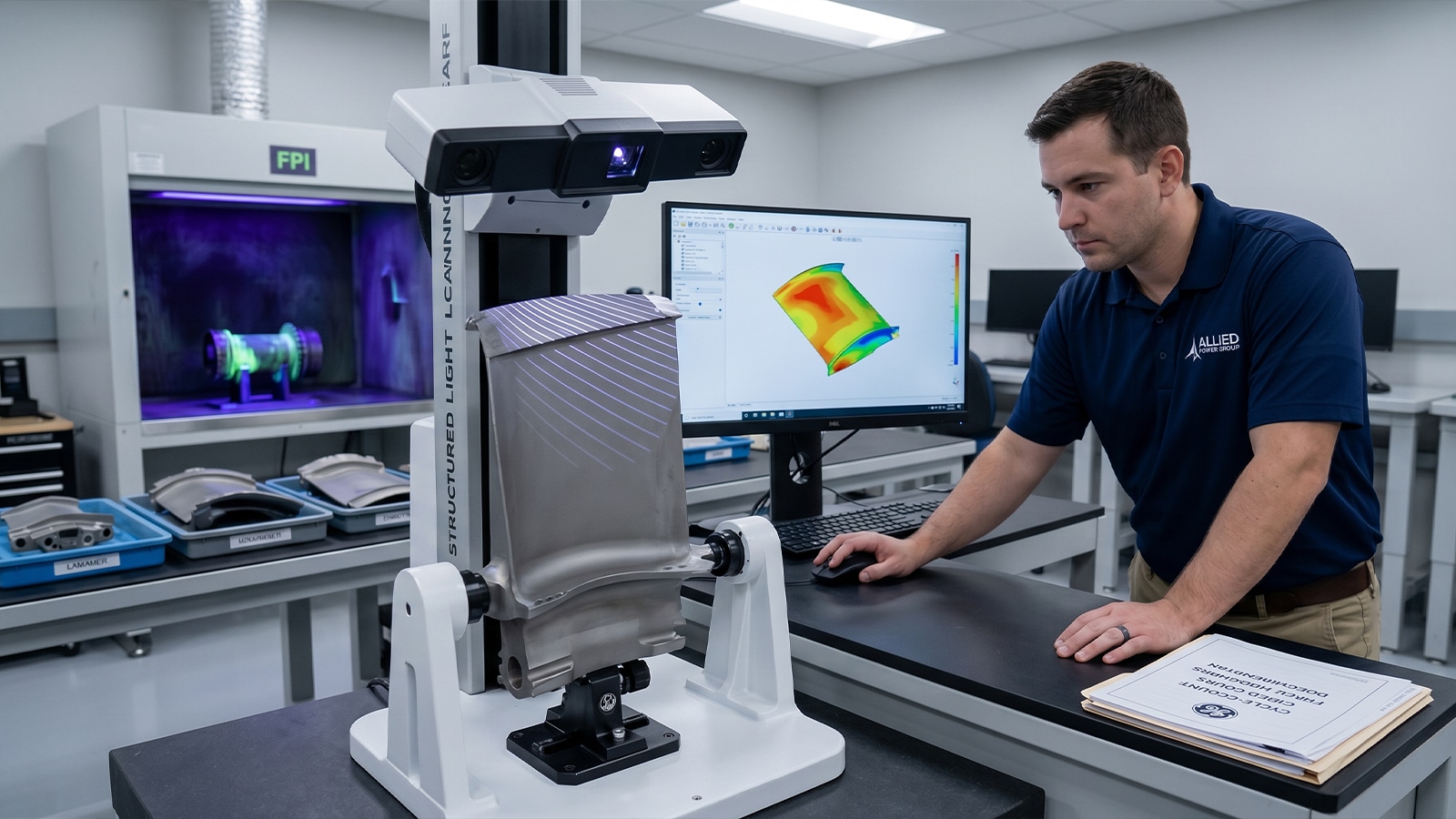
A qualified inspection sequence for 7FA gas turbine components covers substantially more ground than what a borescope provides. Fluorescent penetrant inspection reveals surface-breaking cracks invisible to the naked eye. White light scanning provides the dimensional baseline needed to confirm whether an airfoil has drifted outside acceptable geometry tolerances. CT scanning detects internal voids and creep damage before they become structural failures. Flow testing confirms cooling passage integrity. And cycle-count history reviewed alongside fired hours gives the full picture of thermal fatigue accumulation.
What a Qualified Inspection Covers
The geometry of a 7FA bucket degrades gradually and unevenly. Without dimensional data from light scanning, there is no reliable way to confirm whether an airfoil or tip shroud still meets OEM tolerances after a full service interval. Decisions made without this full data set produce one of two costly outcomes: scrapping a bucket that was still repairable, or returning a bucket to service that was already at end-of-life.
These same standards apply across the broader F-Class and E-Class fleet. Whether the unit is a 7F, 7EA, or part of the 9FA gas turbines operating in combined-cycle service, the logic is identical. Establish incoming condition before committing to any repair or replacement path. If you have fired hours, borescope data, and service history in hand but haven’t had a shop-grade assessment performed, that gap is the highest-leverage thing to close before your outage schedule locks.
The Repair Process: What Qualified 7FA Bucket Repair Actually Involves
Qualified gas turbine component repair for 7FA buckets is a sequenced, engineering-driven process. Receipt and documentation of incoming condition comes first, followed by FPI, dimensional scanning, and repair scope determination. From that baseline, the appropriate repair techniques are selected — and that selection matters more than most operators realize.
Weld, Braze, and Blend: Matching the Technique to the Damage
Weld repair, braze repair, and blend repair are not interchangeable. Each technique is applied based on damage type, location, and the metallurgical characteristics of the base alloy. For trailing edge cracking on R3 stage buckets, weld repair under controlled thermal profiles is the correct approach — improper repair creates stress risers that accelerate crack propagation through the next thermal cycle. Braze repair is appropriate for geometry-sensitive locations where weld heat input would distort critical airfoil sections. Blend repair addresses minor airfoil surface damage where dimensional restoration is achievable without material addition.
APG gas turbine component repairs for 7FA.04 components cover each of these techniques with engineered procedures adapted to the specific casting characteristics of the platform, including weld repair of trailing edge and tip structures. Blade repair procedures have proven highly effective on this platform, resulting in minimal loss of blade tip height and low erosion and oxidation of the repaired blade tips. Bucket tip restoration through precision weld under dimensional control is among the most technically demanding steps — CT scanning and white light scanning data are used to develop the welding sequence, ensuring the tip structure meets both geometric and metallurgical requirements.
Coating Systems: Bond Coat, TBC, and Why Strip-and-Recoat Is Not Optional
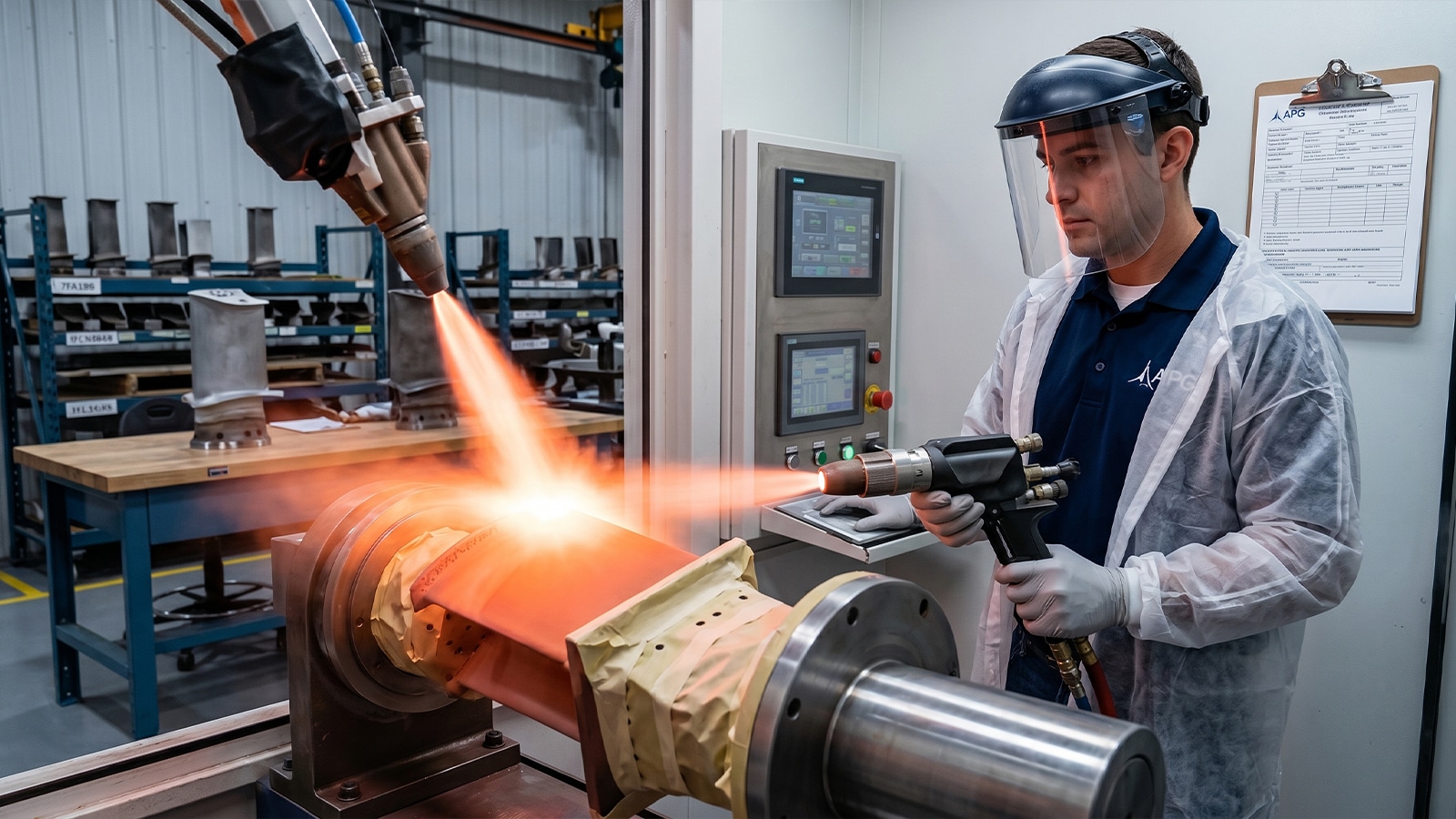
Thermal barrier coating restoration begins with a full strip of the existing TBC system. Partial recoat over a degraded bond coat is not an acceptable repair for hot gas path components because bond coat oxidation under the spalled zone compromises adhesion of any new coating applied over it. Once stripped, the bond coat is inspected, reapplied, and the thermal barrier coating is deposited via plasma spray under controlled process parameters. Repairs also exhibit excellent abrasion resistance under operating contact loads, and repaired turbine blades also exhibit excellent abrasion resistance against the shroud across the subsequent service interval.
| Damage Type | Typical Location | Repair Technique | Shop Capability Required |
|---|---|---|---|
| Blade tip wear | Stage 1 and 2 tip | Bucket tip restoration, weld repair | Dimensional scan, controlled thermal weld |
| TBC spallation | Airfoil pressure and suction faces | Strip-and-recoat (bond coat plus TBC) | Plasma spray, controlled environment |
| Trailing edge cracking | R3 trailing edge | Weld repair, braze repair | Controlled thermal profile weld, FPI |
| Oxidation damage | Airfoil leading edge, shroud | Blend repair, dimensional restoration | FPI, geometry verification |
| Cooling passage blockage | Internal cooling circuit | Ultrasonic cleaning, flow test | Certified flow bench, NDT |
| Creep or subsurface void | Stage 1 bucket body | Metallurgical assessment, scrap determination | CT scanning, metallurgical lab |
Rotor Risk: What a Missed Bucket Failure Actually Costs
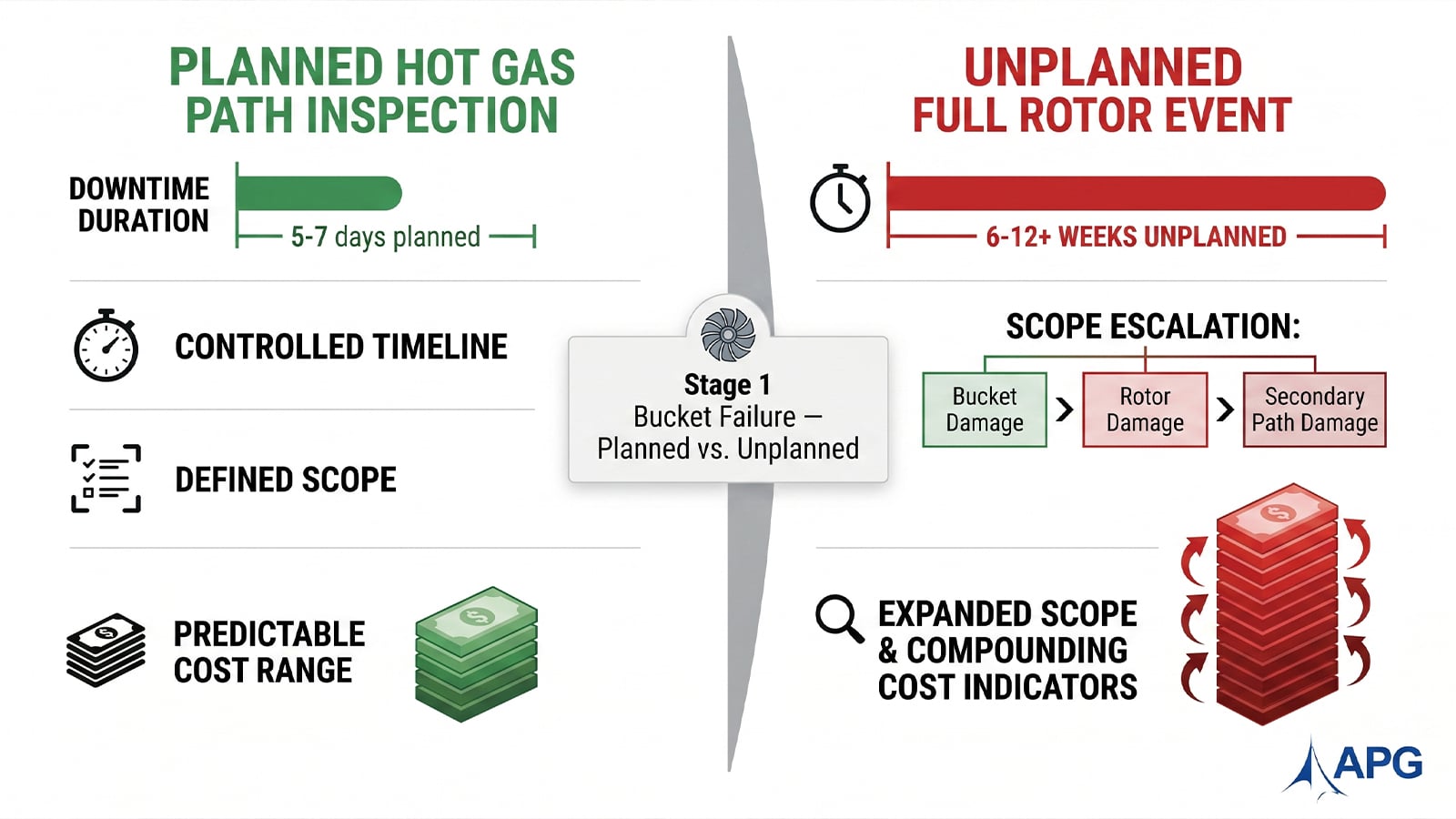
A creep failure in a Stage 1 bucket does not degrade on a convenient schedule. Tip liberation at operating speed is an immediate event. FOD propagates to downstream nozzle stages, the vane row, transition pieces, and the rotor itself. The mechanical dynamics of a liberated bucket tip create an instantaneous dynamic imbalance condition on top of the FOD damage. A planned gas path inspection becomes an unplanned full rotor replacement event.
The cost difference is not marginal. A typical hot gas path component repair runs around $1.5 million. A new rotor can approach $25 million, with a recovery timeline most operators cannot absorb. Collateral damage extends through the combustion components as well — liner damage, flow sleeves, and transition pieces all represent secondary failure risks when a bucket event propagates. Wall thinning in liner and transition piece hardware is a documented secondary outcome of high-temperature gas path disruption. Reducing operating costs over the full fleet lifecycle depends on managing rotor risk before it materializes, not responding to it after the fact.
The $25 million scenario and the $1.5 million repair scenario both begin with the same set of borescope images. The difference is what happens in the assessment phase.
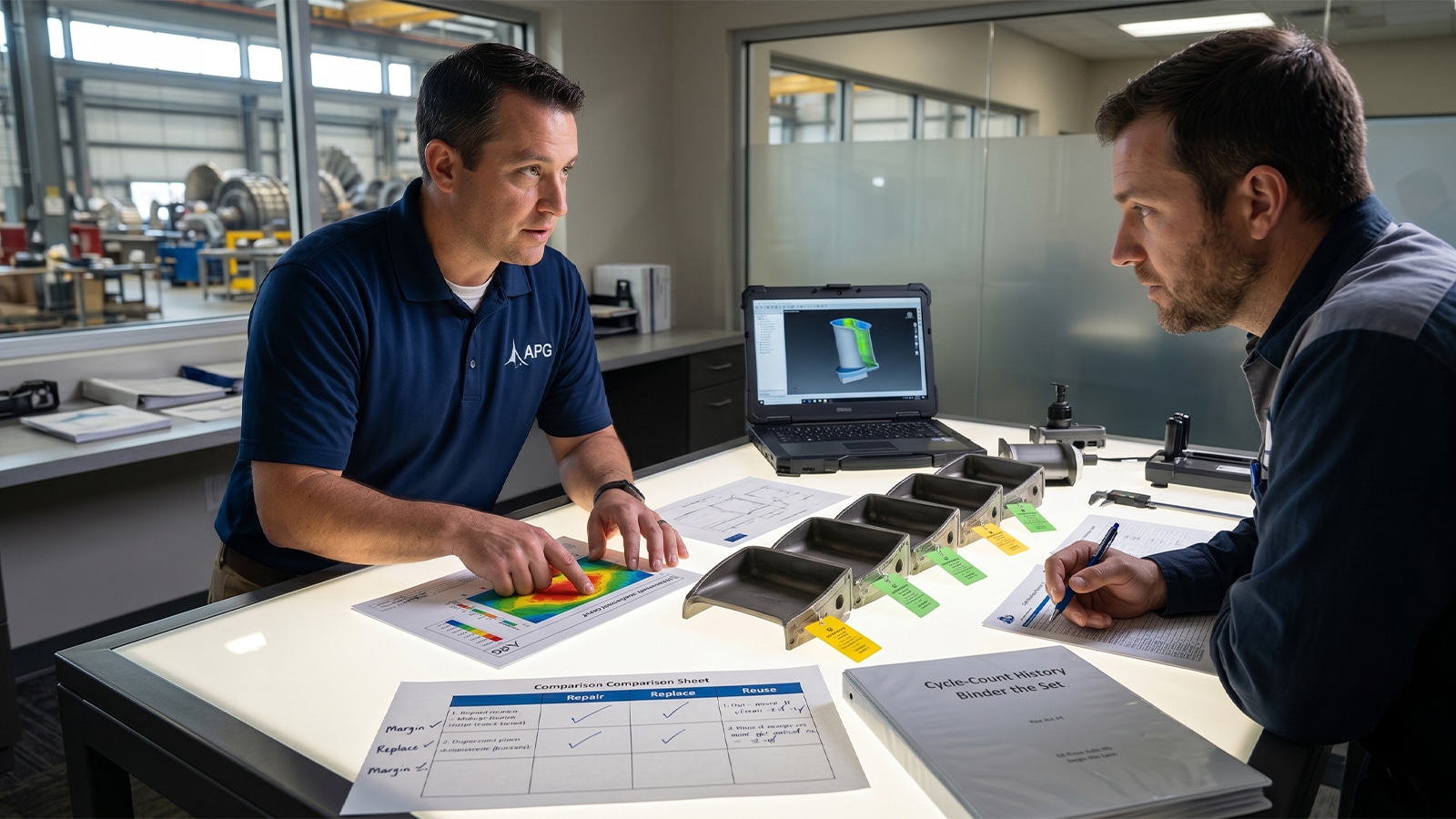
Lifecycle Thinking: Repair, Replace, or Reuse — Making the Right Call
The lifecycle cost of a 7FA rotor and its associated gas turbine components is determined more by repair decision quality across service intervals than by any single event. A data-driven repair process that correctly stages incoming condition, applies the right repair techniques, and returns components within dimensional tolerance protects asset economics over the full unit lifetime. Decisions made without that data destroy value.
Qualified independent repair shops with a documented track record on 7FA.04 and AGP configurations can offer comprehensive repairs at a lower-cost price point than OEM replacement — not as a quality compromise, but as a function of having engineered repair procedures, certified processes, and the equipment to execute them. Allied Power Group has been developing F-Class repair capabilities since 2005 across 7F, 7EA, and 9FA gas turbines, with repair techniques and repair capabilities that extend across combustion components, hot section hardware, and complete gas turbine components. The ability to inspect, assess, and return gas turbine component repair decisions within a defined, documented repair process is what separates a partner from a vendor. Shop capacity for qualified 7FA work is finite and outage windows are competitive — engaging before your window opens is a risk management decision, not a scheduling preference.
Conclusion
The difference between a planned repair and a forced replacement almost always comes down to what was assessed before the unit came offline. Allied Power Group has been repairing GE F-Class components since 2005, with documented repair procedures across 7FA.03, 7FA.04, and AGP configurations. If you have inspection data, fired hours, or a damage description in hand, our F-Class engineering team can give you a direct repair-versus-replace recommendation before your schedule locks. Contact Allied Power Group today and let’s define your repair path before the window closes.
FAQ
How do I know if my 7FA Stage 1 buckets have creep damage before the next inspection?
Creep in 7FA buckets is subsurface and invisible to borescope. CT scanning combined with metallurgical lab analysis is required to characterize material state before a structural failure occurs. Fired-hours tracking alongside thermal cycle count gives the trigger criteria, but the assessment itself requires shop-grade equipment. Approaching a service interval without that data means making a repair decision without the information it requires.
What separates a repairable 7FA bucket from one that should be scrapped?
The incoming condition assessment answers this. Dimensional data from white light scanning, FPI results, TBC adhesion state, and CT or metallurgical confirmation of base metal condition all feed the repair scope determination. Without this full data set, the go/no-go call is a guess. With it, the repair envelope is clear and defensible.
Can TBC spallation on 7FA buckets be partially repaired, or does the whole coating need to come off?
Partial TBC repair is not acceptable for hot gas path components. Bond coat oxidation under a spalled zone compromises adhesion of any new coating applied over it. The correct repair process is a full strip, bond coat inspection, bond coat reapplication, and thermal barrier coating deposition via plasma spray. Anything less leaves the component exposed to early re-spallation and continued base metal oxidation.
How long does a qualified 7FA bucket repair take, and what does that mean for outage planning?
Repair cycle time varies with damage scope and incoming condition, but a full set of 7FA stage buckets typically requires several weeks through a qualified shop. Engaging a repair partner early protects your schedule. Waiting until the unit is offline before initiating assessment almost always extends total downtime.
What happens downstream when a Stage 1 bucket fails mid-operation?
Tip liberation generates immediate FOD to the nozzle row and downstream gas path stages, causes dynamic imbalance on the rotor, and can damage transition pieces and combustion components depending on the propagation path. A single undetected failure converts a planned inspection into a full rotor replacement event — precisely the scenario a qualified incoming condition assessment is designed to prevent.
Is third-party 7FA bucket repair as reliable as OEM replacement?
Qualified independent shops with certified repair procedures, documented track records on 7FA.04 components, and full capability covering CT scanning, white light scanning, plasma spray, and controlled thermal weld can match or exceed OEM repair quality at a cost-effective price point. The right question to ask any repair partner is whether they can produce procedure documentation and material certifications — not just a price. Allied Power Group’s GE gas turbine component repair program has been developed over two decades specifically to meet the technical requirements of F-Class components.