

Your Power Partner
What Determines Turbine Repair Turnaround Time? 8 Factors That Control the Schedule
Every day a turbine sits offline carries a measurable cost, and the math adds up quickly. A 250 MW unit that misses a single day of operation loses 6,000 MWh of generation, which at an assumed $50 per MWh represents roughly $300,000 in lost revenue. Stretch that delay to one week, and the plant is facing a $2.1 million problem before anyone accounts for crew overtime, replacement power purchases, or contractual penalties.
That is why turbine repair turnaround time ranks among the most important variables for plant managers and outage planners. The difficulty is that turnaround is not a single number. Instead, it reflects several factors stacking on top of one another. Some depend on the condition of the components. Some depend on the repair facility. Several are decisions the plant itself controls.
The pressure on repair schedules is also intensifying across the power generation industry. According to EPRI research, large gas turbines now require more than five years from order to delivery. When buying a new machine is not a realistic short-term option, maintaining the existing fleet becomes the plan. That puts repair speed at the center of long-term reliability.
This guide explains the eight factors that control the repair schedule, outlines what a typical component repair workflow looks like, and identifies the practical steps operators can take to reduce downtime and get their parts back sooner.
Key Takeaways
- Incoming condition: Severe damage and an extensive service history lengthen the repair.
- Inspection findings: Repair scope frequently expands once components are stripped and tested.
- Component type: Advanced F-class components require more time than mature-frame components.
- Coating and heat treatment: These sequential processes operate on fixed cycles that cannot be rushed.
- Parts and materials: Long OEM lead times on castings can stall an entire outage.
- In-house vs. outsourced work: Every handoff to an outside vendor adds shipping time and queue time.
- Engineering and approvals: The schedule often stops while a repair decision waits for authorization.
- Outage planning and logistics: Early, detailed maintenance planning is the most effective way to protect the schedule.
What “Turnaround Time” Actually Measures
Before comparing quotes from different turbine repair services, confirm that everyone is measuring the same interval. Repair facilities and power plants frequently use “turnaround time” to describe three distinct clocks:
- Shop time: The duration a component spends inside the repair facility, from receiving inspection through final quality checks.
- Dock-to-dock time: Shop time plus outbound and return shipping, custom crating, and any customs delays on international shipments.
- Return-to-service time: The complete span from turbine shutdown until the unit is back online, including disassembly, installation, and startup.
A facility that quotes eight weeks of shop time may actually be offering the same overall schedule as a competitor that quotes ten weeks dock-to-dock. Because return-to-service time is the figure that directly affects revenue, it is the measurement that deserves the most attention during outage planning.
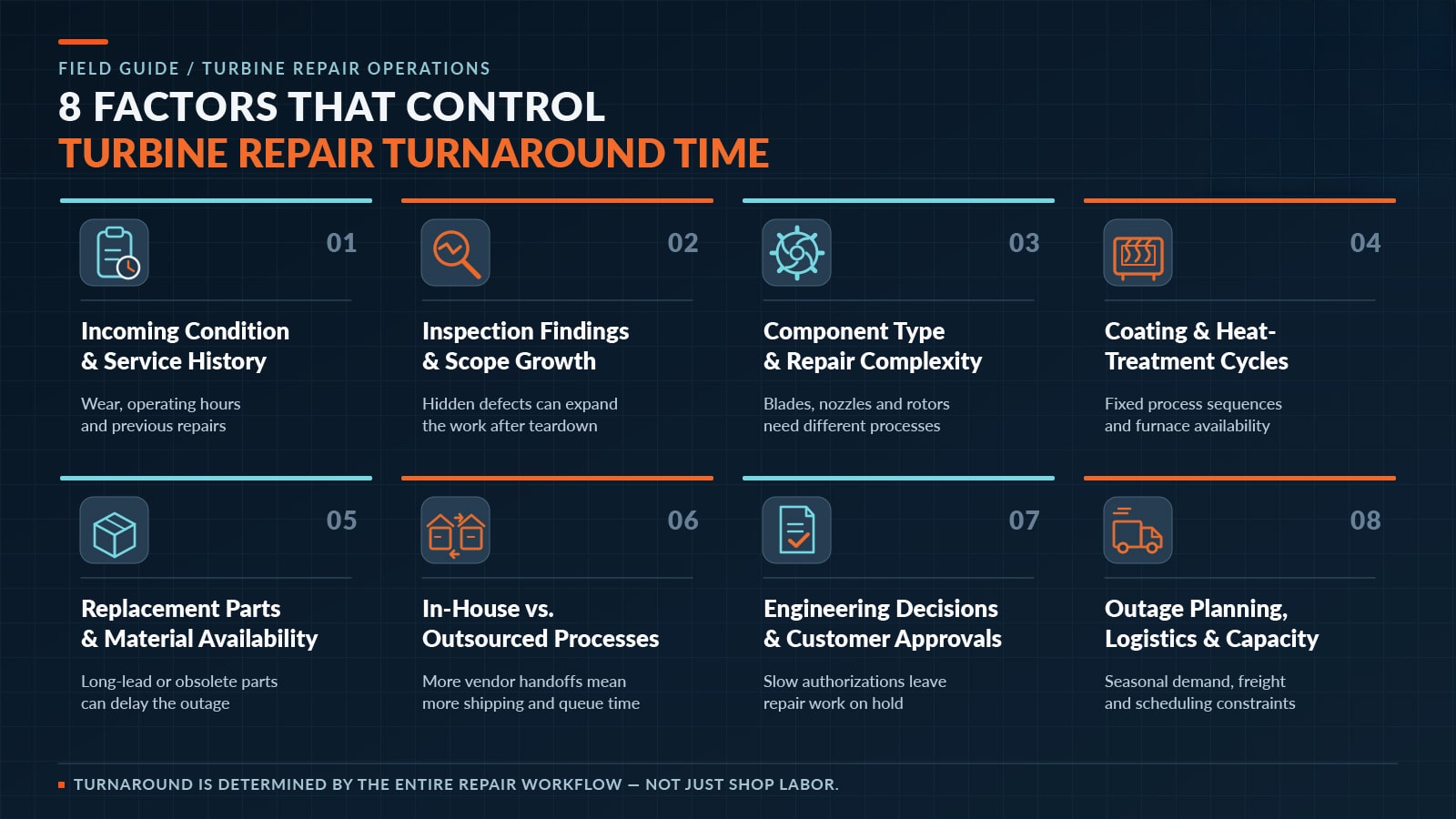
The 8 Factors That Control Turbine Repair Turnaround Time
1. Incoming Condition and Service History
The condition of a component when it arrives at the shop establishes the starting point for every subsequent step. A combustion liner with moderate wear needs far less work than one with burn-through or extensive cracking. Turbine blades or vanes with heavy oxidation, coating loss, or foreign object damage demand more welding, machining, and inspection.
Service history matters just as much as visible damage. Each repair cycle uses up part of a component’s life. A part on its third or fourth repair may need extra procedures, or it may be close to the point where repair no longer makes economic sense. Operating profile also plays a role, since peaking units that start and stop frequently accumulate significantly more thermal fatigue than units operating steadily at base load.
What operators can do: Include complete documentation with every shipment, including prior repair reports, fired hours, starts, and any significant events such as trips or overfiring. A repair partner that understands a component’s history can develop the correct repair plan from the beginning instead of discovering problems midway through the process.
2. Inspection Findings and Scope Growth
No repair plan is truly final until the component has been cleaned, stripped, and evaluated. Non-destructive testing methods, including fluorescent penetrant inspection, eddy current testing, and radiographic (X-ray) inspection, routinely reveal cracks and subsurface defects that were invisible during field inspection. Borescope images collected before the outage are valuable, but they cannot show what lies beneath an intact coating.
This explains why repair scope so often changes after components arrive at the shop. It also explains why a blade repair occasionally requires more than one pass: a crack identified after the initial weld cycle may require another round of welding, heat treatment, and inspection before the component satisfies specifications.
What operators can do: Anticipate scope growth rather than assuming it will not occur. Build reasonable contingency into outage schedules, and establish in advance how the repair facility should handle findings that exceed the original quotation.
3. Component Type and Repair Complexity
Turbine components vary widely in the time they require. Combustion hardware, including liners, transition pieces, and fuel nozzles, is generally less complicated to restore than rotating hot gas path components. Turbine blades (buckets) and stationary nozzles (vanes) demand tighter control over airfoil dimensions, internal cooling passages, and protective coatings.
Turbine class influences the timeline as well. F-class machines rely on advanced superalloys, including directionally solidified and single-crystal materials, which require specialized precision welding techniques and narrower process tolerances than the alloys found in older frames. Rotor repair represents an entirely different category of work, potentially involving unstacking, individual wheel inspection, machining, and dynamic balancing.
Steam turbine and generator projects follow their own paths. Steam turbine diaphragms, valves, and rotors each involve distinct restoration procedures, while generator repair introduces electrical testing requirements that further shape the schedule.
What operators can do: Request a timeline organized by component type rather than a single estimate for the entire scope. This approach makes it easier to identify which critical components define the outage’s critical path.
4. Coating and Heat-Treatment Cycles
Coating and heat treatment are among the most time-intensive stages of hot gas path repair. A representative sequence might include chemically stripping the existing coating, performing a rejuvenation heat treatment such as hot isostatic pressing (HIP) to restore the base metal, completing weld or braze repairs, conducting a post-repair heat treatment, and finally applying new bond coats and thermal barrier coatings.
These operations must occur in a fixed order. A component cannot be recoated until it has been repaired, and it cannot be repaired until the original coating has been removed. Furnace cycles also have fixed durations, and any facility can run only so many loads each week. During peak outage seasons, furnace availability can quietly become the bottleneck.
What operators can do: Ask whether coating and heat treatment are performed in-house or subcontracted. If they are subcontracted, ask how the repair facility manages and monitors the outside vendor’s schedule.
5. Replacement Parts and Material Availability
Some components simply cannot be repaired. When a part exceeds its repair limits, the schedule depends on how quickly a replacement can be sourced, and this is precisely where long OEM lead times can stall an entire outage.
Castings for hot section components remain in short supply throughout the industry. Turbomachinery Magazine reports that hot-section blades and vanes are widely considered among the tightest constraints in the gas turbine supply chain. Legacy frames face a different obstacle, because certain components are no longer manufactured at all.
Reverse engineering and careful material selection can close that gap. A capable repair partner can scan an obsolete component, verify its metallurgy, and manufacture a qualified replacement. Allied Power Group provides reverse engineering and part replication for legacy units where OEM parts are difficult or impossible to obtain.
What operators can do: Identify likely replacement parts before the outage begins, not after inspection results arrive. Order long-lead items early, even when there is a reasonable chance they will ultimately go unused.
6. In-House vs. Outsourced Processes
A repair that travels among several vendors accumulates delays at every transition. Each handoff introduces additional shipping time, a new position in another company’s production queue, and another layer of documentation. A single component might go to one facility for stripping, a second for welding, and a third for coating. Because none of those vendors controls the full schedule, nobody truly owns the delivery date.
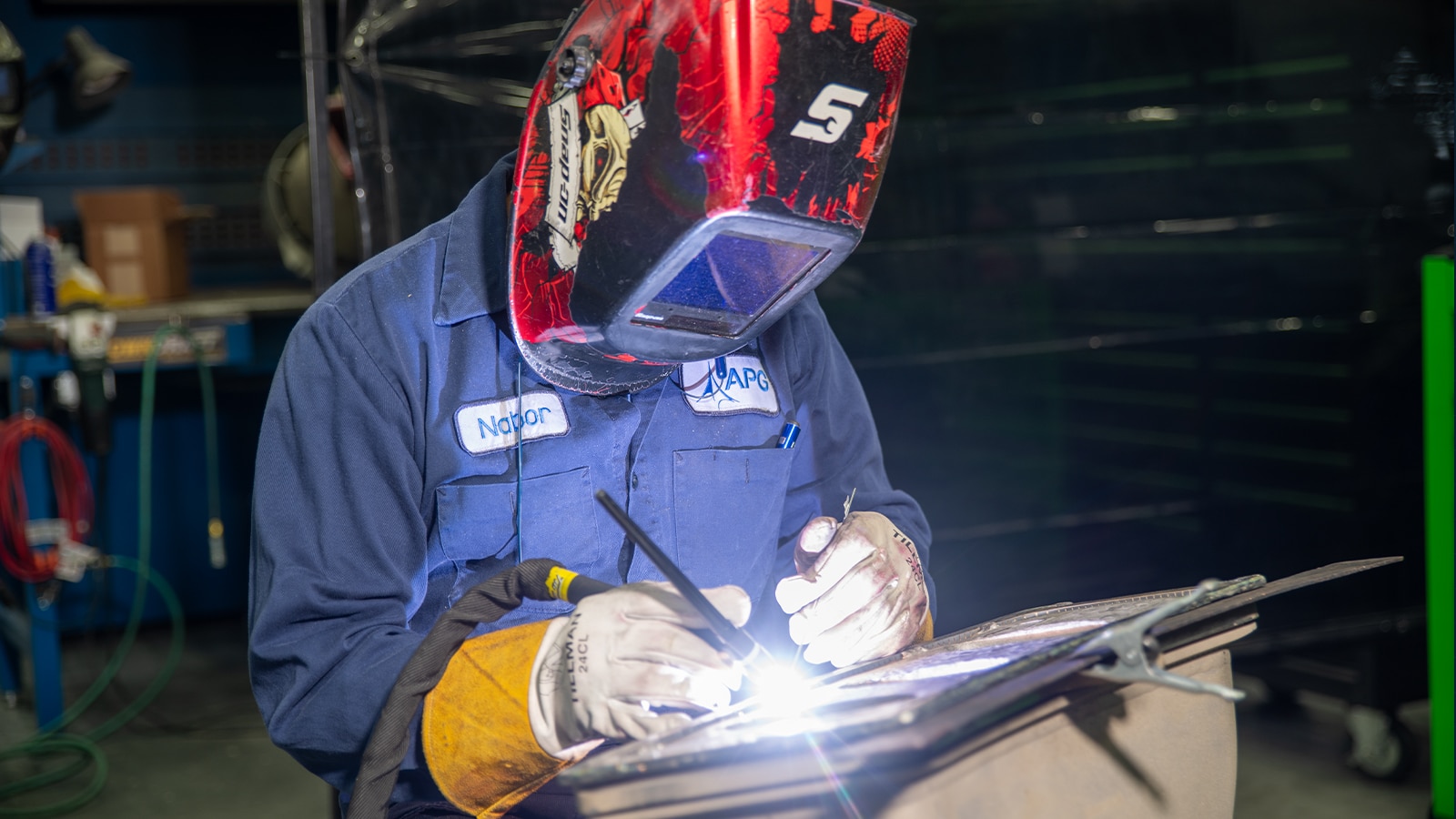
A repair facility that performs the work under one roof eliminates those gaps. Allied Power Group handles welding, machining services, coating, and balancing within its own facility, which keeps components moving directly from one operation to the next and keeps a single team accountable for both quality and delivery.
What operators can do: Ask every prospective repair facility which processes it performs internally and which it subcontracts. Then ask how many times your component will be shipped before it returns to your site.
7. Engineering Decisions and Customer Approvals
Many repairs reach a point where the shop needs a decision from the customer. A crack may be longer than anticipated, a dimension may fall outside tolerance, or a component may need to be scrapped entirely. The facility’s engineers evaluate the finding and recommend a path forward, but the plant must authorize it before work continues.
This is where turnaround time frequently stalls without anyone noticing. A repair recommendation can sit unanswered for days while it waits for the plant engineer, the asset manager, or the insurance carrier. Quality assurance paperwork can add more delays when requirements were not defined at the start.
What operators can do: Pre-approve common repairs up to an established dollar threshold. Designate one individual with authority to make decisions quickly during the outage, and agree on an expected response time for engineering questions.
8. Outage Planning, Logistics, and Shop Capacity
Outage timing has a substantial effect on turnaround. Most planned outages occur during spring and fall, when electricity demand is lower, which means many plants send components to repair facilities simultaneously. A shop with open capacity in July may be fully committed in April.
Logistics introduce their own complications. Large components require custom crating and specialized freight. International shipments may face customs holds, and even minor issues like incomplete shipping documents can push a schedule back by days.
GE notes that advanced planning and scope definition are essential to reducing turnaround times, because they help secure parts availability and shop capacity in advance. The same principle applies to any repair partner.
What operators can do: Reserve repair capacity several months before the outage. Share outage schedules, anticipated scope, and shipping dates with your repair partner early, and request regular status updates once components arrive.
What a Typical Repair Workflow Looks Like
Every repair is different, but most hot gas path component repairs follow a similar sequence. The table below outlines the major steps and identifies which ones tend to have the greatest effect on the schedule.
| Step | What Happens | Schedule Impact |
|---|---|---|
| 1. Receiving inspection | Components are logged, photographed, and checked against shipping records | Consistent |
| 2. Strip and clean | Existing coatings and deposits are removed | Consistent |
| 3. Non-destructive testing | Cracks and defects are mapped using FPI, eddy current, or X-ray | Consistent |
| 4. Engineering review | Engineers define the repair plan and flag scrap or additional work | Variable: depends on findings and approvals |
| 5. Weld and braze repair | Cracks are repaired and dimensions are restored | Variable: depends on damage |
| 6. Heat treatment | Furnace cycles restore material properties | Variable: depends on furnace capacity |
| 7. Machining | Components are returned to drawing dimensions | Consistent |
| 8. Coating | Bond coat and thermal barrier coating are applied | Variable: depends on in-house vs. outsourced |
| 9. Final inspection and balancing | Quality checks, flow testing, and dynamic balancing for rotating parts | Consistent |
| 10. Return shipment | Components are crated and returned to the site | Variable: depends on distance and customs |
The consistent steps require roughly the same duration on every project, while the variable steps are where schedules are ultimately won or lost.
How to Shorten Your Turbine Repair Turnaround Time
Operators influence more of the repair schedule than they often realize. Use the following checklist to minimize downtime before your next outage:
- Plan early. Reserve shop capacity several months in advance, particularly for spring and fall outages.
- Provide complete information. An accurate turnaround estimate depends on accurate inputs, so share serial numbers, service history, fired hours, starts, borescope reports, and previous repair records.
- Order long-lead parts early. Begin sourcing components with long OEM lead times before inspection results are available.
- Pre-approve repairs. Establish dollar limits for routine repairs so the facility can continue working without waiting for authorization.
- Designate one decision maker. Give the repair facility a single contact who can resolve engineering questions the same day.
- Use spare sets. Many power generators keep spare hot gas path parts so they are not forced to wait for repaired components before restarting. If you maintain a spare set, install it during the outage and send the used components for repair afterward.
- Choose a facility that controls the process. Fewer handoffs consistently produce fewer delays.
OEM vs. Independent Repair Shop Turnaround
OEM service centers and independent repair facilities can both deliver high-quality results, but they frequently differ in flexibility and focus. OEM service centers support enormous installed fleets and may build long queues during peak seasons. Independent facilities can often move faster on scheduling and engineering decisions, and they may offer repair alternatives when OEM parts are backordered.
A common concern is whether non-OEM repairs affect turbine performance. A qualified independent facility performs work to OEM-equivalent standards, documents every procedure, and supports its repairs with complete quality records. In some situations, engineered upgrades such as improved coatings or alternative materials can extend component life beyond the original design.
Allied Power Group has repaired industrial gas turbine components since 2005, with extensive experience on F-class units such as the GE Frame 7F and GE Frame 9F. APG also services steam turbines and generators for power plants around the world.
Frequently Asked Questions
How long does turbine component repair typically take?
Turbine component repair typically takes anywhere from several weeks to several months. One industry report places turnaround at approximately 10 weeks for lower-complexity components and up to 40 weeks for highly complex repairs. The actual duration depends on component condition, component type, coating requirements, and replacement parts availability.
Can turbine repairs be expedited?
Turbine repairs can often be expedited when the facility has available capacity and the repair scope is clearly defined, although expedited work generally carries additional cost. The most reliable ways to accelerate a repair are early planning, pre-approval of routine repairs, and selecting a facility that performs most processes in-house.
Why does repair scope change after inspection?
Repair scope changes after inspection because non-destructive testing reveals damage that field inspections cannot detect. Cracks beneath coatings, wall thinning, and internal oxidation typically become visible only after components are stripped and tested at the repair facility.
Which turbine components can be repaired instead of replaced?
Most hot gas path components can be repaired instead of replaced, provided they remain within established repair limits. Repairable components include combustion liners, transition pieces, fuel nozzles, turbine blades, turbine nozzles, and shroud blocks. Rotors, steam turbine diaphragms, and valves can also be restored in many cases.
Will non-OEM repairs affect turbine performance?
Non-OEM repairs do not reduce turbine performance when a qualified facility performs them to OEM-equivalent standards. Many independent repair facilities also offer engineered upgrades, such as improved coatings, that can extend component life.
Plan Your Next Outage With Allied Power Group
Turbine repair turnaround time is not a matter of luck. It is the predictable result of thorough planning, clear communication, and a repair partner that controls the process from start to finish. Allied Power Group combines in-house engineering, precision welding, machining, coating, and balancing under one roof to help power plants reduce downtime and return to service faster.
Planning an outage or facing an urgent repair? Contact a component solutions specialist to discuss your scope and schedule.