

Your Power Partner
Industrial Generator Rewind Process Explained Step by Step
A stator that just failed its megohm test, or one trending toward it, puts a plant manager in a position where guessing isn’t an option. An industrial generator rewind replaces the copper windings in a stator or rotor after insulation fails or electrical damage occurs, and knowing exactly what that generator repair and rewind work involves turns a black-box decision into one you can hold a contractor accountable to. The core, frame, and rotating assembly get reused, provided they test sound. IPP plants usually approve a rewind rather than a full replacement because the core and rotor still meet original spec after diagnostic testing. This applies to GE, Siemens, and Alstom generator OEM platforms alike, on both gas turbine and steam turbine units.
The industrial generator rewind process has several steps: diagnostic testing, disassembly and winding removal, core inspection, rewinding with the correct wire gauge and insulation class, Vacuum Pressure Impregnation (VPI), reassembly and balancing, and final electrical and mechanical testing. Each step confirms that the stator or rotor meets OEM performance specs before the unit returns to service.
Key Takeaways
- A full generator rewind follows five to seven set steps: diagnostics, disassembly, core inspection, rewinding, VPI, reassembly and balancing, and final testing.
- Most industrial rewinds take roughly three to eight weeks, though the timeline depends on stator size, rotor scope, and lead time for copper and insulation materials.
- Rewind costs typically run 30 to 60 percent of a new unit’s price, which makes rewind the more cost-effective path when the core and rotor test sound.
- Insulation resistance, Polarization Index, and surge comparison results should drive the rewind-versus-replace decision, not guesswork.
- A qualified contractor documents every test against IEEE 43, IEC 60034, and NEMA MG-1 standards; a verbal sign-off is not enough.
What Are the Signs a Generator Needs to Be Rewound?
A generator rarely fails without warning. Insulation breaks down gradually, over months and years, rather than overnight. Plants that track test data over time usually catch a problem before it causes an unplanned trip. Plants that test only after a failure are working from a much weaker position, and often at a higher repair cost than the same fault would have carried a few months earlier.
Electrical Warning Signs
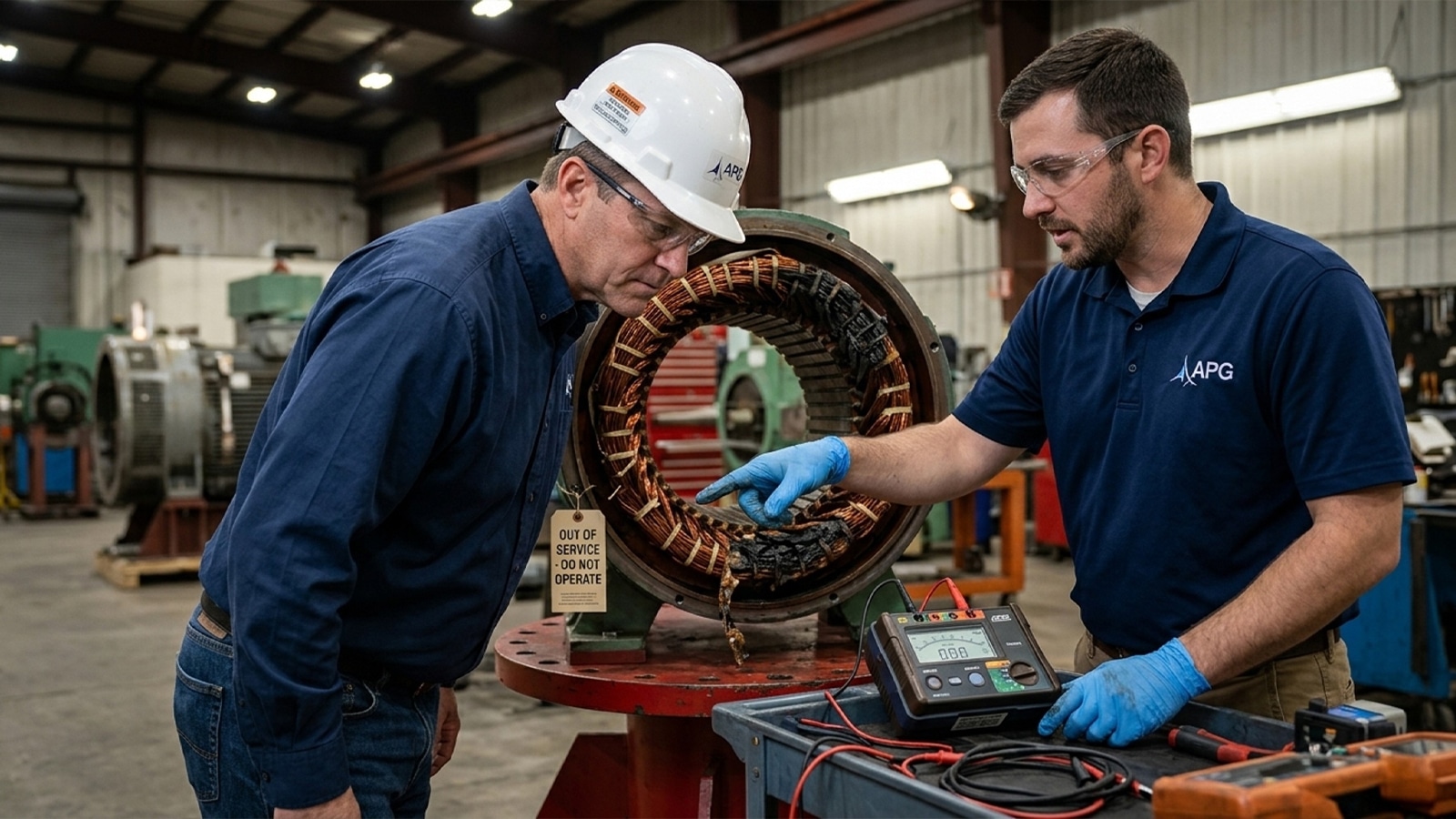
Falling insulation resistance readings point to insulation aging well before outright failure, as does a Polarization Index trend that drifts downward across test intervals. Shorted or turn-to-turn faults inside the stator winding often surface first as localized heating or uneven current draw in a single coil, and these faults will fail a surge comparison test even when the unit still runs. Excitation problems and unstable flux readings can also trace back to winding damage rather than a rotor or exciter fault, so identifying the root cause matters before scoping any repair.
Physical and Mechanical Warning Signs
Burned or discolored coils, brittle or cracked insulation, and contamination from oil or moisture are visible signs that a problem is already underway. A single failed coil can sometimes be the first visible clue that the entire winding is degrading, and arcing at the end-winding is a serious red flag. On the mechanical side, unexplained efficiency loss, rising vibration, and a climbing bearing temperature trend often accompany winding damage, since a degraded stator or rotor rarely fails in isolation from the rest of the machine. Any combination of these signs, especially paired with falling electrical test results, calls for a full diagnostic check rather than a wait-and-see approach. If your own trend data looks like this, it’s worth getting a second set of eyes on it before the next scheduled outage.
Industrial Generator Rewind Process: Step-by-Step
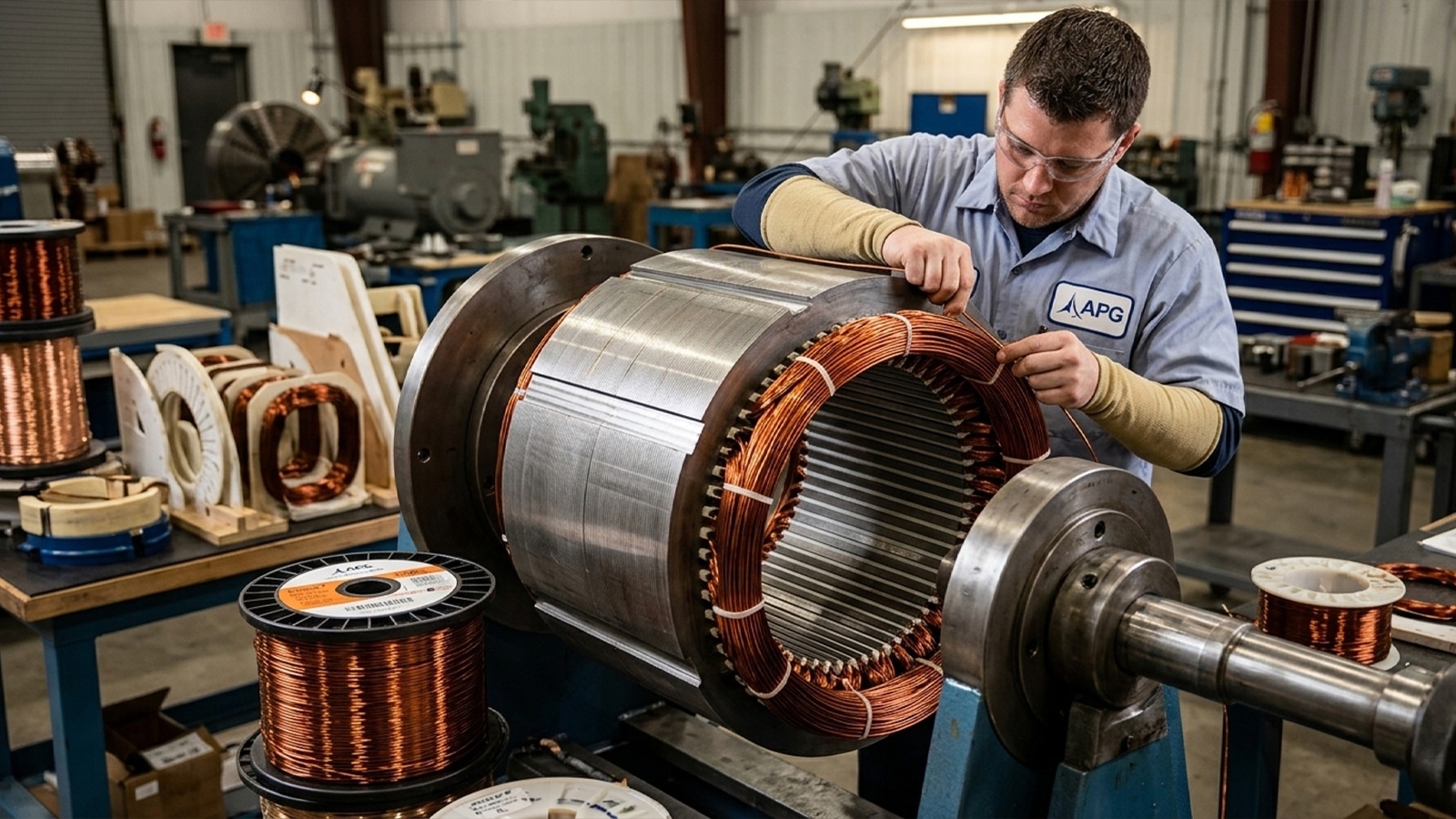
Here is the rewind process broken into the steps a qualified repair shop actually follows, matching the testing and workmanship standards a plant manager should expect to see documented in writing.
Initial Diagnostic Testing
- Baseline testing starts with a Polarization Index (PI) test, megohm readings from a Megger or megohmmeter, and surge comparison testing. These steps establish the condition of the winding before any disassembly begins.
Disassembly, Core Inspection, and Rewinding
- Complete disassembly comes next. The stator slot layout and end-winding setup are documented so that the new coil geometry can be built to the exact original shape.
- The damaged copper windings are removed, after which the stator core is checked using ELCID testing and a lamination check to rule out flux-related hot spots that could cause another failure.
- New windings are wound using the correct wire gauge and Class F or Class H insulation matched to OEM spec, with each coil formed to fit its original stator slot.
VPI, Reassembly, and Final Testing
- Vacuum Pressure Impregnation (VPI) fully insulates and seals the new windings against moisture and contamination, locking each coil in place with an even varnish fill. This is what allows the new copper to hold up against the electrical and thermal stress of continuous operation. The goal at this stage is to insulate every coil uniformly, since a weak spot in the varnish fill can undermine the entire rewind down the line.
- Reassembly comes next, including rotor balancing to remove radial vibration before the unit is torqued back to spec.
- Final electrical and mechanical testing, including non-destructive evaluation (NDE) of key parts, confirms that the rewound generator meets OEM performance before it returns to service.
Generator Rewind vs. Replacement: Cost and Downtime Comparison
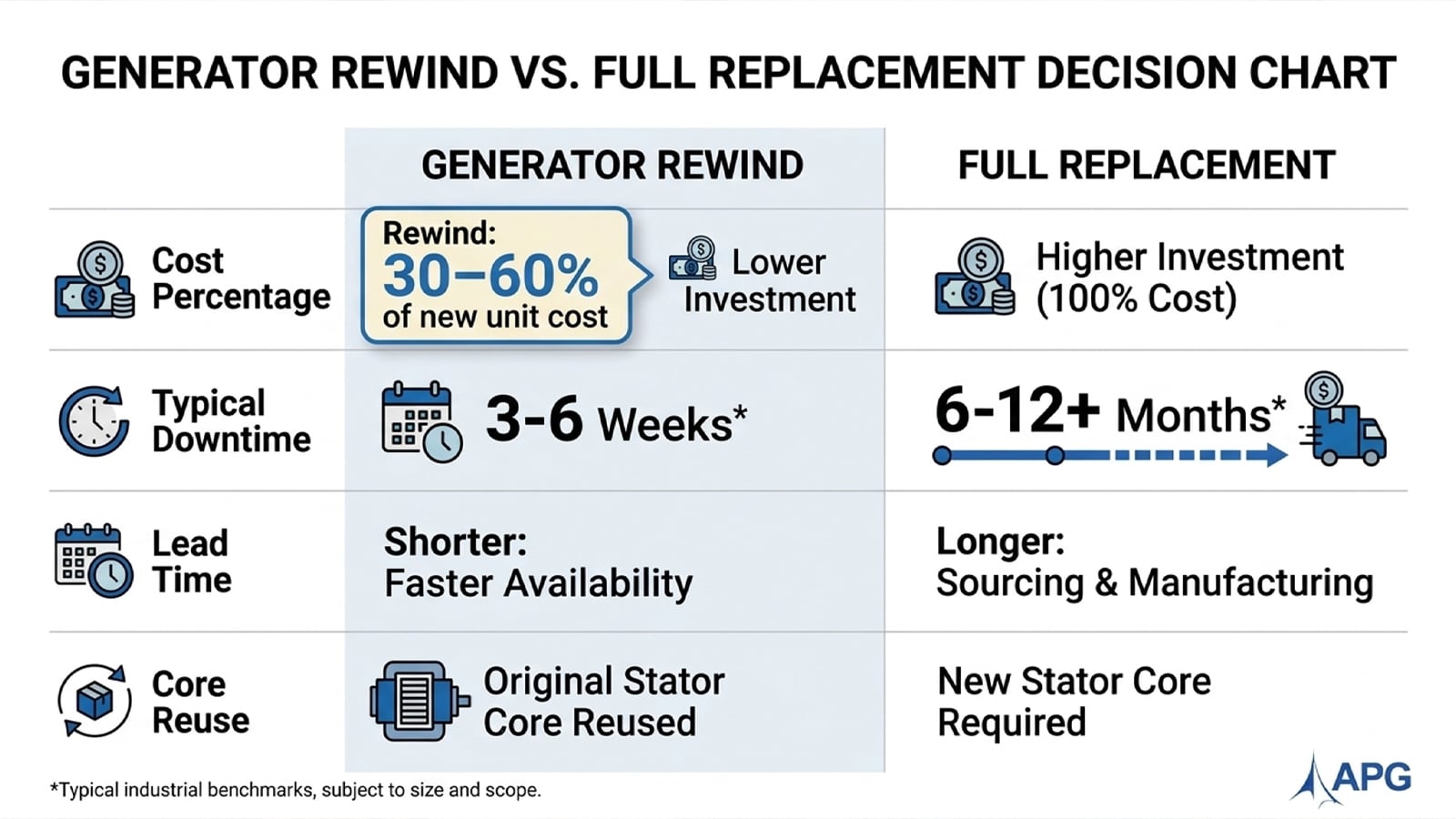
The rewind-versus-replace choice usually hinges on core and rotor condition. If both test sound, a stator rewind is generally the more cost-effective route. If core damage is present, or a unit has already been rewound several times, full replacement becomes the safer long-term choice for steady power generation.
Rewind cost typically runs 30 to 60 percent of a new OEM unit’s price, according to EPRI-referenced industry guidance. OEM replacement lead times for large MW-class generators can extend many months to over a year, while a rewind is measured in weeks. A rewound stator backed by a documented test record can come close to matching its original lifespan. Replacement resets the service clock entirely, but at full capital cost.
Rewind vs. Replacement at a Glance
| Factor | Generator Rewind | Full Replacement |
|---|---|---|
| Typical cost | 30-60% of new unit price | 100% of new OEM unit price |
| Typical downtime | 3-8 weeks | Several months to 1+ year (OEM lead time) |
| Best suited for | Sound core/rotor, isolated winding failure | Core damage, repeated failures, obsolete OEM platform |
| Risk profile | Low, when backed by full diagnostics | Low, but high capital exposure |
For a closer look at how to weigh these factors for a specific unit, see our guide on how to know if your generator needs a rewind vs. replacement.
What Insulation Class and Testing Standards Apply to a Generator Rewind?
Insulation Class Requirements
Class F and Class H insulation systems are rated under NEMA MG-1 and IEC 60034. They set the highest allowed operating temperature rise and determine which wire coating and varnish are used on each coil during the rewind. The choice depends on the OEM platform and the operating temperature the unit runs at in normal service, not a one-size-fits-all default.
Post-Rewind Testing Standards
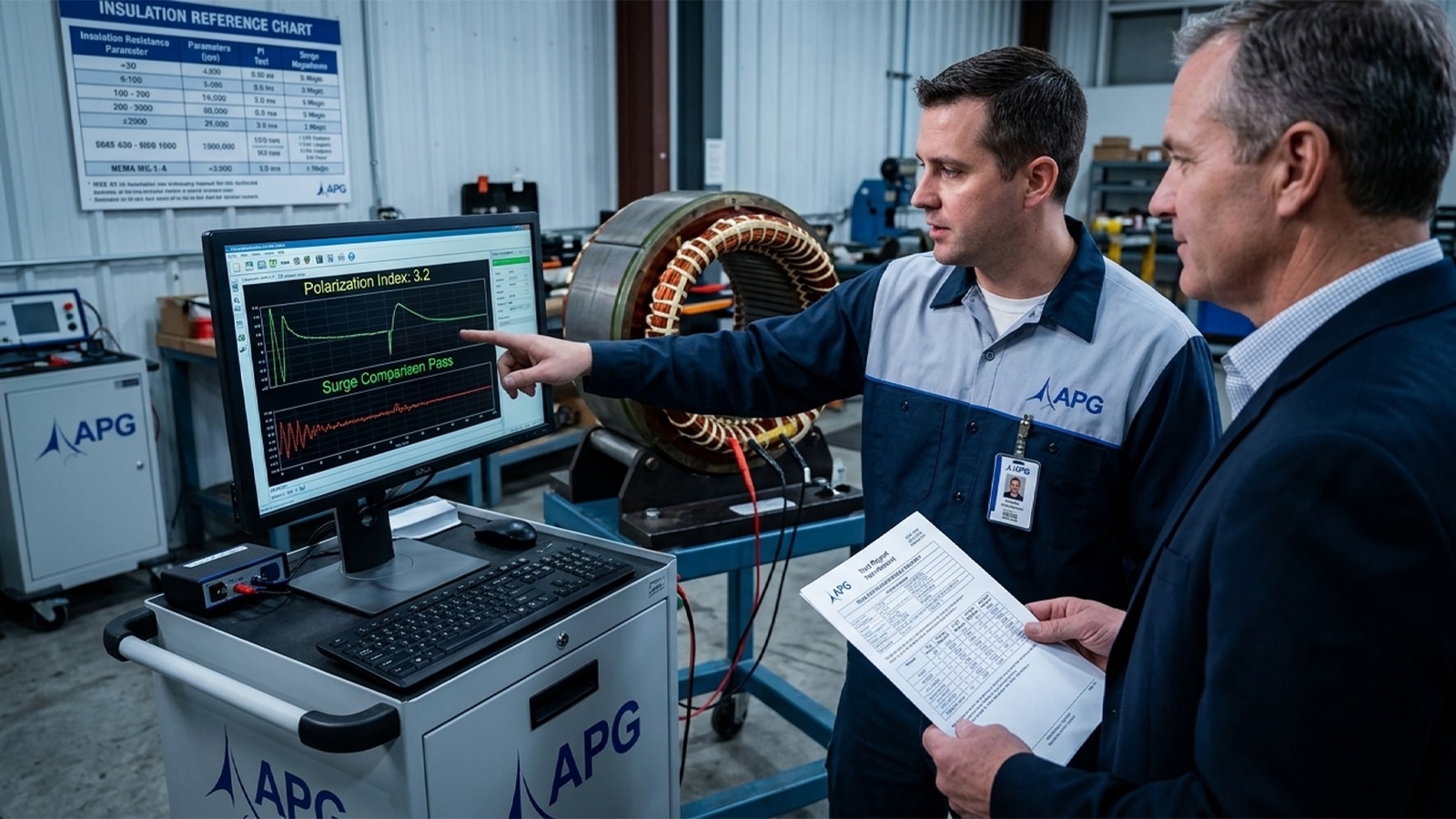
After rewinding, the winding must pass a documented set of electrical tests. Insulation resistance is measured with a Megger or megohmmeter, and the Polarization Index (PI) test is run per IEEE 43 to confirm that the insulation is dry and free of contamination. Surge comparison testing catches turn-to-turn shorts in a coil that a simple resistance reading would miss. Core condition is confirmed through ELCID testing, while electromagnetic performance is checked with no-load and rated-load run tests on the reassembled three-phase, 60 Hz unit. Mechanical condition is checked against ISO 10816-3 vibration limits before the generator is cleared to return to service.
On one recent industrial rewind, ELCID testing during core inspection turned up a localized lamination fault. Left unnoticed, it would have caused a repeat failure within months. Instead, the core issue was corrected before rewinding moved forward, which is a good reminder of why core inspection isn’t a step worth skipping to save a few days on the schedule.
What to Look for in a Generator Rewind Contractor
Choosing the wrong repair shop is one of the costliest mistakes an IPP plant can make on a rewind, since workmanship problems often don’t surface until the unit is back under load. A few pointed questions during the bidding process can save a lot of grief later.
Contractor Vetting Checklist
- EASA-affiliated, with documented workmanship standards from the Electrical Apparatus Service Association
- Proven experience on GE, Siemens, and Alstom generator OEM platforms, where winding and rotor specs differ considerably
- On-site testing and diagnostics capability for turbine generators, which cuts handling risk and turnaround time
- Written warranty covering both the rewind and the VPI work, not just a verbal promise
- Clear quality control documentation and a turnaround commitment in writing, backed by responsive technical support throughout the outage
A shop that satisfies every item on this list gives you an objective basis for comparison, rather than a sales pitch. If a contractor hesitates to put any of this in writing, treat that as useful information in itself.
Conclusion
A generator rewind, done correctly, restores a unit’s performance to original OEM spec, but only when it’s backed by real diagnostic data and standards-based workmanship rather than guesswork. Getting the sequence right, from PI and megohm testing through VPI and final load testing, is what limits downtime and protects the plant’s generation revenue over the life of the machine.
Every generator rewind decision should start with real diagnostic data, not a guess. Allied Power Group evaluates stator and rotor condition against IEEE 43, IEC 60034, and NEMA MG-1 standards before recommending a rewind or replacement path, so your plant avoids unplanned downtime and unnecessary capital spend. If your unit is showing insulation resistance decline, vibration anomalies, or repeated trips, a phone call is a reasonable first step before any repair contract gets signed. Reach our technical team at (281) 444-3535 to talk through your unit’s test data and next steps.
FAQ
How long does it take to rewind a generator?
Most industrial generator rewinds take three to eight weeks from initial diagnostics through final testing. The exact timeline depends on stator size, how much rotor work is needed, and lead times for copper and insulation materials. A qualified contractor should confirm a firm schedule in writing before work begins.
How much does an industrial generator rewind cost?
An industrial generator rewind typically costs 30 to 60 percent of a new OEM unit’s price. That range shifts based on winding damage, rotor condition, and unit size, which is why an on-site diagnostic evaluation remains the only reliable way to get an accurate quote for a specific machine.
What are the signs a generator needs to be rewound?
The clearest signs a generator needs to be rewound are falling insulation resistance, a declining Polarization Index trend, and shorted or turn-to-turn faults confirmed by surge comparison testing. Burned coils, unexplained vibration, and rising bearing temperature often accompany these electrical signs. Professional testing, not visual inspection alone, should confirm the diagnosis.
What is the difference between a generator rewind and a replacement?
A generator rewind replaces the damaged windings while reusing a sound core and rotor, whereas a replacement swaps out the entire unit instead. The right choice depends on core and rotor condition, cost, and downtime tradeoffs, and that decision should rest on documented test data rather than age alone.
What insulation class is used in generator rewinds?
Generator rewinds typically use Class F or Class H insulation systems rated under NEMA MG-1 and IEC 60034. The specific class chosen depends on the OEM platform and the operating temperature the unit is expected to run at. A specialist will confirm this before rewinding begins.
How do you test a generator after rewinding?
A generator is tested after rewinding using Megger or megohmmeter insulation resistance testing, a Polarization Index test per IEEE 43, surge comparison testing, ELCID core testing, and no-load and rated-load run testing. Documented results, not a verbal sign-off, should be the deliverable from any contractor at project close.
What does a generator rewind entail in terms of ongoing maintenance for a large power generator?
A generator rewind resets the winding’s service life, but it doesn’t eliminate the need for ongoing monitoring. Tracking insulation resistance, vibration, and bearing temperature data over time helps catch future problems from mechanical wear, corrosion, or leakage early. This is best managed through a qualified service partner performing regular load testing and field rewind support as needed. If it’s been a while since your last diagnostic check, that’s a reasonable place to start the conversation, whether or not a rewind ends up being the answer.