

Your Power Partner
GE 7FA Hot Gas Path Inspection Guide
Your EOH counter just crossed into territory that means one thing: a 7FA Hot Gas Path Inspection is coming up on the calendar, and the planning window is already shrinking. A GE 7FA Hot Gas Path Inspection is a scheduled teardown that examines the stage 1 through stage 3 turbine nozzles, buckets, shrouds, and combustion hardware for cracking, oxidation, coating loss, and dimensional wear. It uses borescope inspection and fluorescent penetrant inspection (FPI) to assess parts before deciding what gets repaired, replaced, or returned to service. Our GE Frame 7F turbine services team scopes these outages for independent power producers running 7FA fleets toward their next EOH threshold.
This inspection sits in the middle of GE’s maintenance hierarchy, between a Combustion Inspection and a Major Inspection. Getting the scope right matters more than most plant teams expect. A unit that’s slightly off on its maintenance factor can walk into an outage window unprepared for what the borescope finds.
Key Takeaways
- GE 7FA Hot Gas Path inspections are typically due around 24,000 Equivalent Operating Hours or 1,200 to 4,800 starts, whichever arrives first depending on duty cycle.
- A typical HGPI outage runs 21 to 35 days, with repair-versus-replace decisions driving most of the cost and schedule variance.
- Scope centers on stage 1 through 3 nozzles, buckets, shrouds, and combustion hardware overlap, inspected using borescope and FPI methods.
- Parts budgets commonly range from $500,000 to $2 million or more depending on thermal barrier coating condition, cracking, and oxidation severity.
- The choice between OEM and an independent service provider directly affects turnaround time, parts flexibility, and overall outage risk.
What Components Are Inspected During a Hot Gas Path Inspection?
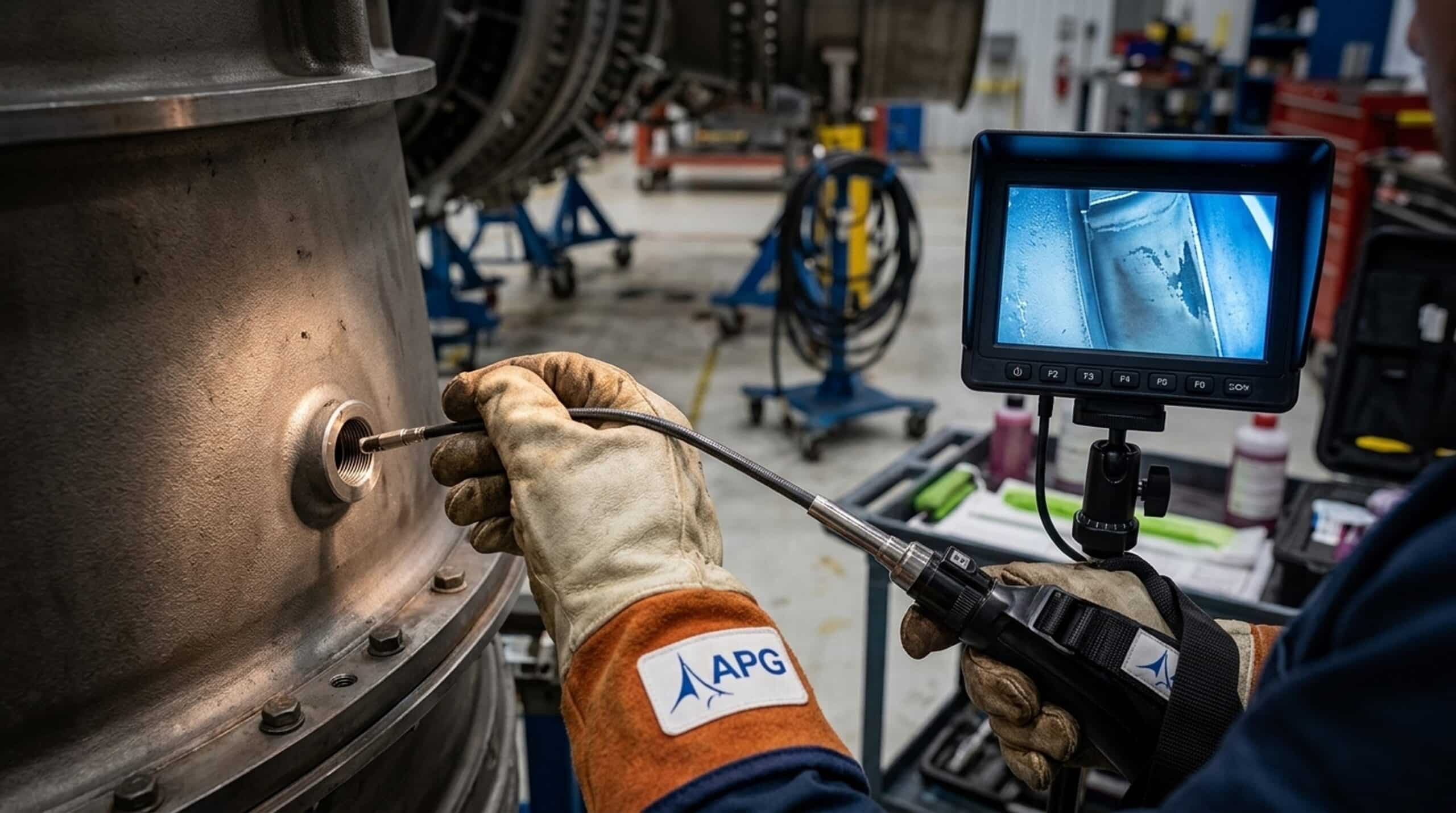
A Hot Gas Path Inspection on a GE 7FA gas turbine opens the casing to reach the hottest, highest-stress section of the machine. The first stage turbine nozzle and first stage turbine bucket take the brunt of combustion temperatures and get the closest scrutiny. But the inspection doesn’t stop there. Stage 2 and stage 3 nozzles, buckets, and shrouds all come out for examination, along with the diaphragm and stator components that guide gas flow between stages.
Hot Gas Path Components and NDT Methods
Technicians run a borescope inspection first, while the casing is still largely intact, to get a visual read on blade tip rub, coating condition, and obvious cracking without a full disassembly. Once hardware is pulled, fluorescent penetrant inspection, a nondestructive testing method that reveals surface-breaking cracks invisible to the naked eye, confirms whether a part is a repair candidate or scrap. Thermal Barrier Coating (TBC) condition gets particular attention, since TBC spallation speeds up oxidation of the base metal underneath. Units running a DLN (Dry Low NOx) combustion system often show different wear patterns around the transition piece and first stage vane. DLN tuning drift changes flame position and temperature distribution across the hot gas path, and that shift shows up in the gas turbine rotor repair inspection data.
If any of this sounds like it applies to a unit you’re currently tracking, it’s worth getting a second set of eyes on your last borescope results before you finalize scope.
HGPI vs. Combustion Inspection vs. Major Inspection
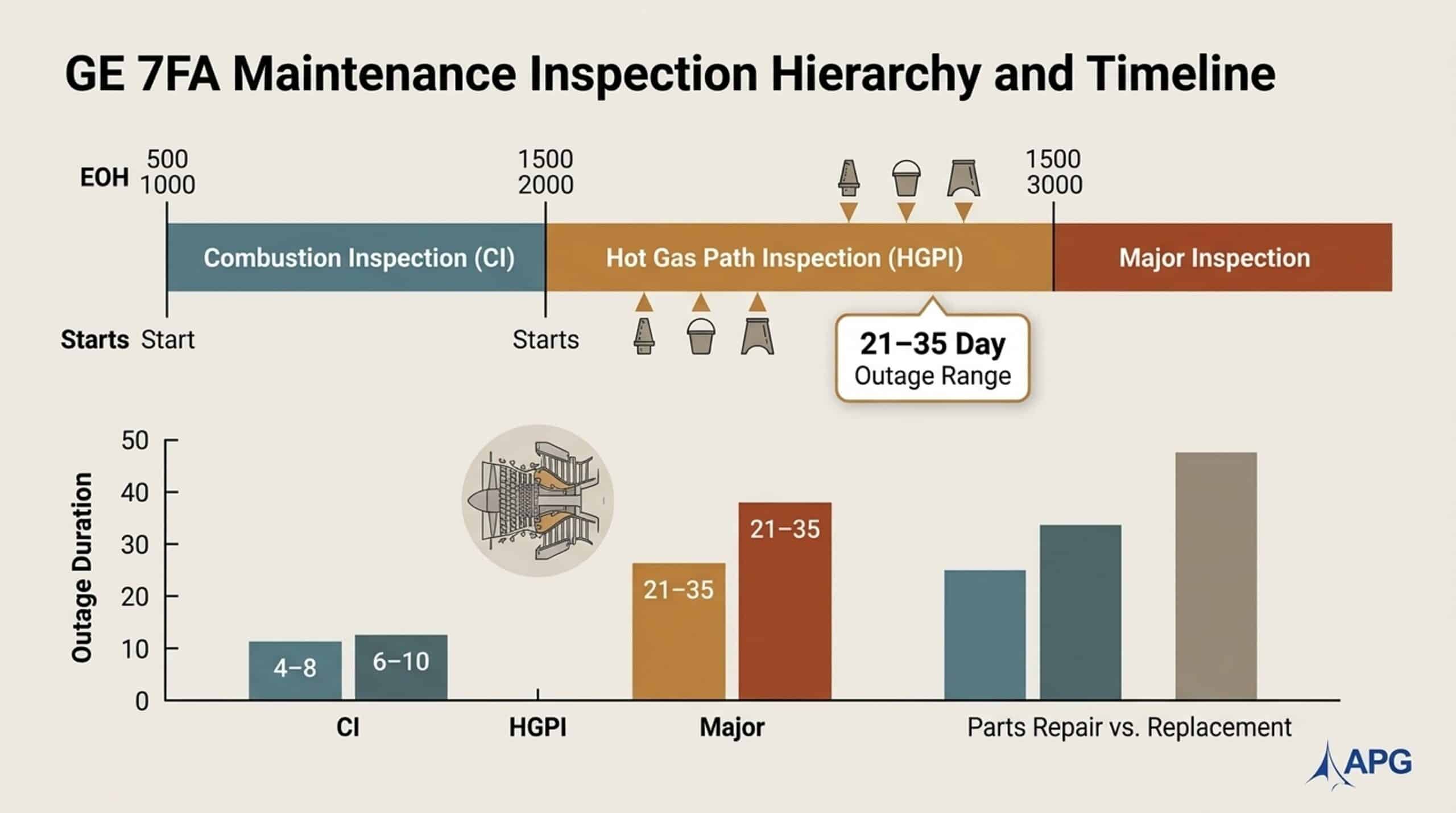
GE’s GER-3620 technical reference is the document most operators cite when defining where one inspection tier ends and the next begins [1]. A Combustion Inspection touches only the combustion chamber hardware, fuel nozzles, and liners. Because that scope is narrower, combustion inspections are typically scheduled more often and completed in a fraction of the time an HGPI requires. A Hot Gas Path Inspection absorbs everything a CI covers and adds the full rotor-side hardware in stages 1 through 3. A Major Inspection goes further still, opening the compressor casing and rotor for inspection.
| Inspection Type | Scope | Typical Outage Duration |
|---|---|---|
| Combustion Inspection (CI) | Combustion liners, transition pieces, fuel nozzles | 4-7 days |
| Hot Gas Path Inspection (HGPI) | CI scope plus stage 1-3 nozzles, buckets, shrouds | 21-35 days |
| Major Inspection (Major) | HGPI scope plus compressor rotor, stators, bearings | 28-45 days |
What Is the Interval for a GE 7FA Hot Gas Path Inspection, and What Drives Cost and Duration?
GE’s published guidance puts the 7FA Hot Gas Path Inspection interval around 24,000 Equivalent Operating Hours (EOH), or somewhere between 1,200 and 4,800 starts, depending heavily on duty cycle [2]. That’s a wide range, and it’s wide on purpose. A baseload unit that rarely cycles leans toward the hours-based threshold. A peaking unit with frequent starts and stops hits its starts-based threshold long before the hours add up, because each start-stop cycle consumes more component life than an equivalent hour of steady baseload running.
Equivalent Operating Hours and Maintenance Factor
EOH isn’t a raw hour count. It’s a weighted figure that factors in fuel type, peak-fired operation, and number of starts against a baseline maintenance factor GE assigns per duty profile. A 7FA unit running on gas fuel at baseload accumulates EOH differently than one cycling daily or burning a lower-grade fuel, which is one reason turbine efficiency varies so widely across otherwise identical fleets. For comparison, a 7EA gas turbine follows a different interval curve entirely, largely due to lower firing temperatures. Fleets running mixed frames shouldn’t assume one platform’s maintenance factor applies to the other.
What Accelerates Hot Gas Path Wear
A few operating conditions consistently push units toward their HGPI threshold faster than the calendar suggests:
- Frequent starts and fast-start operation, which impose thermal cycling stress beyond raw hour count
- DLN combustion system tuning drift, which shifts flame temperature distribution across the first stage turbine nozzle
- Peak load operation above base rating, which raises firing temperature and speeds up creep
- Fuel quality issues, including contaminants that speed up hot corrosion
- Technical Information Letters (TILs) that update inspection criteria for specific component revisions and should be checked before locking outage scope
Cost and Duration Ranges to Budget For
Parts costs for a 7FA HGPI typically fall between $500,000 and $2 million or more, swinging on nozzle segment cracking severity, TBC spallation extent, and bucket tip wear [3]. Outage duration runs 21 to 35 days under normal findings, stretching further if emergent damage forces unplanned rotor access. Long-lead forgings and coated components often need 6 to 12 months of procurement lead time. That’s why parts planning has to start well before the outage window is confirmed, not after. Labor, crane mobilization, and rigging costs scale directly with how many days the unit sits open, so compressing schedule has a real dollar impact beyond the parts invoice, and understanding gas turbine repair costs up front helps avoid budget surprises mid-outage. Plants that stay disciplined about scheduling their combustion inspections on the shorter CI cycle also tend to walk into the eventual HGPI with fewer surprises, since recurring combustion inspections catch liner and transition piece degradation before it compounds into hot gas path damage. If you’re weighing whether a part is worth repairing versus replacing outright, our guide on repair versus replace decisions for 7FA.04 components walks through that tradeoff in more detail.
This is also where the OEM-versus-independent service provider decision matters most. OEMs typically run sequential, standardized procedures that can stretch outage duration when findings deviate from the plan. An experienced independent shop offering dedicated component repair services can often run inspection, NDT, and repair work streams in parallel and adjust scope in the field without waiting on a layered approval chain. That flexibility is one reason a full-service independent provider can cut total downtime versus a strictly OEM-managed outage. If you want a sense of what that looks like in practice on a 7FA fleet, our team is generally happy to walk through a past outage with you for comparison.
Conclusion
A GE 7FA Hot Gas Path Inspection outcome depends less on luck and more on three things: accurate scope definition, parts ordered early enough to beat the lead time, and a crew capable of handling whatever the borescope finds without blowing the schedule. Plants that treat these as separate problems tend to get surprised. Plants that line them up ahead of the outage tend to come back online on budget and on time.
The clearest way to de-risk the outage ahead of you is to get your actual EOH and starts data in front of someone who scopes 7FA units for a living, before the outage window locks in. If you’d like to talk through where your unit stands, call Allied Power Group at (281) 444-3535 or visit our GE Frame 7F service page for more on how we approach these outages. There’s no pressure to commit to anything on that first call, just a chance to compare notes on your numbers while there’s still time to secure parts and crew availability.
FAQ
What is included in a GE 7FA Hot Gas Path inspection?
A GE 7FA Hot Gas Path inspection includes the stage 1 through 3 turbine nozzles, buckets, shrouds, and the combustion hardware overlap zone inspected under HGPI scope. Borescope inspection and fluorescent penetrant inspection confirm part condition before disposition decisions are made. Unit-specific variance means scope should always be confirmed against current TILs before the outage is finalized.
What is the interval for a GE 7FA hot gas path inspection?
The interval for a GE 7FA hot gas path inspection is approximately 24,000 Equivalent Operating Hours, or 1,200 to 4,800 starts depending on duty cycle [2]. Maintenance factor adjustments shift this threshold per unit based on fuel type, cycling frequency, and peak load history. A professional EOH review is the only reliable way to confirm where a specific unit actually stands.
How long does a 7FA hot gas path inspection take?
A 7FA hot gas path inspection typically takes 21 to 35 days from shutdown to startup. Emergent findings, such as unexpected cracking or rotor-adjacent damage, can extend that window if parts weren’t pre-ordered. Experienced crews cut schedule risk by running inspection and repair tasks in parallel rather than strictly in sequence.
What is the difference between a combustion inspection and a hot gas path inspection on a 7FA?
A combustion inspection covers only the combustion liners, transition pieces, and fuel nozzles, while a hot gas path inspection covers that same scope plus the stage 1 through 3 nozzles, buckets, and shrouds. The HGPI is a deeper, longer outage because it requires opening further into the turbine casing. The comparison table above outlines the duration difference between the two tiers.
How much does a GE 7FA hot gas path inspection cost?
A GE 7FA hot gas path inspection commonly costs between $500,000 and $2 million or more in parts alone, depending on coating condition and cracking severity [3]. Labor, rigging, and crane costs scale with outage duration on top of that parts figure. A professional repair-versus-replace assessment before the outage locks in is the most effective way to control total cost.
What components are inspected during a hot gas path inspection?
The components inspected during a hot gas path inspection include the first stage turbine nozzle, first stage turbine bucket, stage 2 and 3 nozzles and buckets, shrouds, and combustion hardware overlap. Borescope inspection and FPI are used by qualified technicians to assess crack initiation and coating loss. In-house visual checks alone generally aren’t enough to catch subsurface cracking that FPI reveals.
Can a hot gas path inspection be done without a major overhaul?
Yes, a hot gas path inspection is a distinct, narrower scope than a Major Inspection and does not require opening the compressor or rotor. HGPI stops at the stage 1 through 3 turbine hardware and combustion components. Scope boundaries should still be confirmed with an experienced provider before the outage is booked, since emergent findings can occasionally justify expanding scope.
What is the difference between a hot gas path inspection and a major inspection for 7FA turbines?
A Major Inspection adds compressor rotor, stator, and bearing access on top of everything covered in a hot gas path inspection, making it the longest and most invasive tier. Typical Major outage duration runs 28 to 45 days compared to 21 to 35 days for an HGPI alone. Getting scope confirmed early by a qualified provider helps avoid budget surprises when the two tiers get conflated during planning.