

Your Power Partner
How to Know If Your Generator Needs a Rewind vs Replacement
A tripped generator or a failed insulation test doesn’t leave much room to think, but the decision that follows deserves more than a guess. The choice isn’t a coin flip based on which repair shop happens to answer the phone first, and it shouldn’t be treated like one. Working through generator rewind vs replacement decisions requires the same thing every time: verifiable test data, not opinion. If you’re weighing your options, our generator repair and replacement services start with diagnostics, not a sales pitch.
A generator typically needs only a rewind when damage is confined to the winding insulation and diagnostic testing confirms the core, rotor, and shaft are sound. Replacement becomes the safer path when core damage, rotor distortion, repeated failures, or an obsolete design are present, since those conditions carry risk a rewind cannot resolve.
Key Takeaways
- A rewind is viable when insulation resistance, surge comparison, and partial discharge testing confirm the stator core and rotor remain in good condition and the failure is isolated to the winding.
- Industry guidance treats 60% of new-unit cost as a practical ceiling; once a rewind quote approaches or exceeds that threshold, replacement is usually the more cost-effective long-term choice.
- Units older than 20-30 years with prior rewinds, efficiency losses, or obsolete parts carry more long-term risk even when a rewind looks cheaper today.
- Ask for IEEE 43, IEEE 56, and NEMA MG-1-referenced test reports before approving either path, since a serviceable unit should have documented proof, not a verbal assurance.
- An independent diagnostic assessment, not a repair quote, is the lowest-risk first step before scheduling an outage.
What Tests Determine If a Generator Winding Is Damaged?
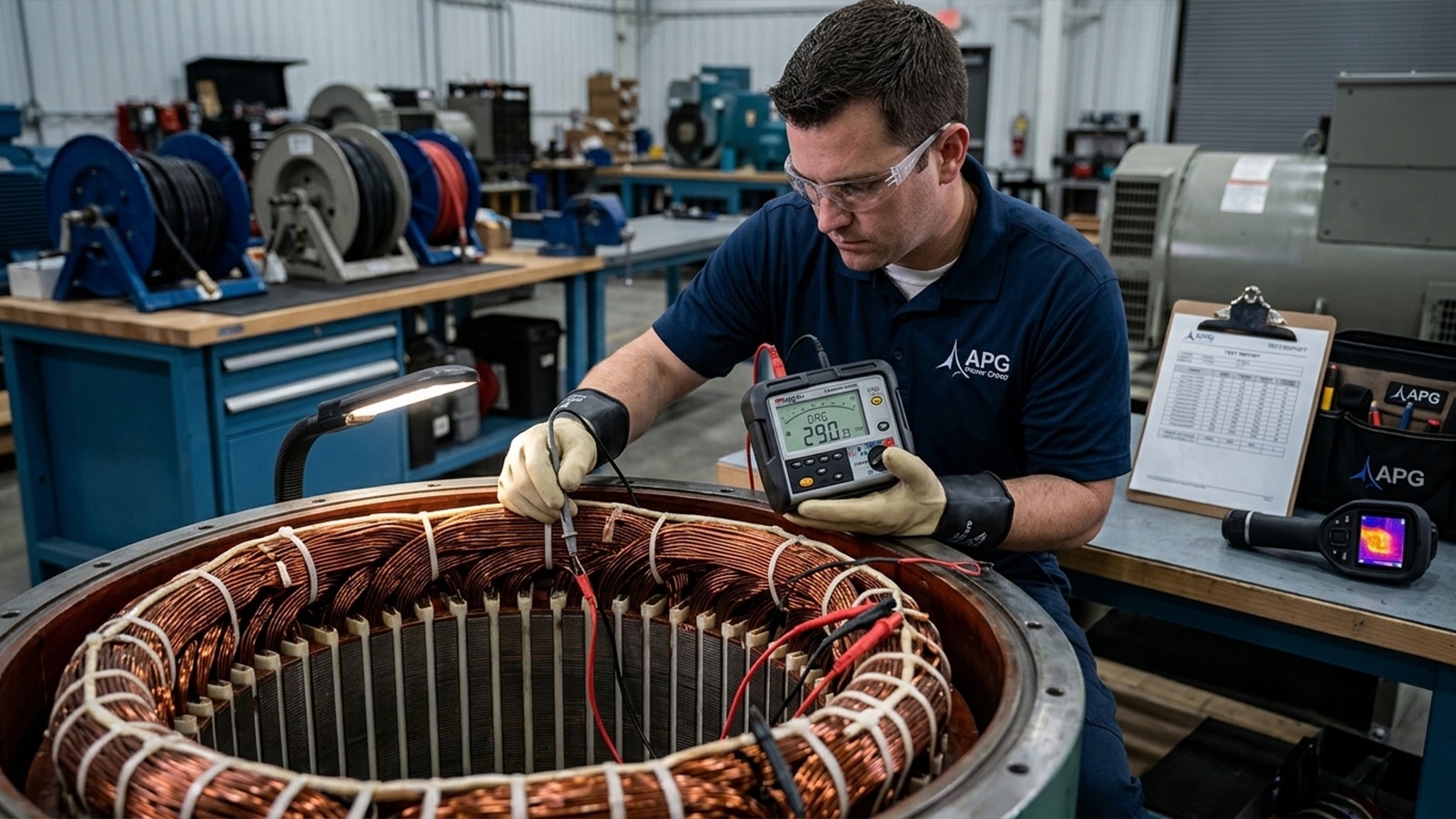
Symptoms like reduced power output, tripped breakers, or a burnt smell tell you something is wrong. They don’t tell you whether the damage is confined to the winding or has reached the core and rotor. That distinction determines everything downstream, and it can only be established through structured testing referenced against named standards, not visual guesswork. This is usually the point where it helps to have a second, disinterested set of eyes on the results.
Insulation Resistance and Polarization Index (IEEE 43)
Insulation resistance testing, typically performed with a Megger insulation resistance tester, measures how well the winding insulation resists current leakage to ground. IEEE 43 also defines the polarization index, a ratio that reveals whether insulation has absorbed moisture or contamination over time [1]. Older insulation systems are commonly evaluated against a polarization index minimum near 2.0 as a pass threshold. That gives plant managers a specific number to check against a vendor’s findings rather than taking their word for it.
Surge Comparison and Partial Discharge (PD) Testing
Surge comparison testing applies a voltage pulse to detect turn-to-turn shorts within the winding circuit, the kind insulation resistance testing alone can miss. Partial discharge testing goes a step further, identifying voids and early degradation inside the insulation before a full breakdown occurs. PD testing carries particular weight on medium-voltage stator windings above 4kV, where insulation stress runs highest.
Core Loss Testing and Visual/Thermal Inspection
Core loss, or iron loss, testing identifies damage to the laminations that make up the stator core, an area a rewind cannot repair. A visual inspection paired with thermal imaging rounds out the picture, revealing discoloration, overheat marks, or bearing-area contamination as physical evidence that either supports or contradicts the electrical data. Together, these five tests form the objective evidence base that should back any rewind recommendation. For a deeper look at how these procedures are run, see our generator diagnostic testing services.
Failure Modes That Favor a Rewind vs a Full Replacement
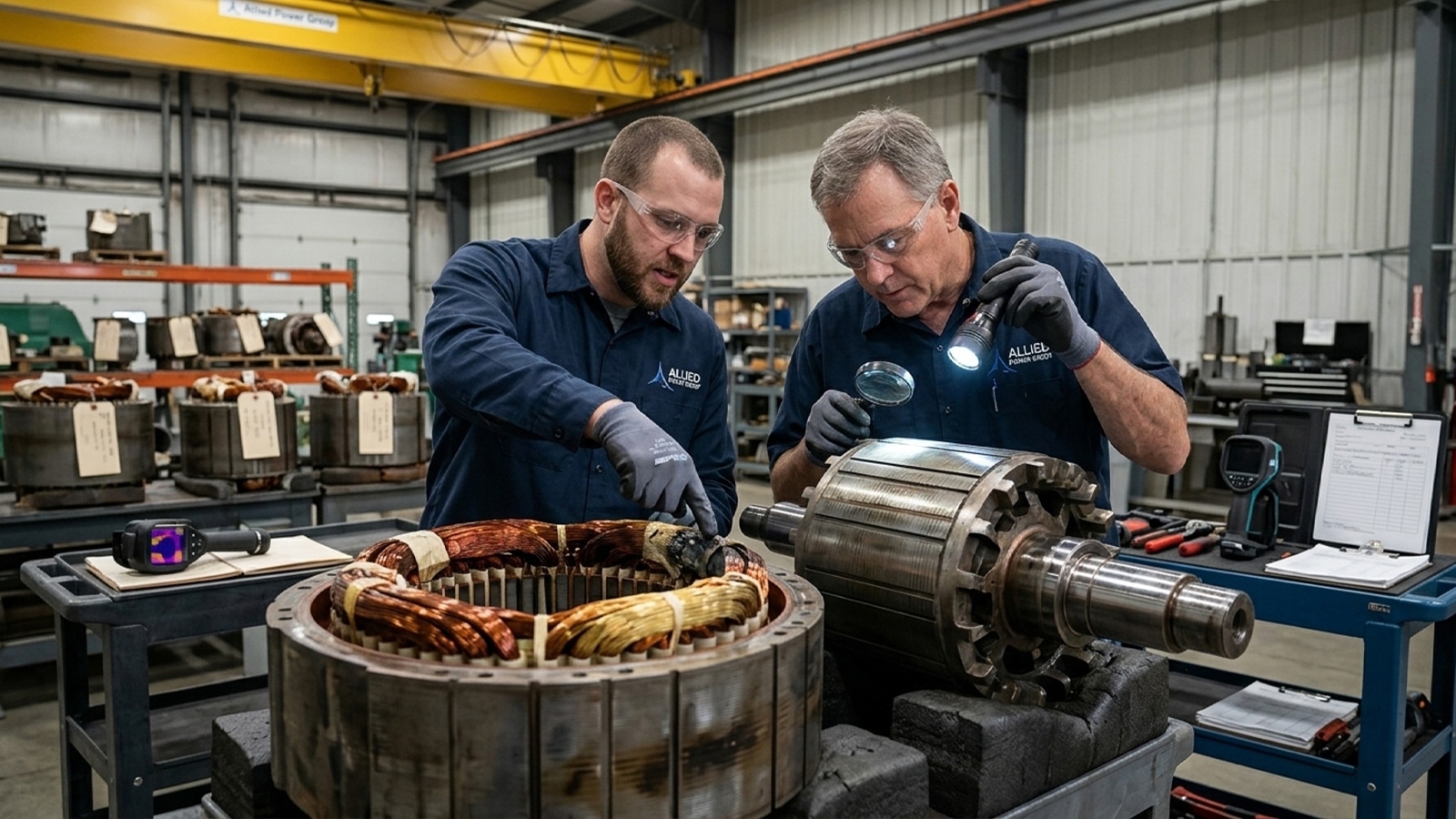
Not every failure carries the same risk profile. Matching the failure mode to the right repair path is where most bad decisions get made, and it’s worth getting a straight answer before capital gets committed either way.
Failure Modes That Favor a Rewind
- Localized winding failure isolated to one coil or phase, with the stator or rotor core otherwise intact
- Contamination from oil, dust, or moisture ingress that degraded insulation without damaging the core
- Age-related insulation breakdown where mechanical components remain in good condition
- A single-phase ground fault that tripped protection before spreading to adjacent windings
Failure Modes That Favor Replacement
- Core lamination damage found during core loss testing
- Rotor or shaft distortion from mechanical issues such as bearing failure or overspeed events
- Repeated failures on the same unit, a pattern that usually signals an unaddressed root cause rather than bad luck
- Obsolete OEM design with no parts support or engineering documentation available
- Catastrophic mechanical failure, such as a bearing seizure severe enough to damage the core
A generator that has already been rewound twice for the same failure signature is a red flag reliability engineers recognize industry-wide. It usually means the underlying cause, whether overload, contamination, or bearing current leakage, was never actually fixed. If your failure profile points toward an isolated winding issue, our industrial generator rewind services are built around confirming root cause before any coil goes back in.
How Much Does It Cost to Rewind a Generator vs Buy a New One?
Cost comparisons only work when they’re built on a consistent framework, not a single line-item quote.
The 30-60% Rule of Thumb
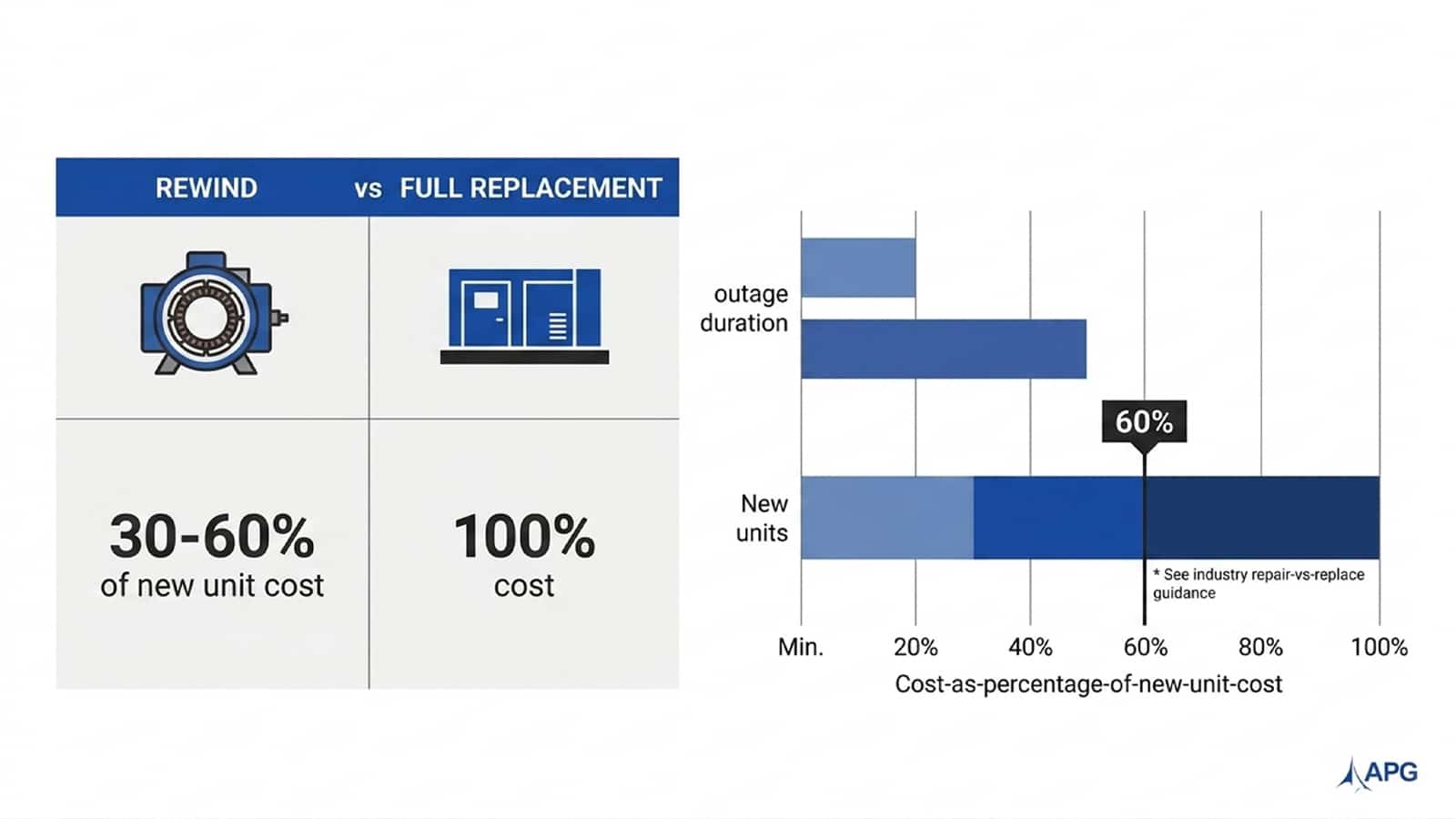
Rewind economics across rotating machinery, drawn from utility and EPRI-referenced repair-versus-replace guidance, generally hold that a rewind makes sense when its cost stays in the range of 30-60% of a new unit’s price [1]. Once a labor-intensive rewind quote, even one that includes VPI (vacuum pressure impregnation) reinsulation, starts to exceed that upper band, replacement usually becomes the better long-term value. A repair at that price only postpones the inevitable.
Factoring Downtime Into the Real Cost
A rewind is often faster to complete than sourcing and installing an entire new unit, since new equipment can carry long OEM lead times. But the true comparison has to include lost generation revenue during the outage, not just the repair invoice.
| Factor | Rewind | Full Replacement |
|---|---|---|
| Typical cost vs. new unit | 30-60% | 100% |
| Typical outage duration | Shorter, if core/rotor sound | Longer, new unit lead time |
| Best fit | Isolated winding damage | Core/rotor damage, obsolescence |
| Risk profile | Lower upfront, moderate long-term risk if root cause unresolved | Higher upfront, lowest long-term risk |
When Age and Efficiency Losses Tip the Decision Toward Replacement
How Age Affects Winding and Core Condition
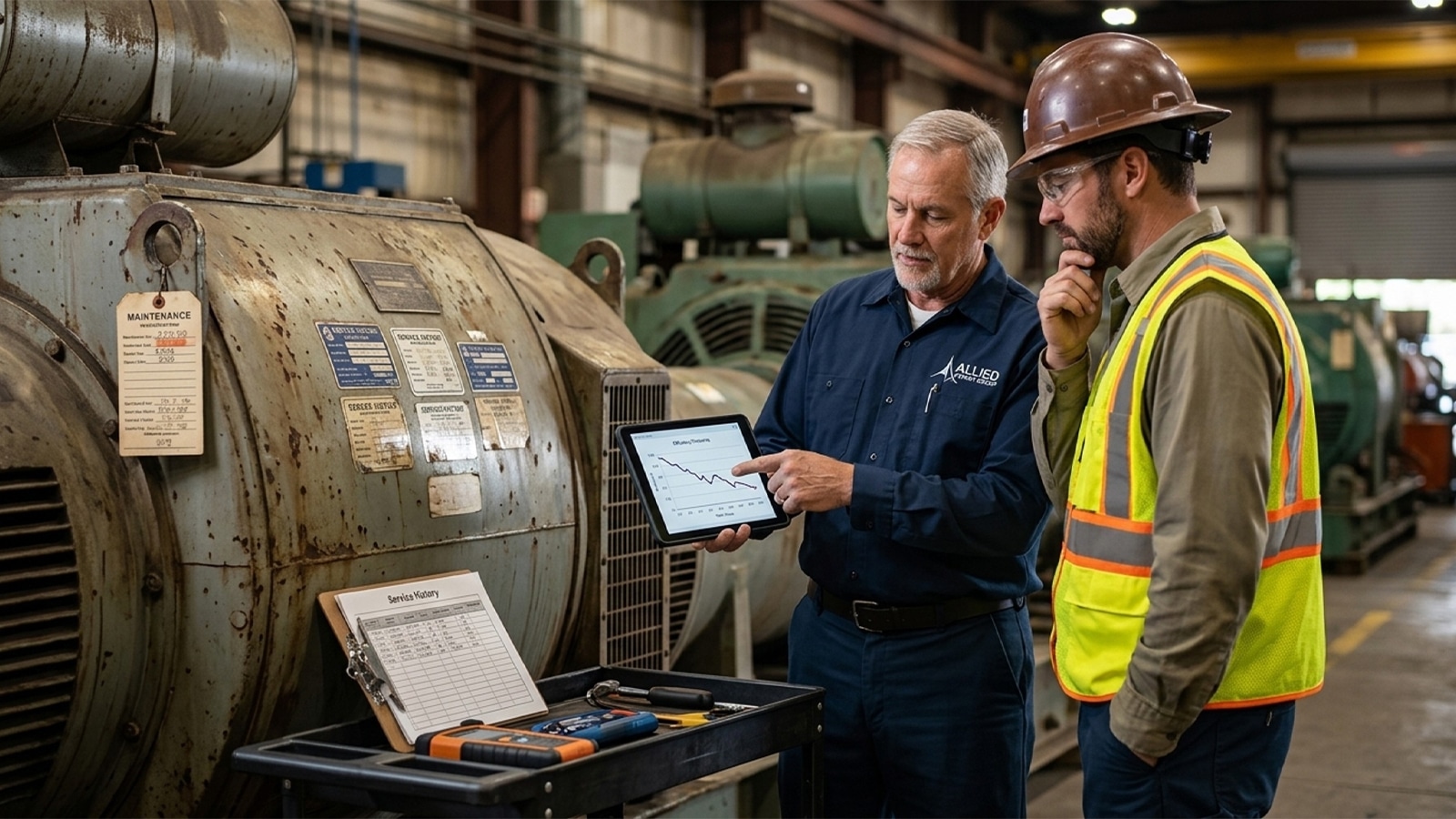
An old generator in the 20-30-plus year range often carries compounding risk beyond whatever failure just occurred. Years of thermal cycling degrade insulation systems gradually. Stator winding insulation commonly reaches the end of its reliable service life somewhere in a 25-40 year range, depending on operating environment and load history, a planning range widely cited in rotating-machinery reliability literature rather than a fixed number. Even standby and diesel generators used in backup or peaking roles show measurable efficiency decline over that span, separate from any single failure event.
When Obsolescence Outweighs a Lower Rewind Cost
A unit could technically run many more years after a rewind, but if its OEM design is obsolete and replacement parts are getting harder to source, the economics shift. Continued patching on an aging asset starts to look like a series of smaller bets rather than one clear decision. That pattern is where operational risk quietly builds. For plant managers weighing whether an aging turbine-generator train justifies continued investment, our steam turbine repair and overhaul work often runs alongside this same age-and-obsolescence evaluation.
Why an Independent Diagnostic Assessment Reduces Decision Risk
Most rewind-versus-replace decisions go sideways for one reason: the party recommending the fix is also the party quoting the fix. That’s not a knock on repair shops, it’s just a structural conflict worth naming. A vendor who only offers rewinds has an incentive to find a way to make a rewind work. A vendor who only sells new units has the opposite incentive.
An independent diagnostic assessment separates the finding from the sale. Test data, whether from insulation resistance testing, surge comparison, PD testing, or core loss testing, should point to the answer before anyone talks price. Allied Power Group’s role at this stage is to run the tests, document the findings against IEEE 43, IEEE 56, and NEMA MG-1 references, and let the numbers make the case. If a rewind is genuinely the right call, that’s what the report will say. If it isn’t, you’ll know before an outage is scheduled rather than after.
That’s also where vendor credentials matter more than most plant managers realize.
Questions to Ask Before You Approve Either Path
- Can you provide documented test reports (insulation resistance, surge comparison, PD, core loss), not just a verbal summary?
- Is the shop EASA-affiliated or otherwise certified to recognized rewind workmanship standards?
- What’s the warranty term on a rewind, and does it cover VPI reinsulation specifically?
- What’s the realistic turnaround guarantee, in writing, not a rough estimate?
- Has this unit had prior rewinds, and if so, was the root cause of the original failure ever identified?
A shop confident in its findings won’t hesitate to hand over the paperwork. If the answer is vague, that itself is useful information.
Conclusion: Choosing the Right Path Without Guessing
Rewinding restores a generator’s original performance only when diagnostics confirm the core and rotor are sound. When they aren’t, or when age and obsolescence have stacked the odds against a long-term fix, replacement makes more financial sense even at a higher upfront cost. The point isn’t to default to the cheaper option or the bigger one. It’s to know, with test data in hand, which one actually applies to your unit.
You now have the test names, cost thresholds, and failure patterns to hold any vendor quote up to real scrutiny, and the next move is a low-risk one. An independent diagnostic assessment, evaluating winding, core, and rotor condition before any repair recommendation, is the step to take before you schedule an outage or sign a capital request. Call (281) 444-3535 or request a Get Estimate and get an objective answer before you commit a dollar.
FAQ
How much does it cost to rewind a generator vs buy a new one?
Rewind costs typically run 30-60% of a new unit’s price, with the exact figure depending on frame size, winding configuration, and whether VPI reinsulation is required. Getting a precise number requires a diagnostic-based quote rather than a rough estimate, since coil count and copper condition vary unit to unit.
How long does a generator rewind take?
A generator or motor rewind timeline depends on unit size, winding complexity, and whether the shop needs to source replacement coil stock. Smaller frame units may turn around in days, while large industrial stators with full VPI processing can take several weeks. Accurate scheduling requires a shop’s inspection findings, not a general guess.
What is the average lifespan of an industrial generator stator winding?
Stator winding insulation systems commonly last in the range of 25-40 years before reaching the end of reliable service life. Actual lifespan depends heavily on thermal loading, contamination exposure, and maintenance history, which is why testing rather than calendar age should drive the rewind decision.
Can a burned-out generator be rewound?
A burned-out generator can often be rewound if the stator core and rotor survived the event without lamination damage or distortion. That determination requires core loss testing and a professional visual inspection, not a visual guess by plant staff, since core damage isn’t always obvious from the outside.
What tests determine if a generator winding is damaged?
Insulation resistance and polarization index testing per IEEE 43, surge comparison testing, partial discharge testing, core loss testing, and visual or thermal inspection together determine whether a generator winding is damaged. Interpreting the results correctly requires a certified testing lab or an EASA-affiliated rewind shop, since raw numbers without context can be misread.
Is rewinding a generator as good as new?
A properly executed rewind, insulated and varnished to spec with VPI processing and confirmed through surge and PD testing, can meet or exceed original performance. That outcome depends on the shop following EASA-recognized workmanship standards, which is a reason to verify a vendor’s certifications before approving the work.
What questions should I ask a rewind shop before approving a repair?
Plant managers should ask for documented test reports, warranty terms, and turnaround guarantees before approving any rewind or replacement. A technician’s word isn’t a substitute for written data, and an independent evaluator with no incentive toward one outcome over the other is the safer first call.