

Your Power Partner
GE 7FA Component Life: How Starts, Fired Hours and Cycling Affect Gas Turbine Lifespan
Fired hours, starts and trips each consume 7FA component life through distinct mechanisms. Hours drive creep and oxidation in Stage 1 to 3 buckets, nozzles and shrouds, whereas starts drive thermal-mechanical and low-cycle fatigue in liners, transition pieces and the rotor. Trips and fast starts multiply start damage considerably. Your schedule is set by whichever limit you reach first, hours or starts, so the practical question is when to repair or replace the affected hot gas path hardware, and a component repair plan built on your actual dispatch answers it better than a baseload calendar can.
Key Takeaways
- GE counts factored hours and factored starts independently, so whichever limit is reached first sets the interval.
- Hours cause creep and oxidation, while starts cause thermal-mechanical and low-cycle fatigue.
- Trips and fast starts inflate factored starts, so one trip can cost far more than one normal start.
- Re-baseline from historian data, not the original baseload calendar.
If your unit has recently shifted from baseload to cycling duty, the sections below are written for that exact situation. Most plant teams find that the hardest part is not the physics but knowing which of their own numbers to trust, so we have laid out where to look.
How Do Fired Hours, Starts and Trips Consume 7FA Gas Turbine Life?
What Do Fired Hours Do to Buckets, Nozzles and Shrouds?
At load, the hot gas path stays at high temperature for long stretches. Under that sustained stress the metal slowly deforms, a process known as creep. Surfaces oxidize, and thermal barrier coatings degrade and spall. Fuel quality and firing temperature set the pace, which is why GE ties hours-based factors to both. Stage 1 buckets and nozzles show the effects first, with shrouds close behind. Running the unit hotter or on heavier fuel speeds the clock.
Why Do Starts Consume More Turbine Life Than Running Hours?
An hour at load is steady-state. A start is a full thermal transient. Parts heat at different rates, so hot and cold sections push against one another, and every cycle adds a small increment of fatigue damage. NREL’s cycling study found that this damage accumulates and costs more than many operators assume. A gas turbine is built for steady running, so every start spends some of that margin, and a machine that starts daily burns through it far faster than one that runs for weeks at a time.
How Does Cycling Affect Combustion Liners, Transition Pieces and Turbine Buckets?
DLN 2.6 and 2.6+ liners and transition pieces crack where thermal gradients concentrate. At the 7F Users Group, members described 7FA.05 transition piece failures at one to two starts per day. One 7FA user reported a Stage 2 bucket creep failure at 22,300 hours and only 95 starts since its last HGPI. Buckets also lose coating at dovetails and leading edges as cycles pile up, and the rotor bore and wheel space regions see fatigue as well.
Which Cycling Events Add the Most Hidden Damage?
Some events do far more harm than a standard start:
- Trips from load, which thermally shock the hot gas path
- Fast starts and peaking fire, which raise ramp rates and firing temperature
- Part-load DLN mode transitions, where emission tuning and compressor airflow interact
- Aggressive startup ramps that outpace metal temperature equalization
- Steam-to-gas cooling transients after shutdown in a combined cycle plant
If several of these describe your current dispatch, that is a useful signal on its own. It usually means the original maintenance calendar deserves a second look before the next outage is locked in.
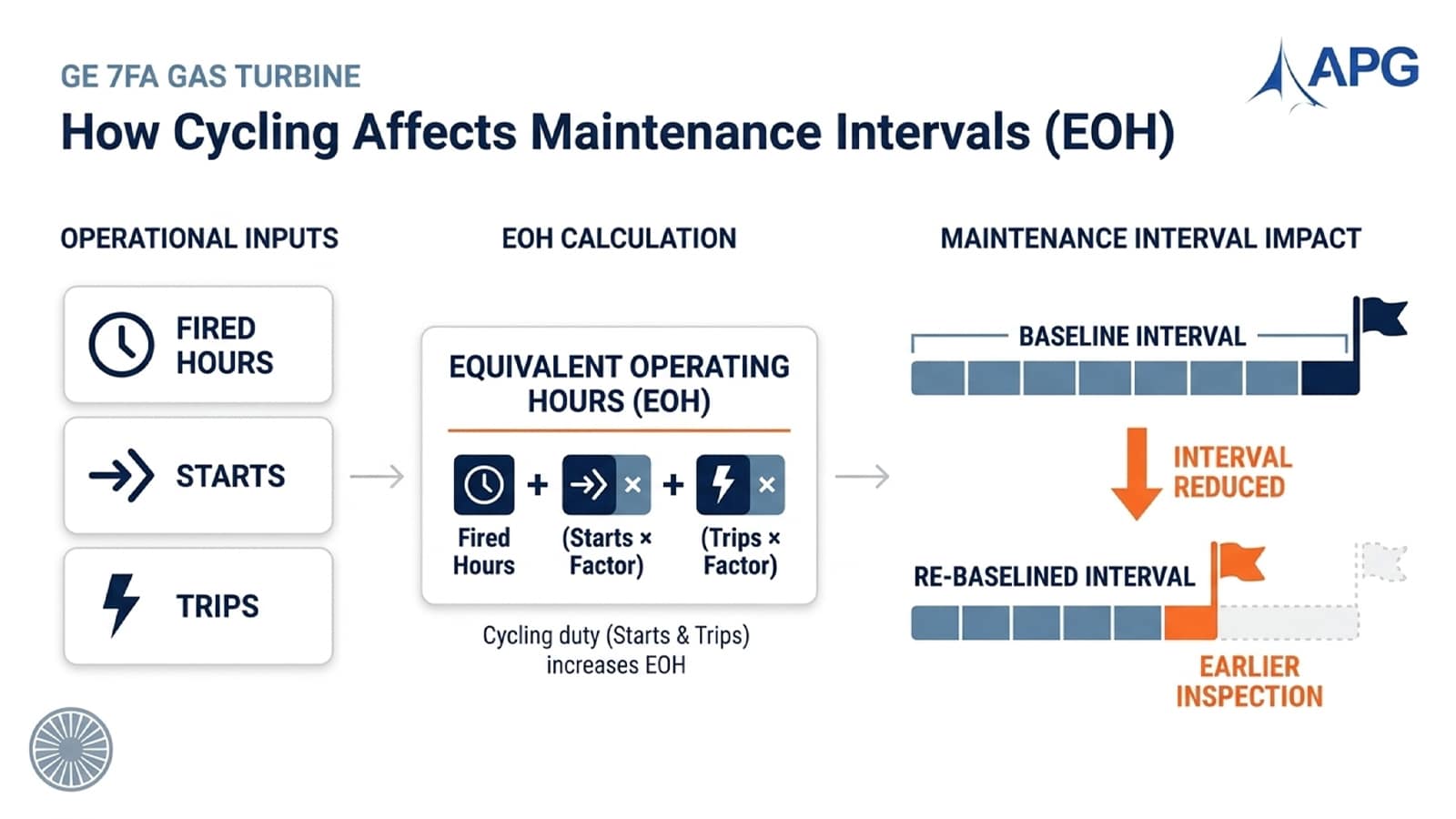
How Do You Calculate EOH and Re-Baseline Maintenance for a Cycling GE 7FA?
What Is the Equivalent Operating Hours (EOH) Formula for a Gas Turbine?
EOH equals fired hours plus a penalty per start, with trips weighted higher. The penalty varies by model and OEM, so confirm yours in the unit’s O&M manual and applicable TILs. GE’s own method tracks factored hours and factored starts separately and applies whichever limit comes first. Third-party multipliers are not GE-published values.
GER-3620 offers a useful case. A unit running 4,000 hours and 300 starts per year reaches its HGPI at about four years on GE’s starts criterion, but at about 2.4 years on an EOH basis. Published HGPI start counts range from 900 to 4,800 depending on model, duty and hardware, so they are not interchangeable.
What Does an 8,000-Hour Baseload vs. Cycling Comparison Look Like?
These figures are illustrative only. Picture two identical units over 8,000 hours, one running baseload and the other cycling. The baseload unit logs 8,000 hours and 20 starts. The cycling unit logs 8,000 hours and 400 starts, including several trips. At an assumed 20 EOH per start, the baseload unit consumes about 8,400 EOH and the cycling unit about 16,000. The hours are identical, yet the cycling unit has used nearly double the life. Your OEM-specific values will differ, which is exactly why the recalculation is worth doing with your own data.
How Long Does Each 7FA Component Last?
Limits below are indicative. Confirm against your O&M manual and TILs.
| Component | Hours-based limit | Starts-based limit | Repair vs. replace trigger |
|---|---|---|---|
| Combustion liners | Moderate | Primary limiter | Repair until cracks exceed weld limits |
| Transition pieces | Moderate | Primary limiter | Replace after repeated repairs |
| Stage 1 buckets and nozzles | Primary limiter | Significant | Recoat or weld repair; replace on creep |
| Stage 2 and 3 buckets and nozzles | Primary limiter | Secondary | Repair per distress findings |
| Rotor | 144,000 FFH | 5,000 FFS | Re-life or replace; long forging lead times |
For repair scoping, see our 7FA component repair guide, which walks through what is typically repairable and what is not.
What Is the Five-Step Process to Re-Baseline Your Intervals?
- Audit actual starts, hours and trips from historian data, and check historian sampling rates so short trips are not missed.
- Recalculate EOH and GE factored counts from that record.
- Re-baseline CI, HGPI and MI intervals against the first limit reached.
- Evaluate repair life extension: recoating, weld repair and re-lifing. Our bucket cracking guide covers what to look for.
- Stage spare parts before the outage, so shop and forging lead times do not dictate your schedule.
The plant historian is the source of truth. A calendar cannot see a trip. If steps 2 and 3 feel like a lot to do alongside daily operations, a second set of eyes on the numbers is a reasonable use of outside help, and it does not commit you to anything beyond the answer.
What Are the Warning Signs a Unit Is Consuming Life Faster Than Planned?
What Will a Borescope Tell You About Hot Gas Path Wear?
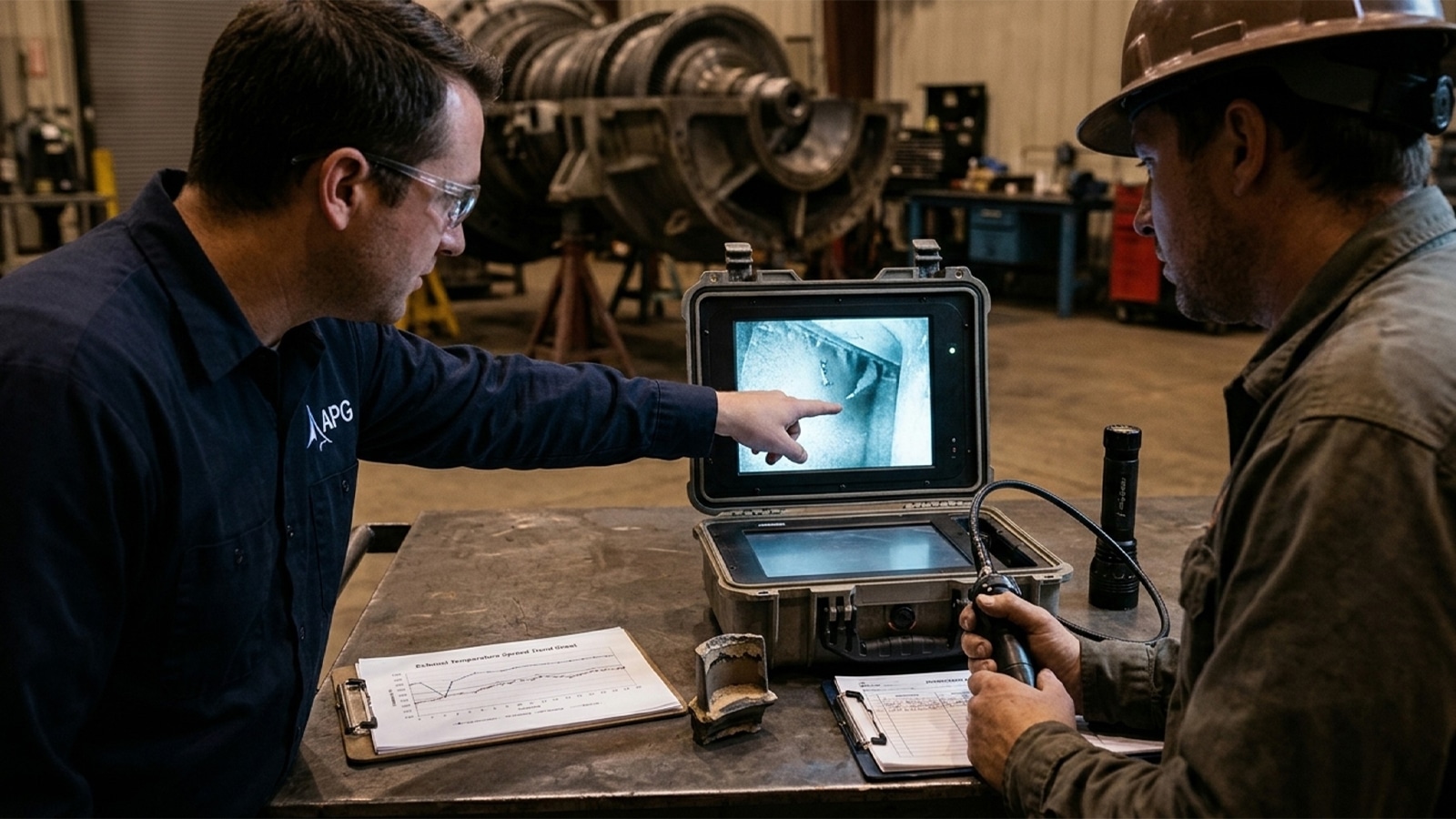
A borescope check can reveal TBC spallation, liner and transition piece cracking, and leading-edge distress on Stage 1 buckets. A missed bucket crack can liberate and turn a planned HGPI into an unplanned rotor event, so treat any new distress pattern as a reason to pull the next outage forward. Our HGPI guide helps with scope planning.
Which Performance Signals Show Up Before a Forced Outage?
Watch for these:
- Rising combustion dynamics during DLN mode transitions
- Widening exhaust temperature spread
- Falling turbine performance or heat rate drift, which ASME PTC 22 testing can validate
- More forced outages, tracked as EFOR and EFORd in NERC GADS data
Rising EFOR is the reliability signal ownership notices first, because it directly erodes capacity revenue.
What Does Cycling Cost?
The NREL and Intertek APTECH plant cycling study concluded that cycling carries real cost even for flexible plants. HGPI parts alone can run roughly $500K to $2M or more, with outages of about 21 to 35 days. Compare your trend against OEM TILs, and treat unexplained drift as an operational flag, one the control room operator should escalate rather than tune around.
Conclusion
A 7FA that now cycles needs a maintenance plan built on starts, hours and trips rather than the baseload calendar. You now have the method: audit the historian, recalculate EOH, re-baseline your intervals, evaluate repair life extension, and stage spares before the outage. That keeps the decision in your hands rather than leaving it to a forced outage.
If you would rather not build that picture alone, an operating-profile life assessment gives you a defensible number to take to ownership. Feel free to call us at (281) 444-3535 to talk through your unit’s duty profile. It is a conversation, not a commitment, and you will leave with a clearer sense of where you stand.
FAQ
What is the maintenance interval for a GE 7FA gas turbine?
GE 7FA maintenance intervals are set by factored hours and factored starts, with the first limit reached governing. GER-3620 provides the framework. Actual intervals depend on the model, hardware package, fuel and duty, so unit-specific factors and TILs must be reviewed against how you actually operate the unit and your real dispatch.
How many starts is a GE 7FA rated for before a hot gas path inspection?
A 7FA’s start limit before HGPI varies by model and start type. Public sources cite figures from 900 to 4,800 starts alongside 24,000 hours, with trips and fast starts counting extra. A professional audit of your unit’s factors yields the number that applies to you.
What is the equivalent operating hours (EOH) formula for a gas turbine?
EOH equals fired hours plus a per-start penalty, with trips weighted higher. The penalty is OEM and model specific, so third-party multipliers should not be used as published values. A unit-specific recalculation from historian data is the reliable approach.
Why do starts consume more turbine life than running hours?
Each start is a full thermal transient that drives low-cycle and thermal-mechanical fatigue, whereas steady running mainly drives creep and oxidation. A historian-based review shows which mechanism dominates your unit.
How does cycling affect combustion liners, transition pieces and turbine buckets?
Cycling cracks liners and transition pieces through differential expansion, and it also causes coating loss and fatigue distress on Stage 1 buckets. Borescope findings and a repair-versus-replace evaluation by a qualified professional show how far along each part is.
What is the difference between a combustion inspection, hot gas path inspection and major inspection?
A CI covers the combustion system, an HGPI adds the turbine-section hot gas path hardware, and an MI adds compressor and rotor scope, with full casing access. Scoping each with a repair provider avoids surprises, and the right depth depends on your counts.