

Your Power Partner
GE 7FA Inspection & Diagnostics Guide: A Plant Manager’s Framework for CI, HGPI, and Major Inspections
An outage window is coming, and the honest question underneath every planning meeting is which inspection tier actually applies and what happens if that call turns out to be wrong. This GE 7FA inspection guide exists because that question has a data-driven answer, not a guess made after the casing comes off. The GE 7FA fleet represents one of the largest installed bases of F-class gas turbines in North America, and that scale means inspection planning mistakes happen constantly. They carry real cost when they do. Allied Power Group works with independent power producers on gas and steam turbine diagnostics, and our engineering team supports plant managers evaluating GE Frame 7F turbine services before committing to an outage plan. If you’d like a second set of eyes on your findings, our team is reachable at (281) 444-3535.
Key Takeaways
- GE 7FA units follow three inspection tiers, CI, HGPI, and MI, each triggered by Equivalent Operating Hours (EOH) and starts count rather than a fixed calendar date.
- Unplanned outages can cost independent power producers 3 to 5 times the cost of a planned turbine inspections.
- Borescope-based diagnostics can catch coating loss and cracking early enough to defer or rescope a full teardown.
- Repair-versus-replace decisions on hot gas path components should hinge on remaining life and coating condition, not age alone.
- A written outage scope document, built before the turbine comes offline, is the single biggest lever for avoiding parts-lead-time surprises.
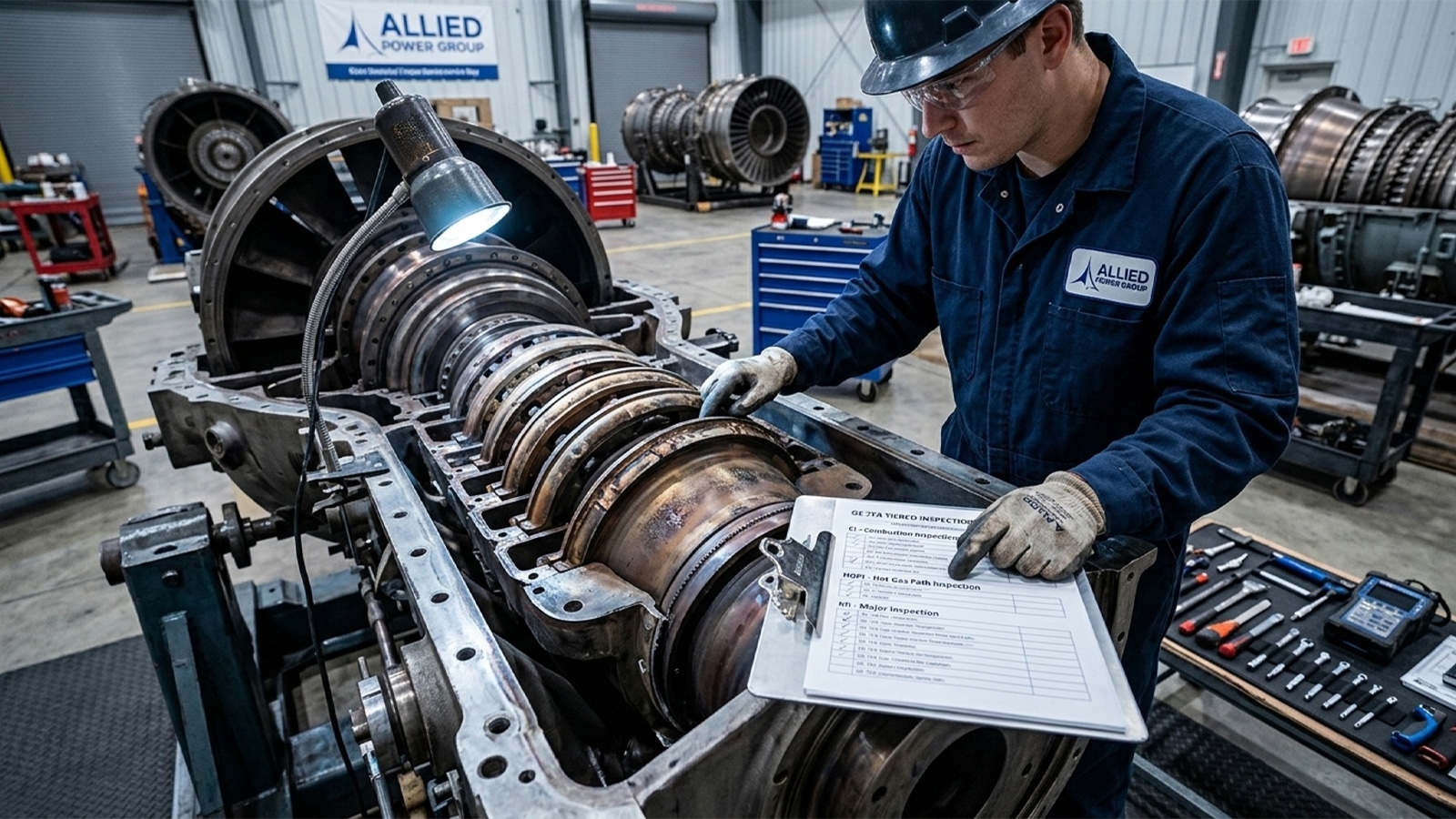
Understanding GE 7FA Turbine Inspection Tiers: CI, HGPI, and MI
Every GE 7FA operator works within three inspection tiers. Knowing which one applies right now is the first decision that shapes everything downstream. These tiers exist because gas turbine components degrade at different rates depending on thermal exposure and mechanical cycling, and the OEM-referenced interval methodology accounts for both.
Combustion Inspection (CI): The Shortest-Interval Checkup
A Combustion Inspection is the shortest-interval tier. It covers combustion liners, transition pieces, and fuel nozzles, the parts most directly exposed to flame temperature swings. Think of it as a routine checkup rather than a deep exam. It’s also one of the more frequent maintenance touchpoints in a 7FA’s operating life.
Hot Gas Path Inspection (HGPI): The Mid-Tier Assessment
A Hot Gas Path Inspection builds on the CI scope and adds stage 1 through 3 nozzles and buckets. It’s a mid-life exam. It catches problems the combustion-only tier simply can’t see.
Major Inspection (MI): Full Teardown Scope
A Major Inspection is the full physical. Complete disassembly. Rotor inspection. Bearing checks. It’s the longest-interval, most extensive tier a 7FA will see.
What determines which tier is due isn’t the calendar. It’s Equivalent Operating Hours, a calculated metric combining fired hours and starts. A unit that cycles frequently accumulates starts-based wear faster than one that runs steady baseload, so two 7FA units with identical fired hours can be due for very different inspections. Units with Dry Low NOx (DLN) combustion systems carry an added layer of inspection focus specific to that hardware, since DLN components behave differently under transient conditions than conventional diffusion combustion. Getting an accurate read on where your unit sits on the EOH curve is the starting point for every maintenance decision that follows. If you’re unsure how your current EOH count maps to a tier, that’s a reasonable thing to ask an outside engineering team to confirm before scheduling anything.
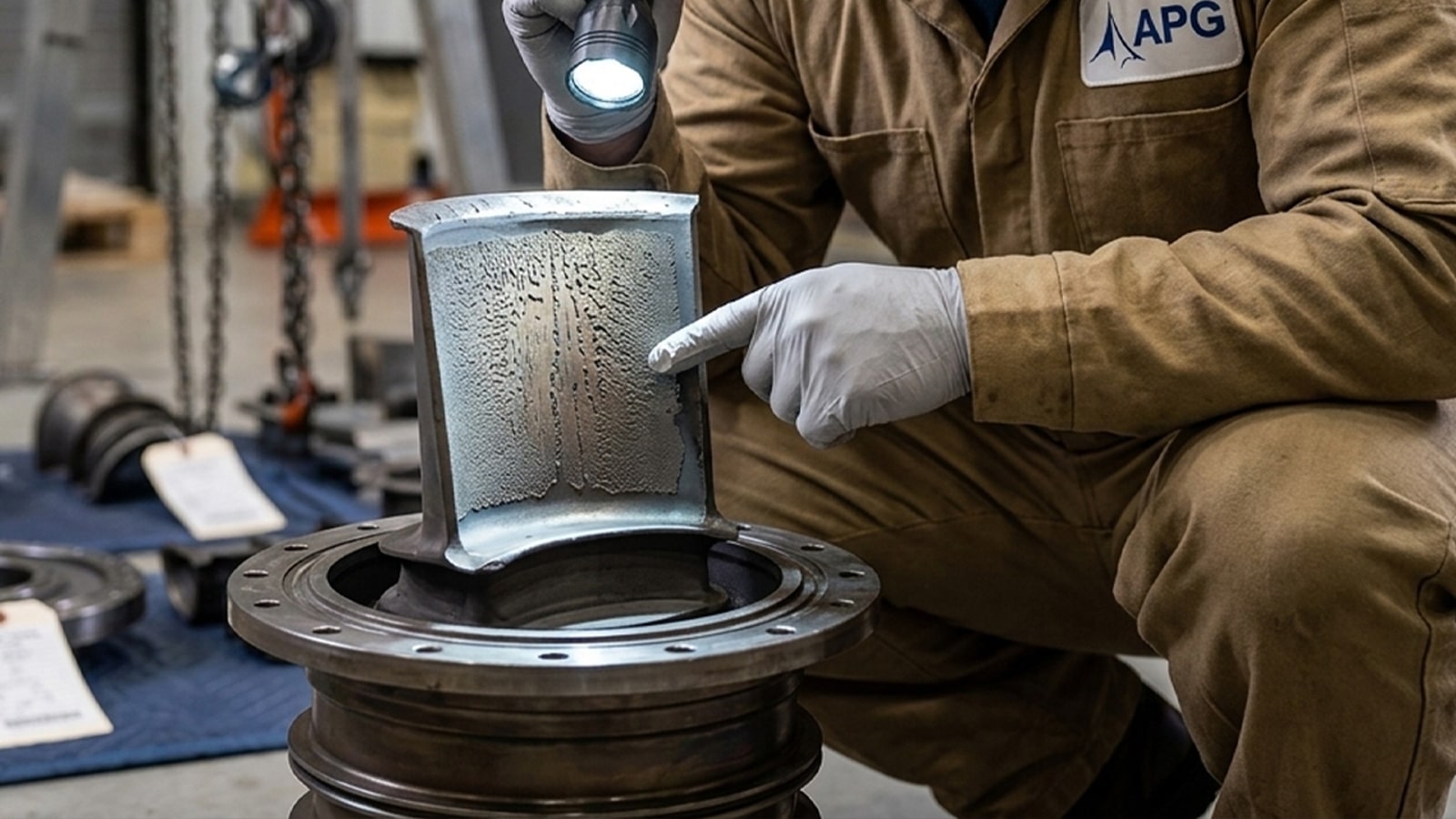
Hot Gas Path Inspection: What to Expect
The Hot Gas Path Inspection tends to be the one plant managers understand least. Partly because it sits in the middle. Partly because its scope can shift once the casing comes off.
What Gets Opened and Inspected
During an HGPI, technicians open the combustion hardware along with stage 1 through 3 nozzles and buckets, the components that see the highest thermal load in the entire gas turbine. This is the hot gas path in the most literal sense, the section directly exposed to combustion gas temperatures before they cool through the later turbine stages. Thermal Barrier Coating (TBC) condition on these parts is a central checkpoint, since coating integrity governs how much longer the underlying base metal is protected.
Typical Duration and Scope Triggers
Duration ranges vary because the plan on paper and the plan after inspection are rarely identical. If technicians find cracking beyond repairable limits, or coating loss deeper than expected, the scope expands mid-outage. That’s not a sign of poor planning. It’s the nature of inspecting components exposed to extreme thermal cycling. Hot gas path component failures account for a significant share of forced outages across F-class fleets, according to NERC GADS data, which is exactly why HGPI thoroughness matters more than schedule adherence. A partner who anticipates scope variability, rather than promising a fixed outcome regardless of findings, is doing the inspection honestly. Our team has walked through this exact scoping conversation with plant managers many times, and it’s usually worth having before the outage window locks in, not during it.
Borescope-Based Condition Assessment and Early Detection
Before any casing comes off, borescope inspection gives plant managers a way to look inside a running or recently shut down turbine without disassembly.
How Borescope Inspection Works
A borescope is a fiber-optic camera inserted through access ports built into the turbine casing. It’s a non-invasive visual inspection technique, and it’s typically the first diagnostic step before deciding whether a fuller teardown is warranted. Skilled operators can maneuver the camera around stage components to document surface condition without pulling a single bolt on the rotor assembly.
What It Catches vs. What Needs Teardown
Borescope inspections are effective at identifying:
- TBC spallation and visible coating loss on buckets and nozzles
- Surface cracking on hot gas path components
- Fouling debris or deposits in the compressor and turbine sections
- Visible signs of creep, the gradual deformation that occurs under sustained heat and stress
What a borescope cannot resolve is subsurface cracking, dimensional creep measurements, or bearing clearance, all of which require physical teardown and direct measurement. That distinction matters. Relying on visual findings alone can mean missing a defect that hasn’t yet broken the surface. Proper borescope inspection intervals can extend time between major inspections by identifying issues before they cascade into larger failures. Early detection through this diagnostic approach is often the difference between a scheduled repair and an unplanned trip.
Common 7FA Hot Gas Path Failure Modes
Understanding what actually breaks on a 7FA makes borescope findings and inspection reports far easier to interpret.
Bucket and Nozzle Cracking Mechanisms
Bucket tip cracking is one of the most frequently cited failure modes, driven by a combination of thermal cycling and mechanical stress at the tip where clearance is tightest. Creep and fatigue are the two long-term material degradation mechanisms behind most of this damage. Creep is the slow deformation that accumulates under constant high temperature and load. Low cycle fatigue, by contrast, results from repeated thermal and mechanical stress cycles, particularly on units that start and stop frequently rather than running steady baseload.
Coating Degradation and Combustion-Driven Trips
TBC bond coat oxidation is another common mode. As the bond coat oxidizes, it loses adhesion to the ceramic top coat, leading to spallation and exposing base metal to accelerated thermal degradation. Combustion liner thermal fatigue follows a similar pattern, driven by cyclic changes in firing temperature. On the trip side, combustion-related issues are among the leading causes of trips in DLN-equipped turbines. Worth remembering when reviewing turbine performance data after an unplanned event, since the root cause often traces back to the fuel nozzle and combustion hardware rather than something further downstream. For a closer look at how these modes develop, our breakdown of common 7FA failure patterns walks through each one in more depth.
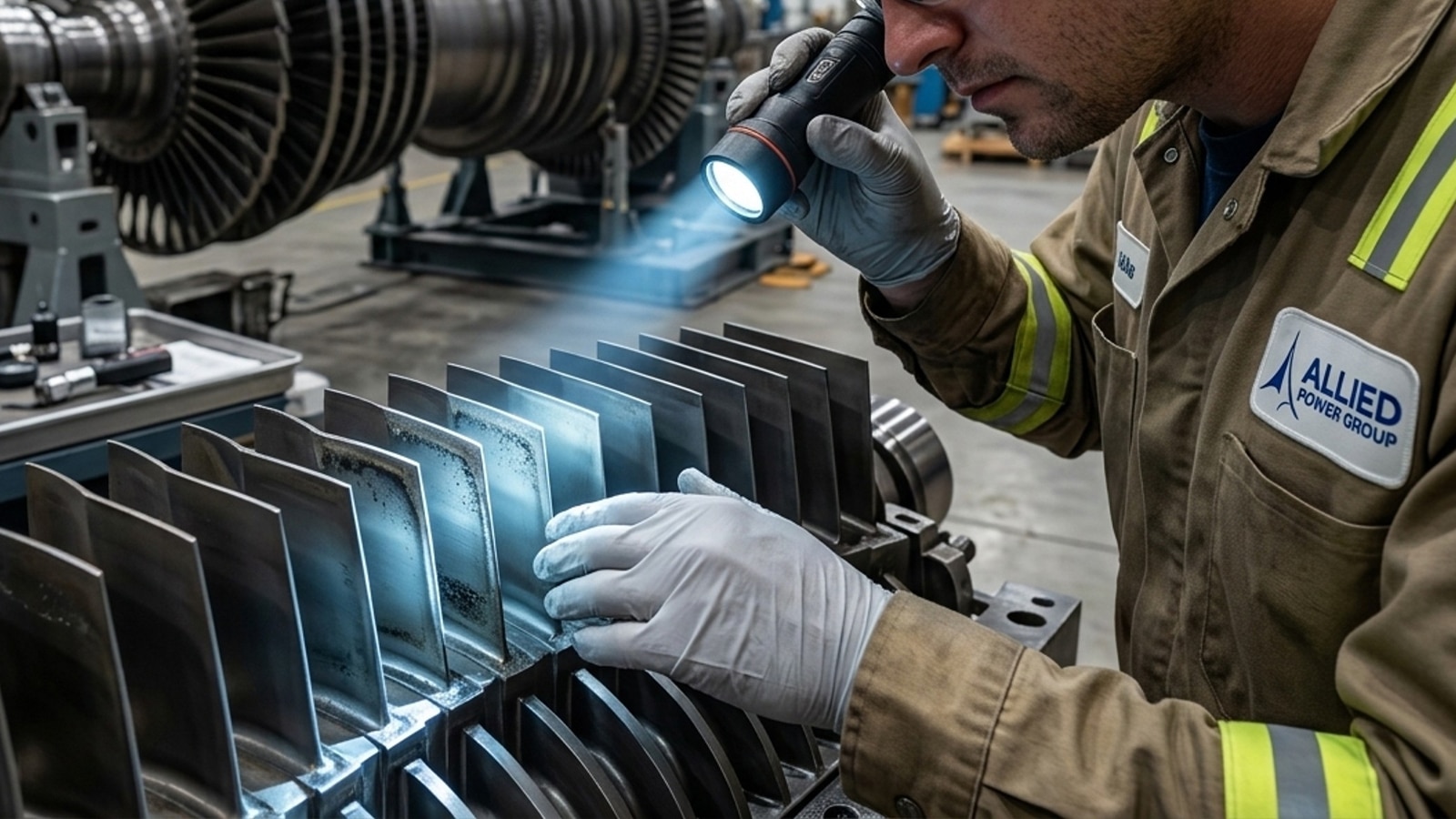
Compressor Section Diagnostics, Rotor and Bearing Inspection
Hot gas path components get most of the attention, but compressor and rotor diagnostics matter just as much, especially heading into a Major Inspection.
Compressor Fouling and Performance Loss
Compressor fouling, caused by airborne particulate accumulating on blade surfaces, erodes output and efficiency well before it becomes a mechanical risk. Detecting fouling early, often through compressor discharge pressure trends and periodic washing schedules, protects both efficiency and downstream turbine performance. It’s one of the simplest maintenance practices for extending time between major overhauls.
Rotor and Bearing Checks at Major Inspection
Rotor and bearing inspection guidelines become most relevant at the Major Inspection tier, since that’s the only point in the cycle where the rotor is fully accessible for direct measurement. Bearing clearances, journal condition, and rotor bore inspection all fall under this scope. None of it can be verified through borescope alone.
Reading Vibration and Temperature Spread Trends
Trend-based diagnostics, particularly vibration and exhaust temperature spread data, let plant managers move from reactive to predictive decision-making. A gradual rise in vibration amplitude or a widening temperature spread across exhaust thermocouples can signal a developing mechanical or combustion issue well before it trips the unit. The table below outlines general guidance for interpreting common trend signals.
| Trend Signal | Possible Cause | Recommended Action |
|---|---|---|
| Rising vibration amplitude | Bearing wear, rotor imbalance | Schedule unplanned inspection review |
| Widening exhaust temperature spread | Combustion or fuel nozzle issue | Borescope combustion section |
| Compressor discharge pressure drop | Compressor fouling | Schedule compressor wash |
| Gradual output decline at steady load | Multiple factors, including fouling and clearance loss | Trend against EOH and starts count |
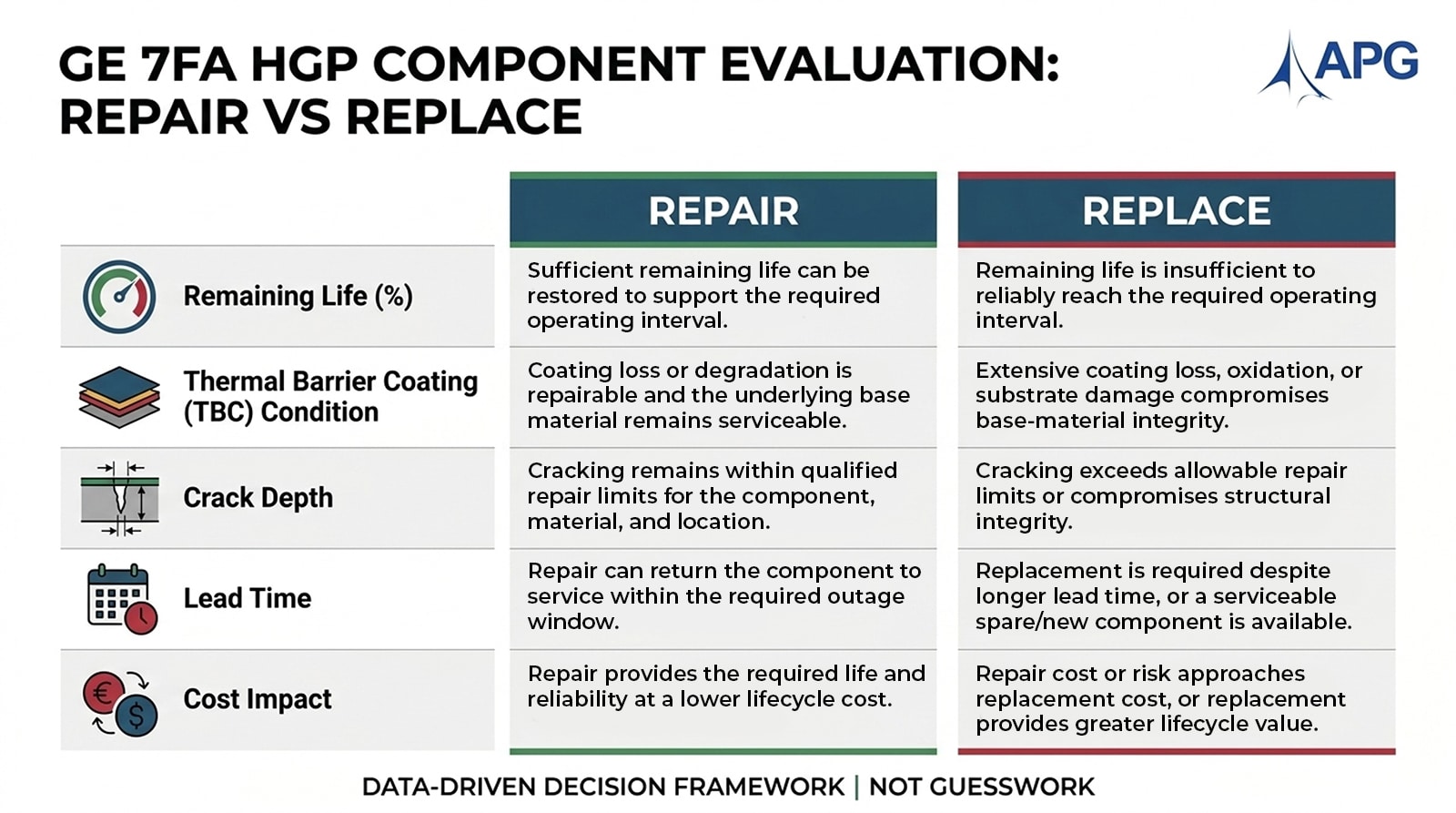
Repair vs. Replace: Evaluating Hot Gas Path Components
This is where inspection data turns into a capital decision. It’s also the one plant managers most often ask us to help with.
Remaining Life and Coating Condition
The decision framework rests on three factors: remaining life, coating condition, and crack depth measured against OEM or Design Engineering Representative (DER) limits. Coating condition often matters more than raw hours. A bucket with moderate EOH but failed TBC integrity may have less usable life left than one with higher hours but intact coating. Crack depth exceeding OEM/DER limits sets a hard boundary. Beyond that point, a component moves from repairable to scrap regardless of how much life remains elsewhere on the part. For a more detailed walkthrough of this decision process, our guide on repairing versus replacing major 7FA.04 components covers the criteria in more practical detail.
OEM vs. Independent Shop Considerations
Choosing between GE and a qualified independent repair shop depends on part condition, lead time, and cost, not brand loyalty. GE brings OEM engineering backing and original design data. Independent shops, when properly certified, often offer faster turnaround and lower cost for repairs within standard limits. The right call depends on the specific part in front of you. Weighing repeated repair cycles against the capital cost of replacement is worth doing before locking in either path. If you’re evaluating a specific 7FA component decision, our GE Frame 7F service page walks through repair scope and options in more detail, and it’s a reasonable starting point before a formal quote conversation.
Outage Planning, Parts Lead Time, and the Outage Scope Document
Every inspection tier eventually leads to the same question: how do you plan the outage itself without getting stuck.
Building the Outage Scope Document
An outage scope document is a pre-outage plan detailing inspection depth, parts needed, and expected duration. It should prioritize borescope findings by severity first, then by lead-time risk, so the components most likely to delay the outage get ordered earliest. We also put together a downloadable outage scope checklist, available as a PDF, that plant managers use as a starting template before finalizing their own plan.
Managing Parts Lead Times Against the Outage Window
Parts lead times routinely exceed outage windows, particularly for hot gas path components ordered reactively rather than staged in advance. Strategies that help include:
- Staged procurement based on EOH projections, ordering long-lead parts before the tier is technically due
- Evaluating refurbished spares as a bridge when new parts won’t arrive in time
- Comparing OEM and independent shop sourcing to find the fastest realistic delivery, not just the lowest quote
- Documenting training and handoff notes so field teams aren’t relearning scope decisions mid-outage
Unplanned outages can cost power generation producers 3 to 5 times the cost of a planned inspection. That gap has direct revenue impact for every day a unit sits offline longer than planned. If your parts timeline doesn’t match your outage calendar, it’s worth pressure-testing the scope document with an outside engineering review before the window closes.
Conclusion
An inspection-driven approach built on EOH data, borescope findings, and a documented outage scope is a lower-risk path than reacting to whatever a teardown happens to reveal. You now have the same framework our engineers use to sort CI from HGPI from MI, and to weigh repair against replace on hot gas path components, language you can bring straight back to your team or ownership group. Every day a 7FA sits offline past its planned window costs 3 to 5 times more than the inspection that could have caught it. If it would help to talk through your specific unit’s EOH position or an upcoming outage scope, Allied Power Group’s engineering team is available at (281) 444-3535.
FAQ
What is the difference between a Combustion, Hot Gas Path, and Major Inspection on a 7FA?
A Combustion Inspection, Hot Gas Path Inspection, and Major Inspection represent three escalating tiers of scope on a GE 7FA turbine. CI covers combustion liners, transition pieces, and fuel nozzles at the shortest interval. HGPI adds stage 1 through 3 nozzles and buckets. MI includes full disassembly, rotor inspection, and bearing checks at the longest interval. Confirming which tier applies to your specific unit’s EOH profile is best done through an engineering review rather than a calendar guess.
How do I know if my 7FA is due for a CI, HGPI, or MI?
Equivalent Operating Hours and starts count together determine which inspection tier is due on a given unit. A turbine that cycles frequently accumulates starts-based wear faster than a steady baseload unit, even with fewer fired hours. Misreading EOH and starts data is common, so having an engineering team calculate your actual position on the interval curve avoids scheduling the wrong tier.
What typically causes unplanned trips on 7FA units?
Combustion-related issues in DLN-equipped units are among the top causes of unplanned trips. Bucket and nozzle cracking, along with TBC coating failures, also contribute to forced outages. Root cause analysis after a trip requires trained diagnostic review of vibration, temperature, and combustion data, not guesswork after the fact.
Should hot gas path components be repaired or replaced?
The repair-versus-replace decision on hot gas path components depends on remaining life and coating condition, not age. Crack depth measured against OEM or DER limits sets the hard boundary between repairable and scrap parts. Misjudging that boundary carries real financial and reliability risk, so an engineering assessment before the decision is made pays for itself.
How long does a 7FA Major Inspection take?
Major Inspection duration on a GE 7FA varies significantly based on what technicians find once the unit is opened, rather than following a fixed schedule. Rotor and bearing findings, along with hot gas path condition, both influence how long the outage actually runs. Accurate duration planning depends on a proper outage scope document built in advance with professional input.
Should I use the OEM or an independent shop for hot gas path component overhaul?
Both GE and qualified independent repair shops have a legitimate role in hot gas path component overhaul, depending on part condition, lead time, and cost. GE offers OEM engineering backing, while independent shops often deliver faster turnaround within standard repair limits. An engineering evaluation of the specific component in question determines which path fits best.
What should a borescope inspection look for on a 7FA?
A borescope inspection on a 7FA should target TBC spallation, surface cracking, and fouling debris across the hot gas path and compressor sections. These visual indicators often signal deeper issues that may or may not require a full teardown. Translating borescope images into an accurate outage scope is a skill best handled by experienced inspectors familiar with 7FA-specific failure patterns.
How do I plan an outage when parts lead times exceed my outage window?
Staged procurement and early scope documentation are the primary levers for managing parts lead times that exceed an outage window. Ordering long-lead components based on EOH projections, rather than waiting until the tier is officially due, closes much of that gap. Misjudging lead times risks extending an outage well beyond plan, so professional outage planning support is worth the investment before the window closes.