

Your Power Partner
7FA Gas Turbine Component Repair Guide
Every outage cycle, independent power producers running GE 7FA fleets hit the same fork in the road: repair the component in hand, or commit capital to replacement. For plant managers responsible for combined-cycle and simple-cycle availability, that call carries real financial weight, and getting it wrong in either direction means premature failure or wasted spend. This guide breaks down 7FA.04 component repair decisions from the platform level down to individual hot gas path parts, using the same inspection data and dimensional logic engineering teams rely on in the shop.
Sound gas turbine component repair decisions hinge on understanding how 7FA.04 components, from stage buckets and nozzles to transition pieces and combustion components, actually degrade in service, not just what the OEM manual assumes. Turbine blades, vanes, and shrouds all carry their own wear signatures, and the blade tip region in particular tends to reveal early signs of oxidation and creep long before a unit trips on performance.
For fleets running Allied Power Group’s GE Frame 7F turbine services, this reflects how these calls actually get made, not just how they’re pitched in a sales meeting. Our repair capabilities cover the full gas turbine hot gas path, and our team applies proven repair techniques, including weld repair, blend repair, and bucket tip restoration, to extend component lifecycle rather than defaulting to replacement. If you’re weighing a specific finding against a decision deadline, our engineering team is easy to reach at (281) 444-3535 for a second set of eyes on the data.
Key Takeaways
- A structured, inspection-driven approach to 7FA component repair reduces both financial risk and unplanned outage exposure compared to reflexive replacement.
- Hot gas path components account for over 70% of gas turbine maintenance costs, making repair-vs-replace decisions on these parts the highest-leverage calls a plant manager makes.
- Repair feasibility should be assessed against EOH, borescope findings, and crack depth relative to OEM or DER limits, not visual impression alone.
- Refurbished components can achieve 80-95% of new part life expectancy at a fraction of replacement cost, when the underlying dimensional and metallurgical data supports it.
- Third-party repair shops can cut turnaround time by 20-30% compared to OEM lead times, which matters most when an outage window is already tight.
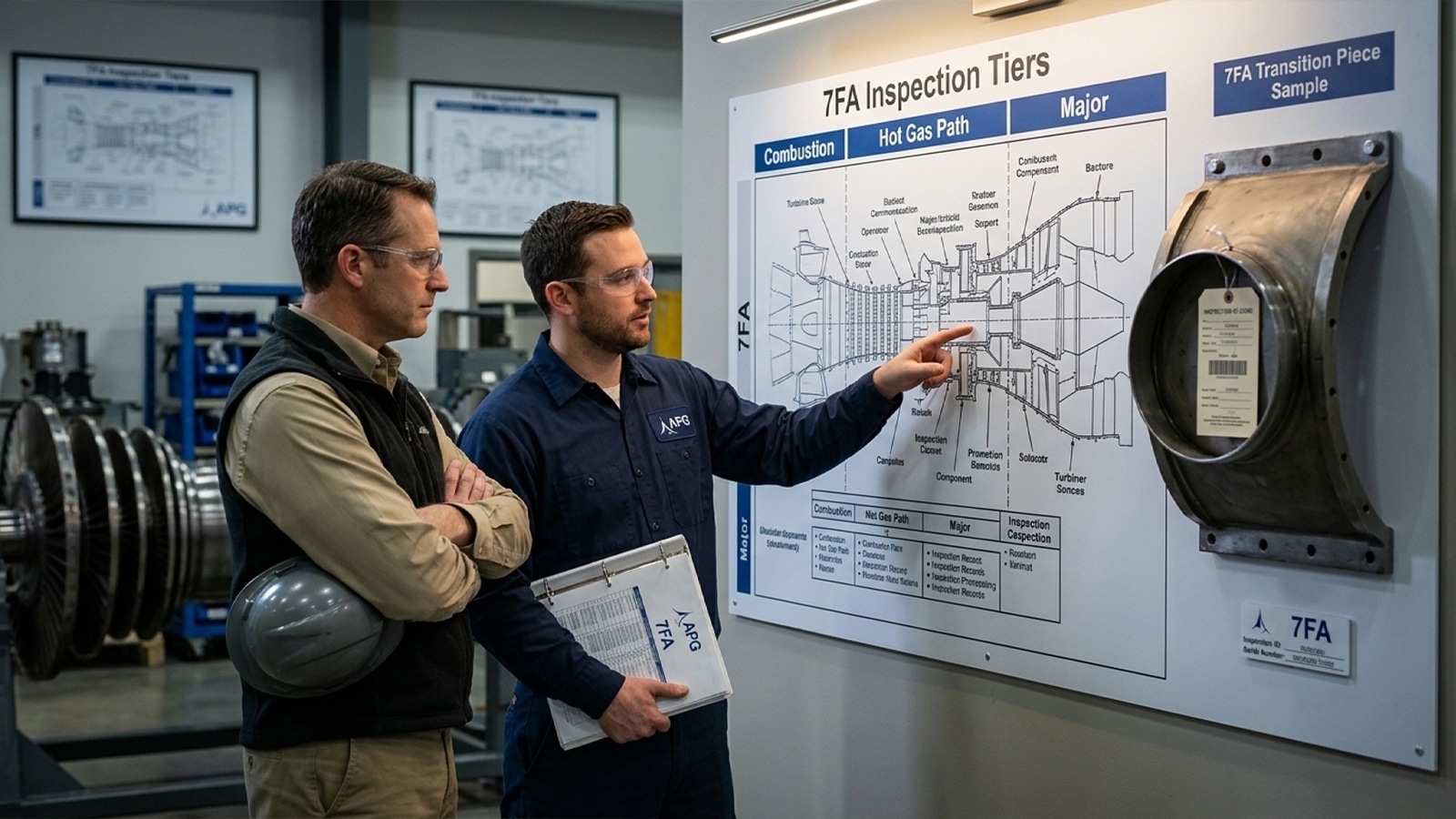
Understanding the 7FA Gas Turbine Component Repair Landscape
Before any repair-vs-replace decision gets made, it helps to know which inspection tier a component falls under and what that tier typically reveals. The 7FA platform’s inspection intervals (Combustion Inspection, Hot Gas Path Inspection, and Major Inspection) each surface a different set of components and a different level of risk if something is missed.
Combustion Inspection (CI) Components
The Combustion Inspection is the shortest-interval outage event, focused on fuel nozzles, combustion liners, and transition pieces. Because it happens more frequently than HGP or Major events, CI findings often serve as the earliest warning signs of a bigger problem developing downstream in the turbine section.
Hot Gas Path (HGP) Inspection Components
HGP inspections cover combustion, turbine, and transition components exposed to the highest thermal stress in the unit. This is where the majority of maintenance dollars get spent, and where the repair-vs-replace decision tends to carry the most weight. Stage 1 and Stage 2 buckets, nozzles, and shrouds all get scrutinized here.
Learn More: 7FA Bucket Damage: When Repair Isn’t Enough and Downtime Becomes a Crisis
Major Inspection Components
The Major Inspection is the most comprehensive outage event on the 7FA platform, including full rotor and compressor teardown. Findings at this stage touch rotating components, stationary components, and often auxiliary systems that don’t get inspected during shorter outages.
Rotating vs Stationary vs Auxiliary Components
Rotating components (blades, rotors, wheels) carry different failure consequences than stationary components (nozzles, shrouds, casings), simply because a rotating part failure tends to cascade faster and further through the machine. Auxiliary and fuel system components are lower-consequence individually, but they’re also where deferred maintenance quietly accumulates if inspection scope gets trimmed to save outage days.
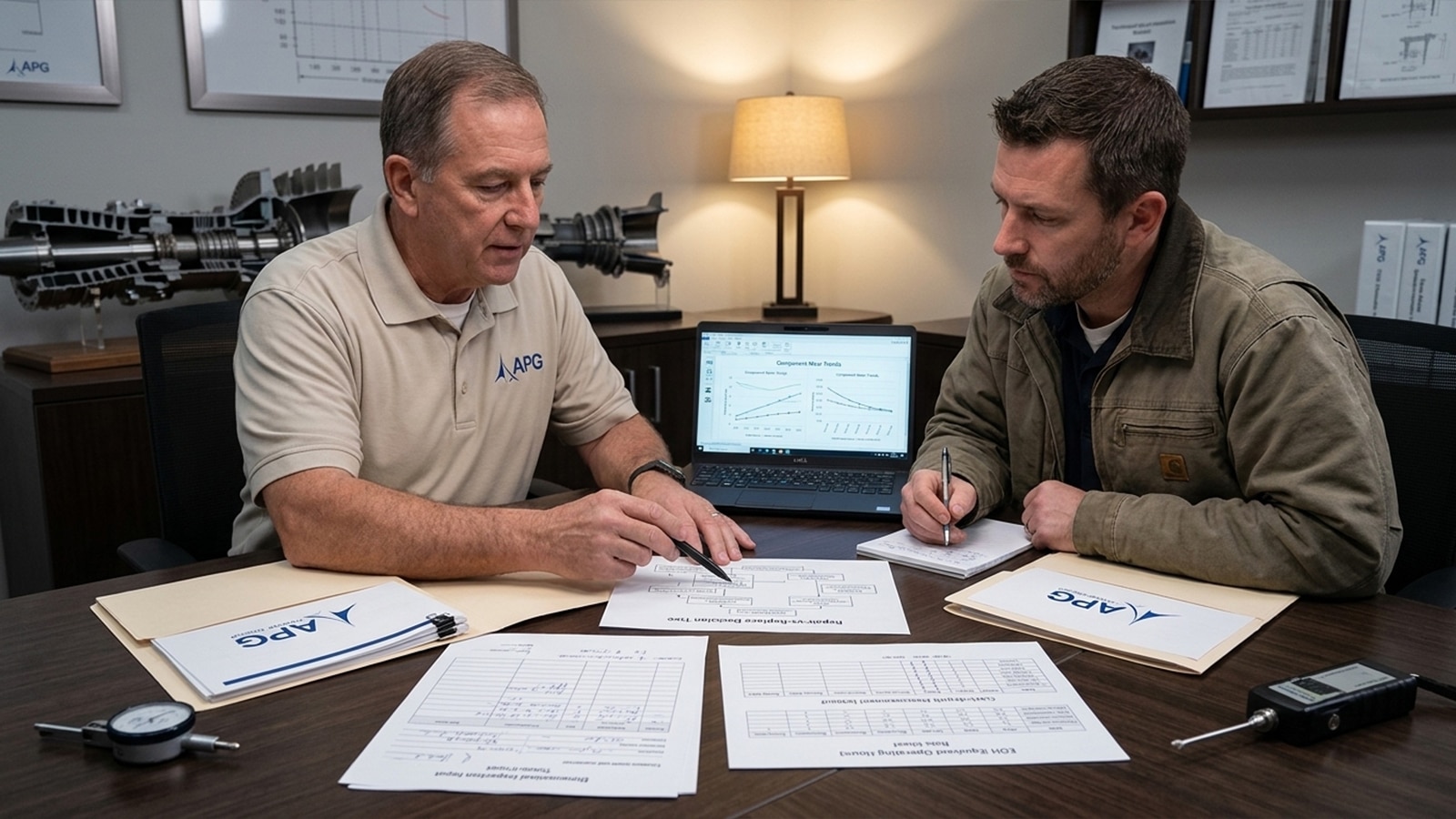
The Replace vs Repair Decision Framework
The core question on almost every component that comes off a 7FA during an outage is the same: does this part get repaired, or does it get scrapped and replaced? Answering that well requires a consistent framework rather than a case-by-case judgment call made under outage time pressure.
Reading Equivalent Operating Hours Against Component Limits
Equivalent Operating Hours (EOH) combines starts and hours into a single wear metric, and it’s the starting point for almost every repair decision. A component sitting well within its EOH limit with clean borescope findings is a very different conversation than one approaching its limit with visible coating loss.
What Borescope Findings Actually Tell You
Borescope inspection is a non-invasive way to assess internal component condition without a full teardown, and it’s often the first real signal that something needs a closer look. Borescope findings don’t replace dimensional inspection once a part is pulled, but they do tell you where to focus attention and whether an unplanned outage risk is building.
Crack Depth and OEM/DER Limits
Once a component is out of the machine, crack depth measured against OEM or Designated Engineering Representative (DER) limits determines whether a weld repair is viable or whether the part has crossed into run-to-scrap territory. This is where engineering judgment, not just a pass/fail dimensional check, tends to separate a good repair decision from a costly one. If a finding is borderline, it’s worth a direct conversation before committing either way, and that’s a call our team fields often.
Repair vs Replace Decision Tree
| Finding | Likely Path | Why |
|---|---|---|
| Within EOH limit, clean borescope | Repair or return to service | Low risk, no immediate action needed |
| Approaching EOH limit, minor coating loss | Repair with coating restoration | Addresses wear before it becomes structural |
| Crack depth within OEM/DER limit | Weld repair | Restores component within spec at lower cost than replacement |
| Crack depth beyond OEM/DER limit | Run-to-scrap | Repair risk outweighs cost savings |
| Repeated failure mode on same component type | Root cause analysis before repair | Prevents recurring, avoidable outage risk |
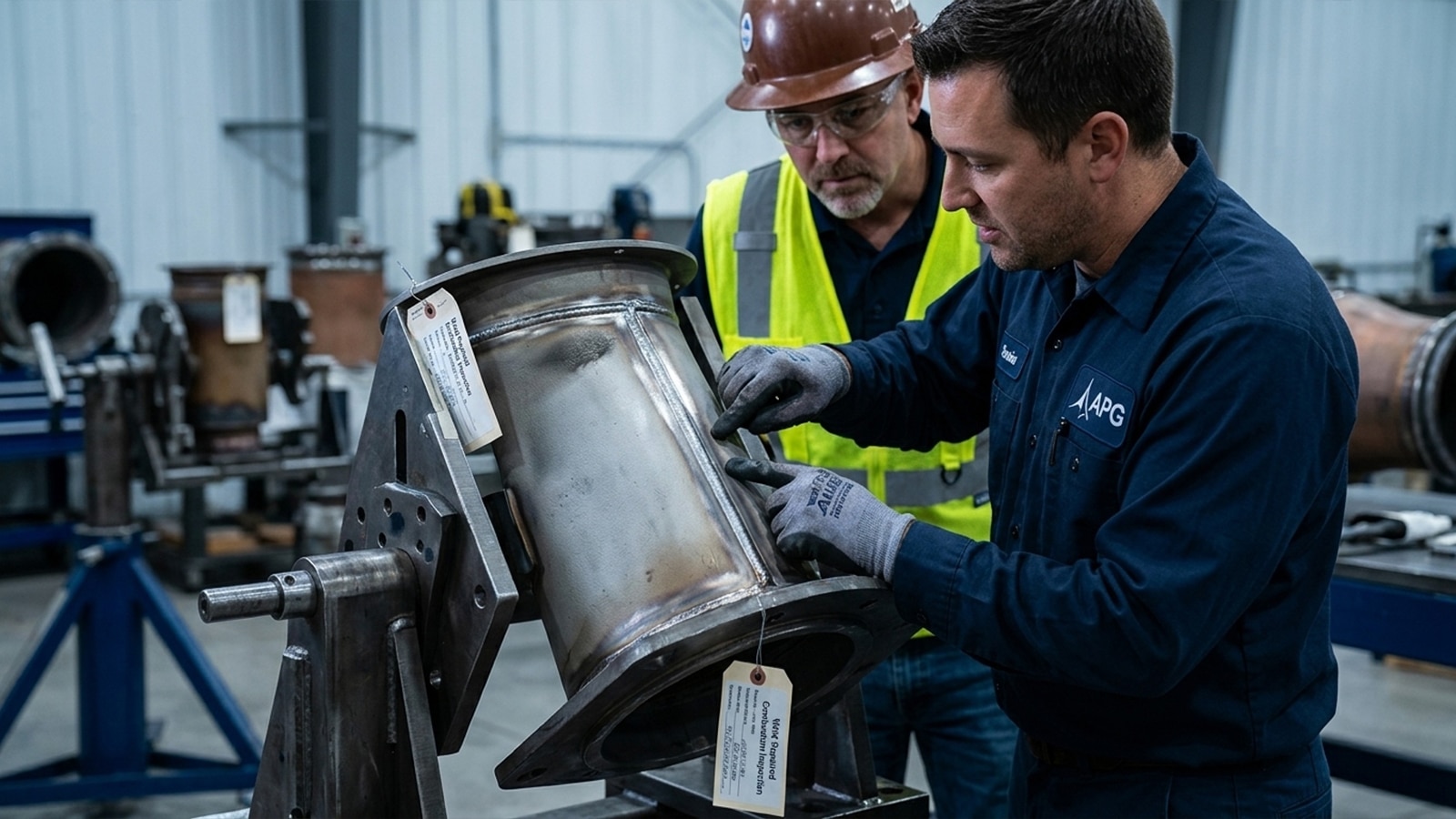
Combustion Liner and Transition Piece Repair
Combustion liners and transition pieces see some of the highest thermal cycling on the entire unit, which makes them frequent candidates for repair evaluation at every CI and HGP event.
Common Degradation Patterns
Transition pieces typically show distress in the aft end and at the frame interface, where thermal expansion and vibration combine to accelerate wear. Combustion liners tend to show cracking around cooling holes and at weld seams first.
Repair vs Run-to-Scrap Considerations
Repairable versus run-to-scrap status on these components usually comes down to how much base material remains after the damaged section is removed, and whether the remaining wall thickness supports a durable weld repair. A component with thin remaining wall stock in a high-stress zone is rarely worth the repair investment, even if the weld itself would hold.
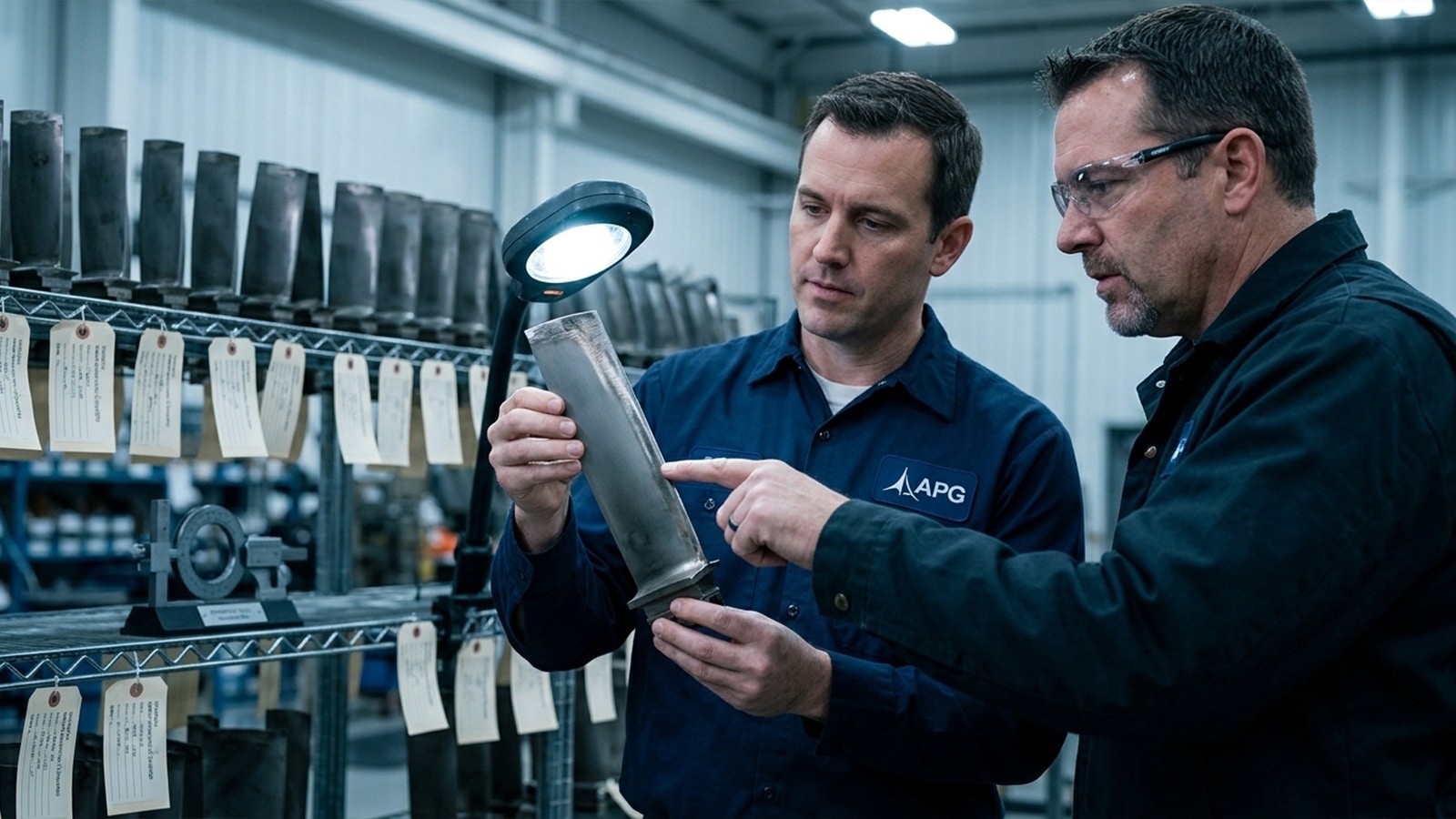
Compressor Blade and Vane Repair vs Replacement
Compressor blades and vanes don’t see the thermal stress of hot gas path components, but they carry their own wear patterns tied to erosion, foreign object damage, and corrosion pitting.
When Blending Is Sufficient
Minor leading-edge nicks and shallow erosion can often be addressed with a blend repair that restores aerodynamic profile without pulling the part from service life calculations entirely.
When Replacement Makes More Sense
Corrosion pitting that’s progressed past a certain depth, or damage near the blade root, generally pushes the decision toward replacement, since the structural margin in those zones is less forgiving than on the airfoil surface.
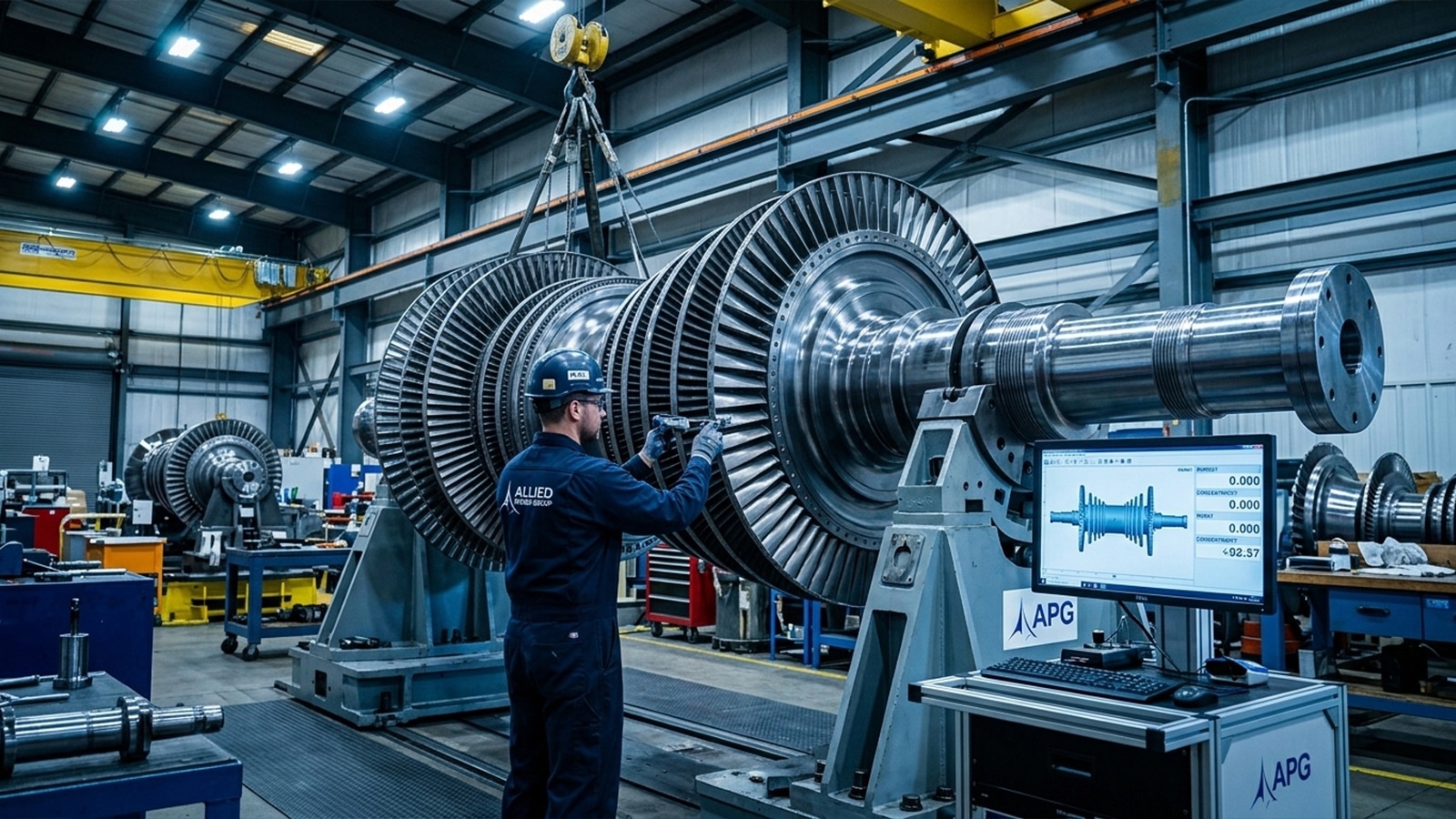
Rotor Inspection and Refurbishment
Rotor findings at Major Inspection carry outsized consequence, since the rotor is the one component that can’t be swapped out on short notice if something unexpected turns up.
What Gets Inspected
Rotor inspection covers wheel dovetails, bore areas, and coupling faces, typically using a combination of visual, magnetic particle, and ultrasonic methods depending on the finding location.
Refurbishment vs Replacement Economics
Refurbishment restores a used component to within OEM dimensional and metallurgical specifications, and on rotors specifically, this is almost always the more economical path when findings are within acceptable limits. Rotor replacement lead times can extend well beyond a typical outage window, which is its own risk factor separate from the repair decision itself.
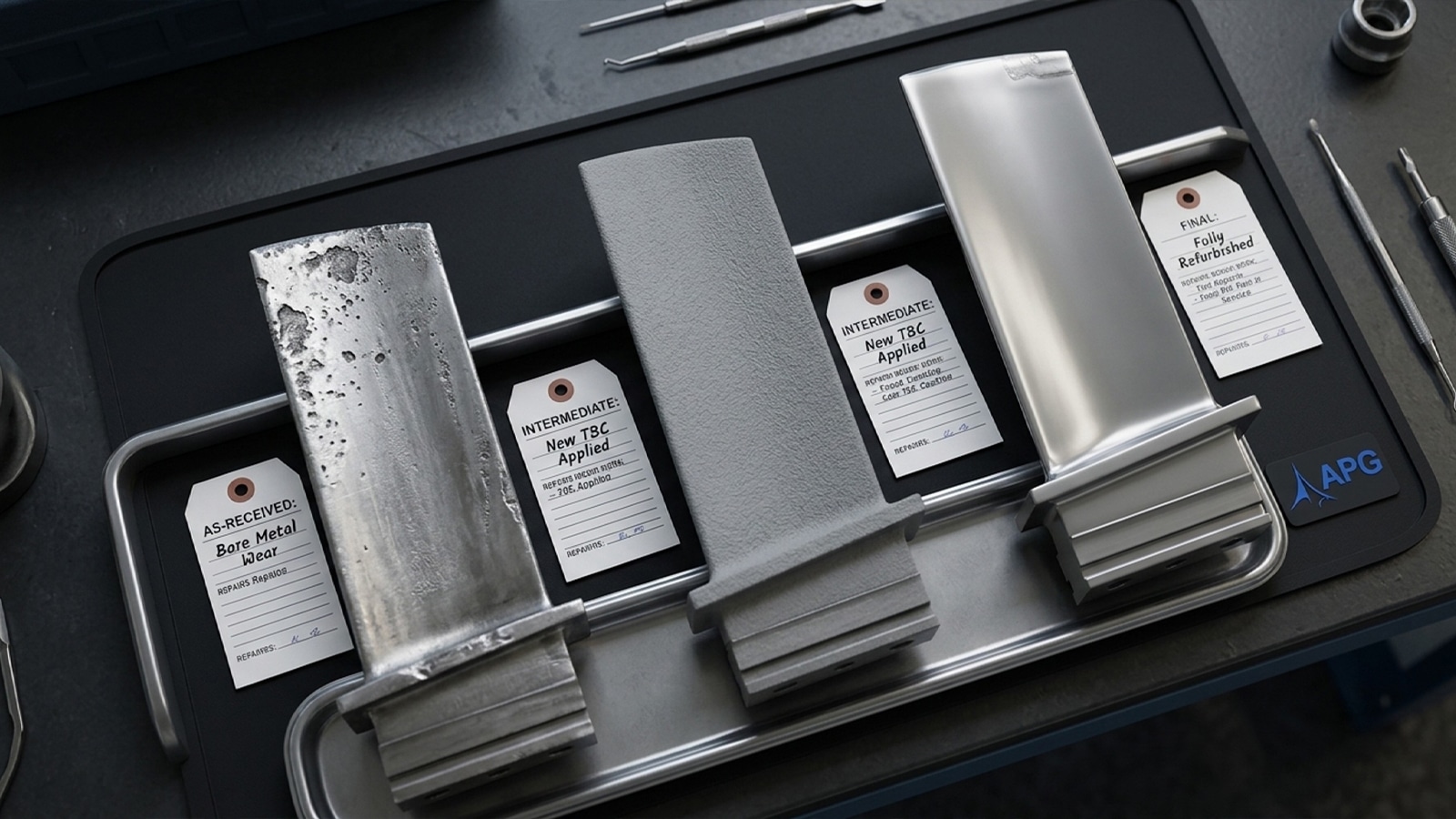
Turbine Blade Repair Capabilities and Coating Life
Turbine blades carry some of the clearest wear signatures on the entire unit, largely because thermal barrier coating condition is directly observable and directly tied to remaining life.
Reading TBC Condition
Thermal Barrier Coating (TBC) is a ceramic coating applied to hot section components to reduce metal temperature and extend component life. Once TBC spallation exposes base metal, oxidation accelerates quickly, which is why coating condition assessment is one of the first checks during any hot gas path evaluation.
Repair Options by Damage Type
- Recoating: appropriate when base metal is intact but TBC has thinned or spalled in limited areas
- Weld repair: appropriate for tip damage, cracking, or material loss within OEM/DER limits
- Blend repair: appropriate for minor nicks or edge damage not affecting structural margin
- Full replacement: appropriate when base metal oxidation or crack depth exceeds repairable limits
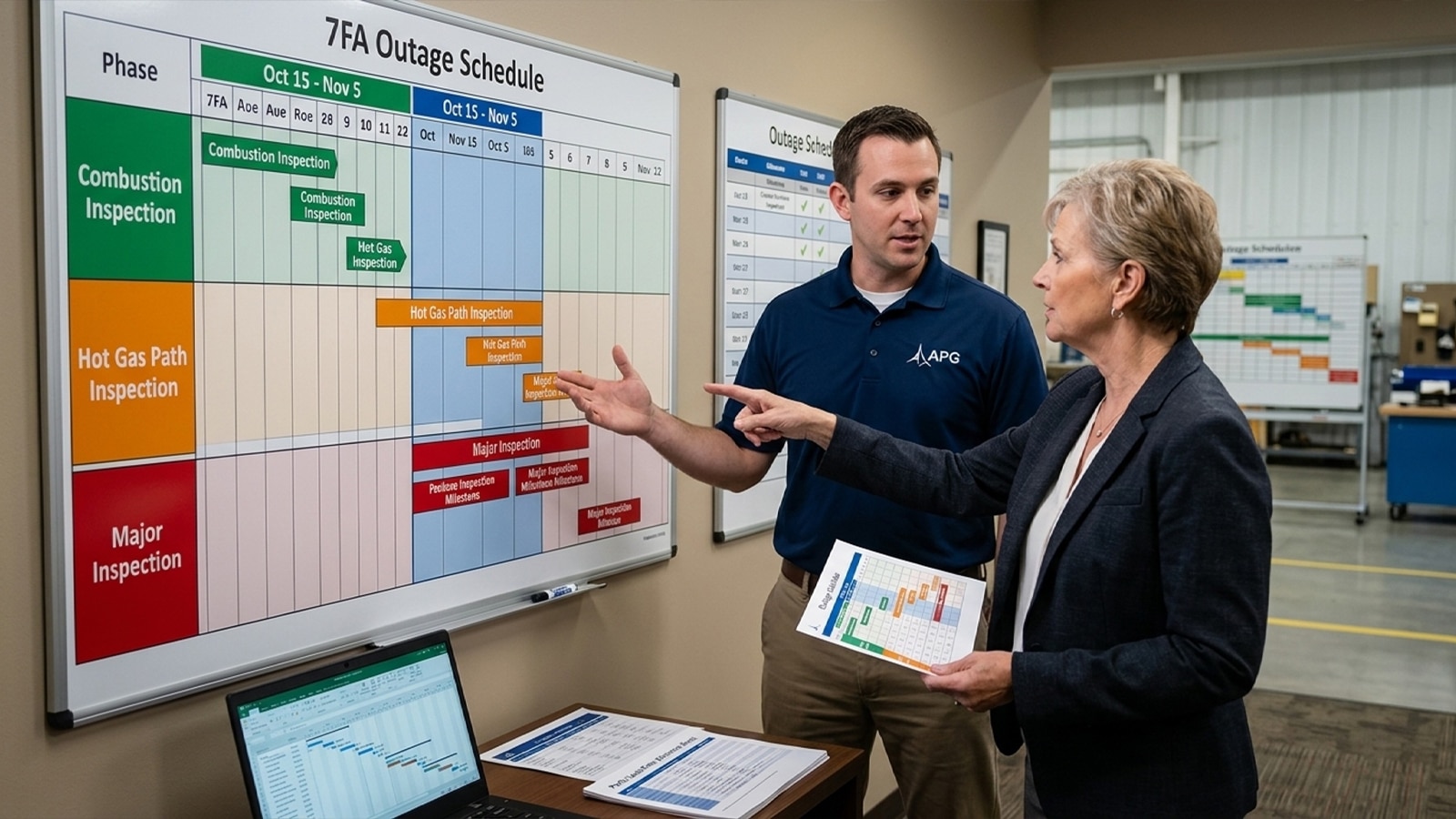
Outage Planning and Scheduling for 7FA.03 and 7FA.04 Units
Even a technically sound repair decision loses value if it’s made too late to act on. Outage planning has to account for repair lead times, not just the inspection findings themselves.
Outage Risk Scoring
Weighing component criticality, lead time, and failure consequence together helps prioritize repair scope before the outage starts rather than during it. A component with a long repair lead time and high failure consequence deserves attention early in planning, even if the current finding looks minor.
Building Schedule Margin Around Uncertain Findings
Components with a history of borderline findings deserve schedule margin built in ahead of time, since a mid-outage surprise is far more expensive to absorb than a planned contingency.
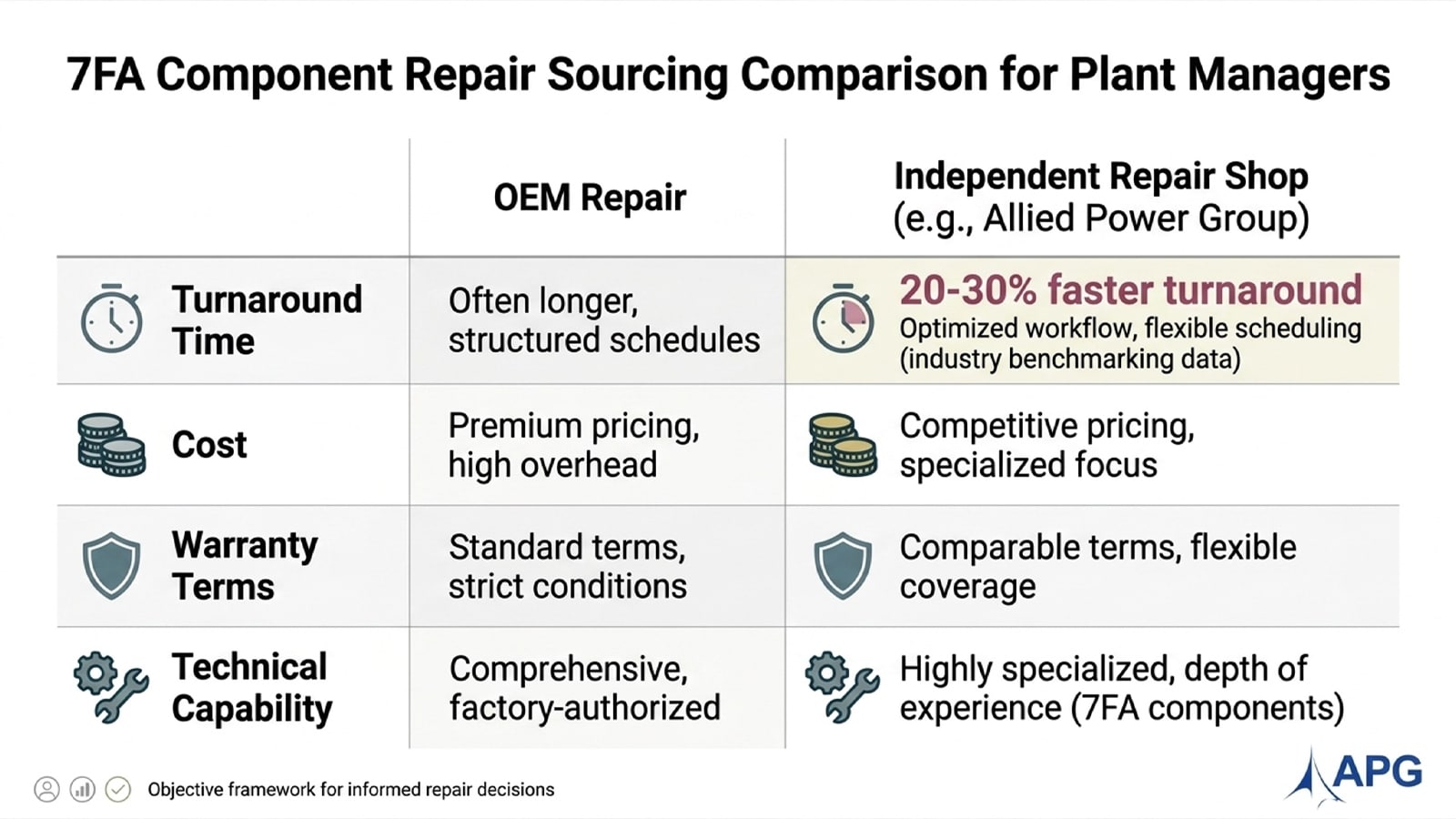
OEM vs Independent Repair Shop Comparison
Plant managers weighing OEM versus independent repair shops are usually balancing cost, turnaround time, warranty terms, and technical capability, and the right answer isn’t always the same for every component type.
Where Independent Shops Typically Win
Third-party repair shops can reduce component repair turnaround time by 20-30% compared to OEM lead times, which matters most when an outage is already scheduled and a delayed part threatens the whole timeline.
Where OEM Involvement Still Matters
For components tied to warranty obligations or design-level engineering questions, OEM involvement may still be the right call, even if turnaround is longer. The decision usually comes down to whether the component in question is a known, well-characterized repair or one where design intent is genuinely in question.
OEM vs Independent Shop Selection Matrix
| Factor | OEM | Independent Shop |
|---|---|---|
| Typical turnaround | Longer | 20-30% faster on average |
| Cost | Higher | Often lower |
| Warranty considerations | Preserves OEM warranty terms | May affect warranty depending on component and agreement |
| Technical capability | Strong on design-intent questions | Strong on established repair processes |
| Best fit | Warranty-covered or design-uncertain components | Time-sensitive, well-characterized repairs |
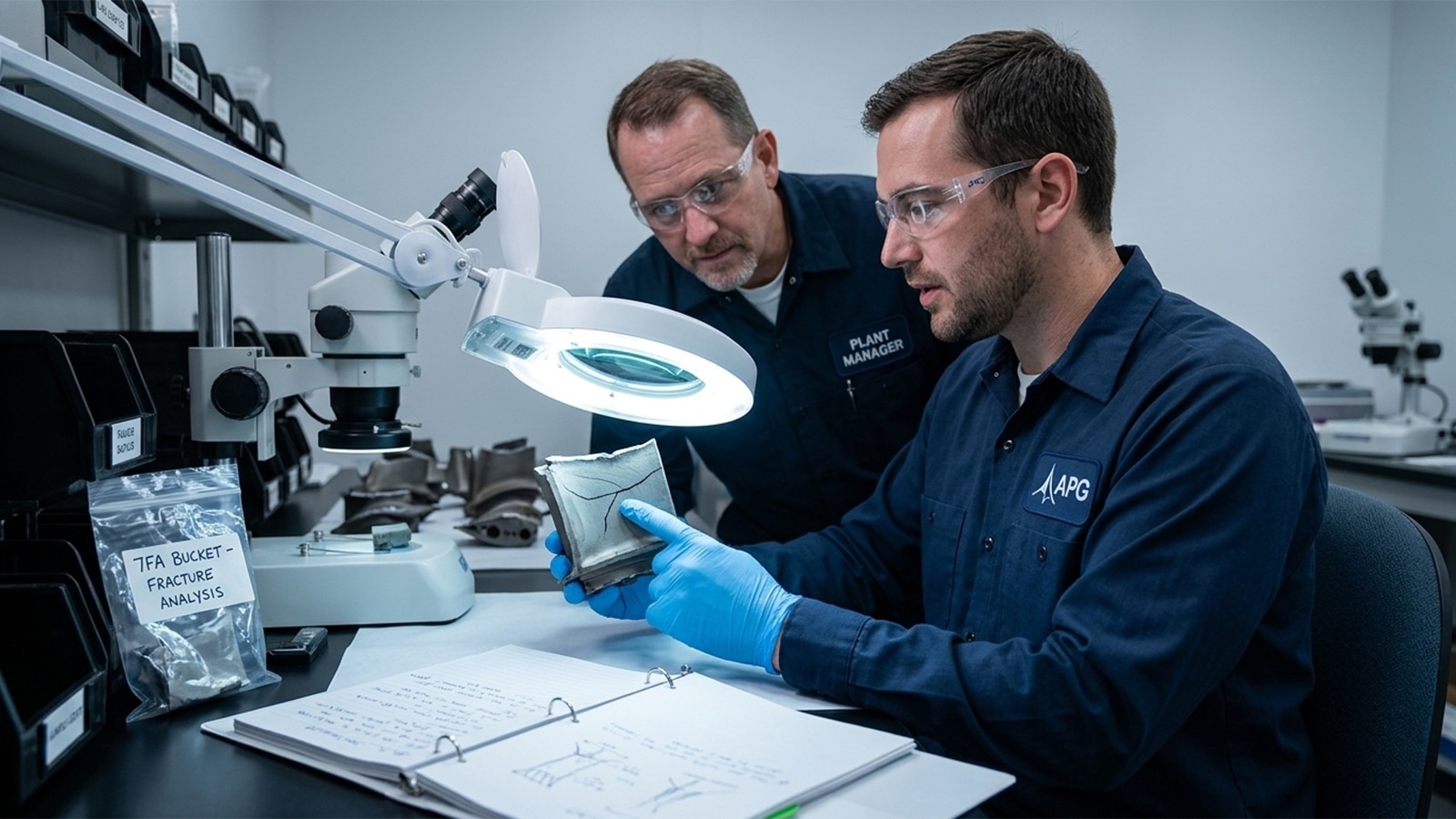
Root Cause Failure Analysis for 7FA Components
A repair that addresses the symptom without addressing the cause tends to reappear at the next inspection interval, often in worse shape than before.
Mapping Failure Mode to Repair Pathway
Root cause findings should map directly to one of three outcomes: a targeted repair, a coating upgrade, or a design modification. Skipping this step and defaulting straight to repair is how the same failure mode ends up recurring outage after outage.
When a Recurring Finding Signals a Bigger Issue
If the same component type shows the same distress pattern across multiple units in a fleet, that’s usually a signal worth escalating past the individual repair decision and into a broader engineering review.
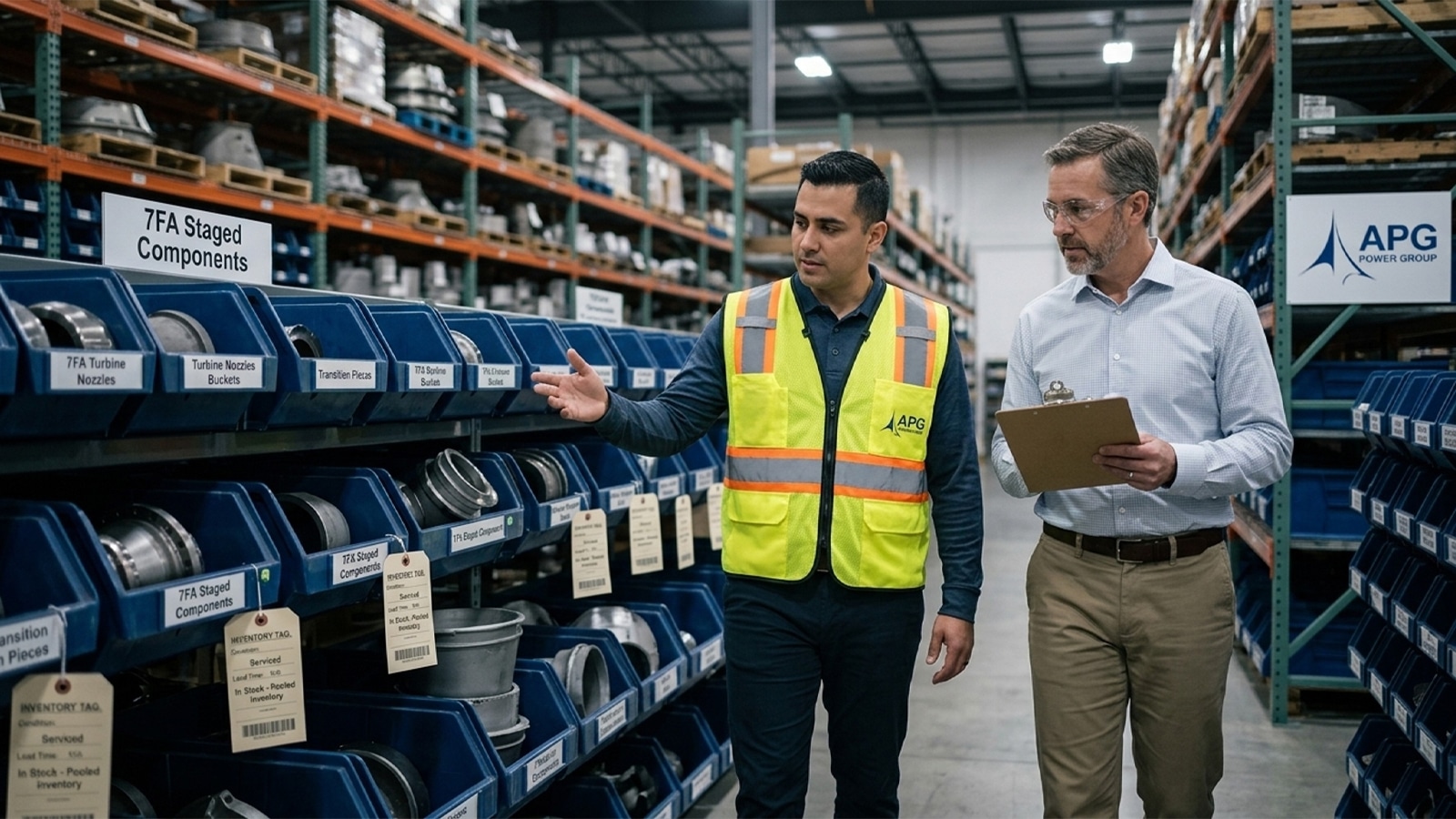
Spare Parts Strategy and Inventory Pooling
Repair decisions don’t happen in a vacuum. They’re also shaped by what’s sitting in inventory and how quickly a replacement could arrive if repair isn’t viable.
Owned Spares vs Pooled Inventory vs Exchange Programs
Fleet size and outage frequency both factor into whether owned spares, pooled inventory, or an exchange program makes more financial sense. A single-unit operator has a very different calculus than an IPP running multiple 7FA units across several sites.
How Spares Strategy Should Influence Repair Urgency
When a spare is already on hand, there’s more room to take a conservative approach on a borderline repair decision. When lead time on a replacement is long and no spare exists, that same borderline finding may need a faster, more decisive call.
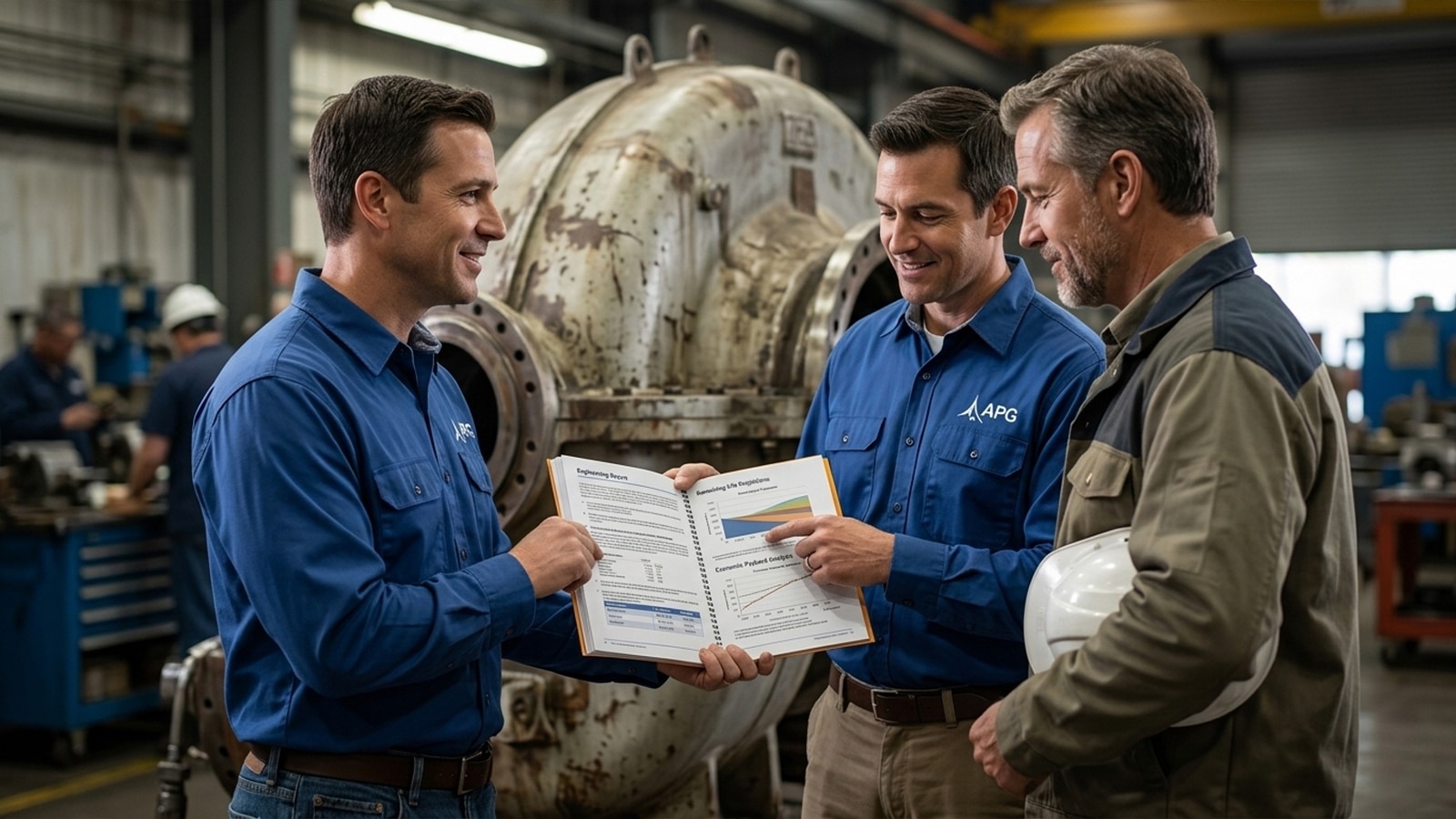
Life Extension Programs for Aging 7FA Turbines
For fleets running 7FA units well past their original design assumptions, life extension becomes its own category of decision, separate from routine repair.
What a Life Extension Evaluation Involves
Life extension refers to engineering and repair actions taken to safely operate a component beyond its original design life. This typically involves a closer look at remaining component life, supporting engineering analysis, and the economic payback of extending service versus planning for eventual replacement.
The Go/No-Go Checklist
- Remaining component life based on current EOH and inspection findings
- Engineering analysis supporting extended operation
- Economic payback compared to replacement or retirement
- Fleet-wide implications if the finding applies to sister units
Conclusion
A structured, inspection-driven repair process consistently lowers risk and cost compared to reflexive replacement on 7FA fleets. Every decision covered in this guide, from combustion liners to rotor findings at major inspection, is only as good as the dimensional and coating data behind it. That includes checking thermal barrier coating condition on airfoil surfaces, since TBC degradation and base alloy oxidation are often the earliest indicators that a weld repair, rather than full replacement, is the right call. Getting that data right, and matching it against defensible OEM and engineering limits, is what protects both plant availability and the long-term service life of your gas turbine.
Allied Power Group’s gas turbine services offer comprehensive repairs across the full range of gas turbine components, backed by engineering judgment that accounts for mechanical dynamics, not just visual wear. Our shop applies cost-effective repair techniques designed for reducing operating costs across the fleet, and in most cases a comprehensive repairs approach, addressing the shroud, nozzle, vane, and weld-affected zones together, proves more economical than piecemeal replacement.
If you have an upcoming 7FA outage or a component sitting in question right now, it’s worth talking through the specifics before the inspection window closes in. Our engineering team can be reached at (281) 444-3535, and there’s no pressure in that call, just a straight read on what the data is telling you.
FAQ
How do I know if a 7FA component is repairable or should be scrapped?
The determining factors are almost always EOH relative to OEM limits, borescope or dimensional findings, and crack depth measured against OEM or DER limits. A component within those limits with no structural concerns is typically a repair candidate; one beyond them is usually run-to-scrap.
What’s the difference between a Combustion Inspection, HGP Inspection, and Major Inspection?
Combustion Inspection is the shortest-interval event, focused on fuel nozzles, liners, and transition pieces. Hot Gas Path Inspection covers combustion, turbine, and transition components under the highest thermal stress. Major Inspection is the most comprehensive, including full rotor and compressor teardown.
Is it cheaper to use an independent repair shop instead of the OEM?
Often, yes. Independent shops can reduce turnaround time by 20-30% compared to OEM lead times and frequently offer lower costs, though OEM involvement may still make sense for warranty-covered or design-uncertain components.
What is Equivalent Operating Hours (EOH) and why does it matter?
EOH combines starts and hours into a single wear metric used to estimate cumulative component wear. It’s a key input for deciding whether a component is a repair candidate or approaching the end of its usable life.
Can a refurbished component really perform like a new one?
In many cases, yes. Refurbished turbine components can achieve 80-95% of new part life expectancy at a fraction of the replacement cost, provided the underlying dimensional and metallurgical data supports the repair.
What should I do if a finding is borderline and I’m not sure which way to go?
That’s exactly the kind of situation worth a direct conversation before the outage schedule forces a decision. Calling (281) 444-3535 to walk through the specific finding with an engineering team is a reasonable next step, especially when replacement lead time and repair risk are both on the table.